

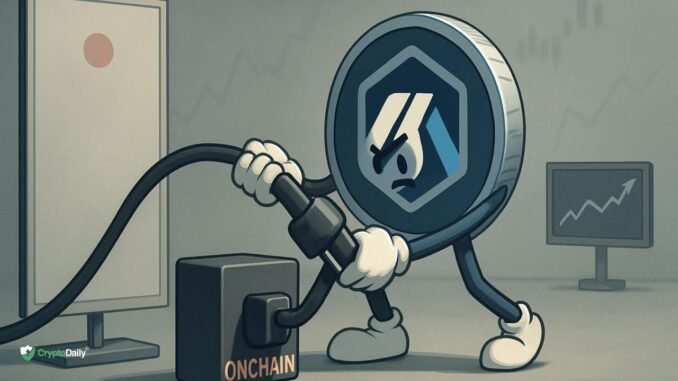

Arbitrum’s ARB popped after headlines that a global electronics brand is building an onchain advertising platform with Arbitrum tech. The news sparked a familiar debate: can enterprise utility meaningfully reprice a governance token whose gas is settled in ETH?
This article unpacks the LG announcement, outlines how an onchain ad network could translate into Arbitrum usage, and examines what—if anything—flows through to ARB holders. We also map risks, practical metrics to track, and how competing L2s stack up.
If you’re asking whether “corporate adoption” is finally the bridge to token value, here’s a grounded framework to judge it.

Enterprise demand can lift Arbitrum’s brand, developer interest, and possibly network activity—but ARB’s direct value capture is limited because gas is paid in ETH and revenue sharing to token holders is not guaranteed. LG’s move validates Arbitrum’s stack and could support a narrative premium near term; durable repricing needs visible onchain usage, clear economic links to ARB via governance, treasury, or future policy, and execution beyond a pilot.
- LG is piloting an Arbitrum-based ad network and exploring a market launch later this year (Fortune).
- ARB rose roughly 5% after the news, with Arbitrum confirming the project on X (The Block; Cointelegraph).
- The addressable market is massive: global ad spend is forecast at $1.06T in 2026, with digital ~69% share (Dentsu (Global Ad Spend Forecasts)).
- Whether activity accrues to Arbitrum One, Nova, or an Orbit chain will determine how much reaches public L2 metrics.
- Investors should separate enterprise adoption headlines from token economics and watch for measurable throughput and policy signals.
What exactly is LG building, and why choose Arbitrum?
LG Electronics is developing a blockchain-based advertising network that uses Arbitrum technology to place, buy, sell, and manage digital ads. The initiative reportedly completed a pilot with a Japanese advertising firm, and LG said it aims to explore taking the service to market later in the year (Fortune).
The market backdrop is compelling: global ad spend is projected to hit $1.06 trillion in 2026, with digital accounting for the bulk of growth (~69% share). That puts any credible efficiency or transparency gains in front of real money (Dentsu (Global Ad Spend Forecasts)).
Arbitrum is an EVM-compatible rollup stack known for high throughput and low fees relative to Ethereum L1, alongside developer familiarity. The design space also includes Arbitrum Orbit—a framework to deploy customized chains that settle to Arbitrum. For ad-tech’s high-volume, low-margin dynamics, this flexibility matters: LG can calibrate costs, privacy, and throughput across public L2s (Arbitrum One/Nova) or app-specific chains.
Beyond tech fit, there’s signaling. The day the LG story broke, ARB climbed over 5%, and Arbitrum publicly acknowledged the project on X (The Block; Cointelegraph). That alignment between enterprise branding and ecosystem confirmation is what often fuels short-term re-ratings.
How could an onchain ad network show up in Arbitrum’s usage metrics?
Ad-tech infrastructure has several layers—auctioning, trafficking, verification, billing, and reconciliation. Not every step needs to be onchain. A pragmatic design is hybrid: keep user-level data and real-time bidding offchain for speed and privacy, while anchoring critical events and settlements onchain for auditability.
If LG’s stack anchors to Arbitrum, here are the surfaces where public metrics could move:
- Smart contract deployments: registries for publishers, advertisers, creatives, and deals.
- Event commitments: periodic batched writes (Merkle roots) of impression/click logs.
- Payment rails: escrow, milestone releases, and dispute resolution via stablecoins.
- Identity and attestations: onchain credentials for inventory quality and brand safety.
Expect the heaviest lift to be data availability, not microtransactions. That’s why an Orbit chain or Arbitrum Nova (optimized for low-cost data) could be attractive. The exact choice will shape observable metrics: a private or permissioned Orbit chain settling to Arbitrum will show fewer transactions on Arbitrum One but may still push L1 calldata and settlement posts that are visible.
Pro tip: When evaluating “enterprise onchain” news, map the architecture. Public L2 activity only grows if the design posts meaningful state or data to Arbitrum, not if everything lives on a siloed app-chain with minimal settlement.
Does enterprise usage actually accrue to ARB holders?
ARB is primarily a governance token. On Arbitrum networks, gas is paid in ETH, so increased activity doesn’t automatically create direct transactional demand for ARB. Value accrual, if any, tends to be indirect and policy-driven: control of grants and incentives, stewardship of the ecosystem treasury, and any future mechanisms the DAO may adopt.
This is a critical distinction from networks where the native token is the gas unit. Enterprise traction can still be bullish for ARB by strengthening governance relevance and deepening the developer moat, but the path is circuitous. Much depends on whether fee revenue policies, incentive programs, or staking features meaningfully link network economics to the token—matters decided by governance and subject to change.
Here’s a quick, high-level comparison of token value capture across popular L2 options:
| Network | Gas Unit | Token Role | Enterprise Path | Direct Fee Share to Token |
|---|---|---|---|---|
| Arbitrum One/Nova | ETH | Governance (ARB) | Public L2s; Orbit for app-specific chains | Not inherent; governance-dependent |
| Optimism (OP Stack) | ETH | Governance (OP) | Public chain + app-chains using the stack | Not inherent; policy-dependent |
| Base | ETH | No public token | Enterprise via Coinbase’s platform reach | N/A |
| Polygon PoS | MATIC | Gas + staking | Public chain; enterprise sidechains possible | Varies by design; not guaranteed |
| Polygon zkEVM | ETH | Governance (MATIC) for broader ecosystem | zk rollup for EVM workloads | Not inherent; policy-dependent |
The takeaway: enterprise utility can improve network fundamentals without automatically repricing ARB. Watch how the DAO frames incentives for app-chains that anchor to Arbitrum and whether any fee-related mechanisms emerge. Until then, the linkage is narrative first, economics later.
What did the market just price in—and is it sticky?
The initial reaction was swift: ARB gained roughly 5% around the announcement window, with coverage highlighting that Arbitrum confirmed LG’s project on X (The Block; Cointelegraph). Moves like this usually reflect a “validation premium”: the idea that an enterprise pilot de-risks technology and can catalyze partners.
Whether it sticks depends on execution signals over the next few quarters. Many corporate blockchain pilots don’t translate into scaled, public activity. On the other hand, if LG’s stack begins posting verifiable state to Arbitrum and advertising workflows meaningfully migrate, the higher baseline could be justified.
- Architecture reveal: Is it Arbitrum One, Nova, or an Orbit chain? Public or permissioned?
- Contracts and addresses: Are canonical contracts deployed and active on public explorers?
- Throughput: Growth in transactions, calldata, and fee consumption linked to the app.
- Payments: Stablecoin volumes and settlement patterns attributable to ad campaigns.
- Governance: DAO proposals around incentives/revenue policies for enterprise app-chains.
Also contextualize size. The ad market is enormous—Dentsu projects $1.06T in 2026—but only a sliver needs to settle onchain to move L2 metrics. Early milestones may be qualitative (partnerships, SDKs, audits) before they’re quantitative.

Can ad-tech really run on public L2s without breaking privacy or latency?
It depends on what you put onchain. Real-time bidding with millisecond SLAs won’t sit on a public L2. But anchoring outcomes, payments, and verification data is well within scope. Modern rollups can batch thousands of events and post succinct commitments while preserving user privacy via offchain aggregation or cryptographic proofs.
Potential patterns include:
- Commit-and-reveal: offchain auctions with onchain settlement and dispute windows.
- Batched attestations: DSP/SSP signatures batched into periodic proofs stored onchain.
- ZK-based verification: selectively reveal proof of delivery without exposing PII.
- AnyTrust/DA choices: leverage data availability schemes (e.g., Arbitrum Nova) to cut costs for non-critical data.
The operational win is traceability and reconciliation efficiency across thousands of counterparties. Even if the high-velocity matching remains offchain, immutable ledgers for what was bought, delivered, and paid can compress disputes and fraud leakage—material line items at the scale of digital ads.
What are the main risks and open questions for ARB investors?
There are several. First, the pilot-to-production gap: LG stated it completed a pilot and will explore how to bring the service to market later in the year (Fortune). Exploration is not the same as rollout.
Second, value capture risk: If the system runs on a permissioned Orbit chain with minimal anchoring, public Arbitrum metrics may barely move. Even if they do, ARB’s link is through governance rather than fee demand.
Third, compliance and data: Ad-tech touches personal data and regional privacy laws. Designs must avoid putting sensitive information on public ledgers and still meet audit needs.
Finally, market cyclicality: A 5% pop can retrace if catalysts go quiet. Without sustained throughput, TVL, or policy developments, narrative premiums fade.
Common Mistakes
- Assuming ARB is the gas token. On Arbitrum, fees are paid in ETH, so usage doesn’t automatically create ARB buy pressure. Separate network health from token demand.
- Equating a pilot with production scale. Wait for contracts, traffic, and payments you can measure on public explorers before extrapolating revenue or price impacts.
- Ignoring architecture choices. An Orbit or permissioned chain may generate far less public L2 activity than Arbitrum One/Nova. Track where the state actually settles.
- Overlooking governance levers. If you’re making a valuation case, include the probability that the DAO enacts (or rejects) policies connecting fees to ARB economics.
- Underestimating privacy constraints. Designs that mishandle PII will hit regulatory walls; sustainable systems minimize onchain sensitive data.
For continuing coverage, briefings, and interviews across Web3 infrastructure and enterprise pilots, visit Crypto Daily.
Frequently Asked Questions
Will advertisers or publishers need ARB to use LG’s platform?
Unlikely. Arbitrum networks use ETH for gas, and enterprise-facing apps typically abstract fees behind familiar invoices or stablecoin rails. ARB’s role is governance, not transactional currency for ad buys.
Could LG run a private chain and still say it uses Arbitrum?
Yes. The Arbitrum stack supports Orbit chains that can be permissioned and tuned for enterprise needs while settling to Arbitrum. That still counts as Arbitrum technology, but the public footprint depends on how often and how much state is posted.
What early onchain breadcrumbs would validate real adoption?
Look for a canonical set of contracts, identifiable batch posting addresses, steady growth in batched event commitments, stablecoin settlement flows tied to the app, and developer documentation linking to those addresses.
Does this compete with Optimism or Base for enterprise deals?
Indirectly, yes. Enterprises often evaluate multiple L2 stacks for cost, tooling, and support. Optimism’s OP Stack and Base’s developer ecosystem are credible alternatives. Differentiation tends to hinge on performance, partner support, and the app-chain pathway.
What if Arbitrum governance introduces fee sharing later?
That would strengthen the economic link between network usage and ARB, but it is a governance decision—not a given. Investors should treat it as a scenario with probabilities, not an assumption.
How big could the impact be if even a small share of ads settles onchain?
At ad-market scale, even modest onchain settlement can be meaningful for network activity. But the conversion rate from “market size” to “onchain settlement volume” is highly uncertain and hinges on integration costs and privacy constraints.
Is there confirmation that Arbitrum is involved beyond media reports?
Yes—coverage noted that Arbitrum acknowledged the LG project on X following the news, alongside reports of a ~5% ARB move (Cointelegraph).
Disclaimer: This article is provided for informational purposes only. It is not offered or intended to be used as legal, tax, investment, financial, or other advice.






Be the first to comment