

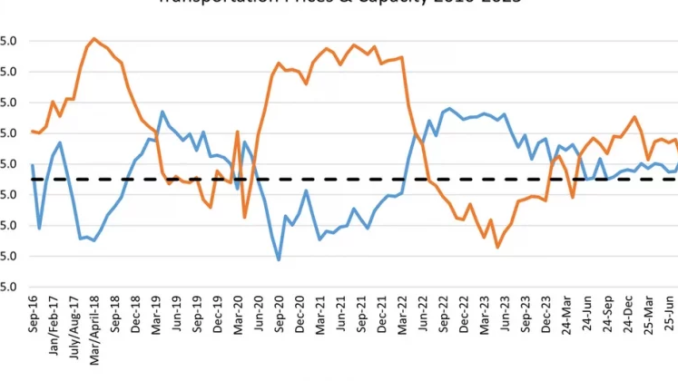

US freight is getting expensive fast. The April 2026 Logistics Managers’ Index registered Transportation Prices at 95.0, a 5.6-point jump from March and the second-highest reading in the index’s entire history. The only time prices ran hotter was during March and April of 2018.
The capacity crunch behind the price spike
Transportation Capacity cratered 10.9 points in April to 28.4, the second-lowest recording the LMI has ever produced. Any reading below 50 signals contraction, so 28.4 isn’t just contraction. It’s a market gasping for air.
The spread between Transportation Prices at 95.0 and Transportation Capacity at 28.4 is 66.6 points. That’s a record gap, the largest delta in the index’s history.
The headline LMI itself climbed to 69.9, up 4.2 points from March’s reading of 65.7. That represents the fastest pace of expansion since March 2022, when supply chain chaos from the pandemic era was still rattling through the system.
Aggregate logistics costs reached approximately 242, the highest since April 2022.
The Strait of Hormuz factor
The proximate cause of this tightening appears to be fuel costs. The closure of the Strait of Hormuz, a critical chokepoint for global oil transit, has driven energy prices higher.
Transportation prices have been climbing steadily since September 2025, but April’s jump represents a sharp acceleration rather than a gradual drift.
Analysts tracking the LMI have attributed the dynamics primarily to a tightening freight market compounded by those elevated fuel costs. The combination is creating what they describe as supply-driven inflationary pressure, the kind that’s harder for monetary policy to address because it originates from physical constraints rather than excess demand.
What this means for investors
Survey respondents within the LMI expect the index to climb further, projecting a reading of 73.2 over the next 12 months. If that forecast holds, it would mean logistics costs continue expanding well into 2027.
Crypto markets aren’t immune to this dynamic. Bitcoin and other risk assets have historically struggled during periods of sustained, supply-side inflationary pressure because they compete with the rising yields that central banks deploy in response. The last time aggregate logistics costs were at these levels, in spring 2022, Bitcoin was in the early innings of a brutal drawdown.
The 66.6-point record spread between prices and capacity isn’t just a data point. It’s a stress indicator for the entire supply chain, and the longer it persists, the more likely it is to produce cascading effects well beyond the shipping dock.



Be the first to comment