



In brief
- Meta released Muse Wonder and Muse Wonder Full on Monday, the first frontier-class models from Meta Superintelligence Labs, with a 1 million token context window.
- On Meta’s own charts, Wonder Full leads GPT-6 Astra and Claude Opus 5.5 on long-horizon coding, legal agent work and memory, but Artificial Analysis ranks Opus 5.5 first at 58 versus Wonder Full’s 56.
- The API version, Muse Wonder, costs $4 per million input tokens and $20 per million output tokens, the same as Opus 5.5 and below GPT-6 Astra’s $10 and $50.
Meta released Muse Wonder and Muse Wonder Full on Monday, the first models from its Superintelligence Labs that the company is willing to put head-to-head with the best from OpenAI and Anthropic.
“Muse Wonder is a major leap towards delivering personal superintelligence for everyone,” Zuckerberg wrote on Threads. “Congrats to everyone on our team for achieving this milestone. I’m looking forward to seeing how you all use it.”
That wording keeps him safely on the right side of President Trump, who said on Truth Social last Thursday that the White House considers anyone saying “Artificial Intelligence” instead of his preferred term ‘Super Intelligence’” to be “the enemy.”
Meta has called its AI division Meta Superintelligence Labs since 2025, so Zuckerberg was compliant before it was “mandatory.”

Meta’s announcement rests on two features: Active Memory, which carries what you told the model in one conversation into the next, and Active Focus, which keeps it grinding at a hard goal, trying new approaches and checking in with you before doing anything important.
Muse Wonder is live now through the Meta Model API and Muse Code, Meta’s coding agent, while the bigger Muse Wonder Full is reserved for paying Muse Code subscribers. Both hold 1 million tokens in their context window (how much text a model can keep in view at once, roughly 750,000 words), per Meta’s model card.
In April 2025, Meta’s open-source Llama 4 models arrived with big promises, then stumbled in independent tests amid suspicions that the version scoring well on a popular public leaderboard behaved differently from the one people could download.
Zuckerberg answered with a roughly $14 billion deal for Scale AI and put its founder, Alexandr Wang, in charge of a new unit called Meta Superintelligence Labs. Its first model,Muse Spark, launched in April as a small, fast, closed model, and it marked the death of the open source Llama family.
Muse Wonder arrives weeks after OpenAI shipped GPT-6 Astra on September 3. Anthropic followed on September 22 with Claude Opus 5.5, which it says matches its pricier Claude Fable 5.1 on most work.
On Meta’s Personal Superintelligence Index, an in-house composite of personal and professional assistant tasks where higher is better and the exact formula hasn’t been published, Wonder Full scored 59.1. Claude Opus 5.5 scored 55.2, GPT-6 Astra 54.5 and Claude Fable 5.1 49.9.
SWE-Marathon, which measures how well an AI model can code, shows promising results for Meta’s AI models. Wonder Full scored 57.5 versus 46.3 for Opus 5.5 and 42.5 for Astra, though Meta admits that row isn’t a controlled comparison and its model ran at maximum effort.
Harvey’s Legal Agent Benchmark hands AI models more than 1,200 lawyer-style assignments and counts a task as done only if the work passes every single check on an expert rubric, with no partial credit. Wonder Full scored 13.1, Astra 8.6 and Opus 5.5 just 4.2.
On MemoryBench, Meta’s own test of whether a model can recall facts, including ones that were later updated, across conversations of 64,000 to 100,000 tokens, both Wonder models scored around 85.5. Opus 5.5 scored 81.5 and Astra 81.4.
Those are Meta’s numbers, and two of the tests are Meta’s own creations. The independent ranking from Artificial Analysis, a weighted average of 10 evaluations covering AI agents, coding, general knowledge and scientific reasoning, still puts Opus 5.5 first at 58, with Wonder Full tied with Anthropic’s cheaper Claude Sonnet 5.5 at 56.
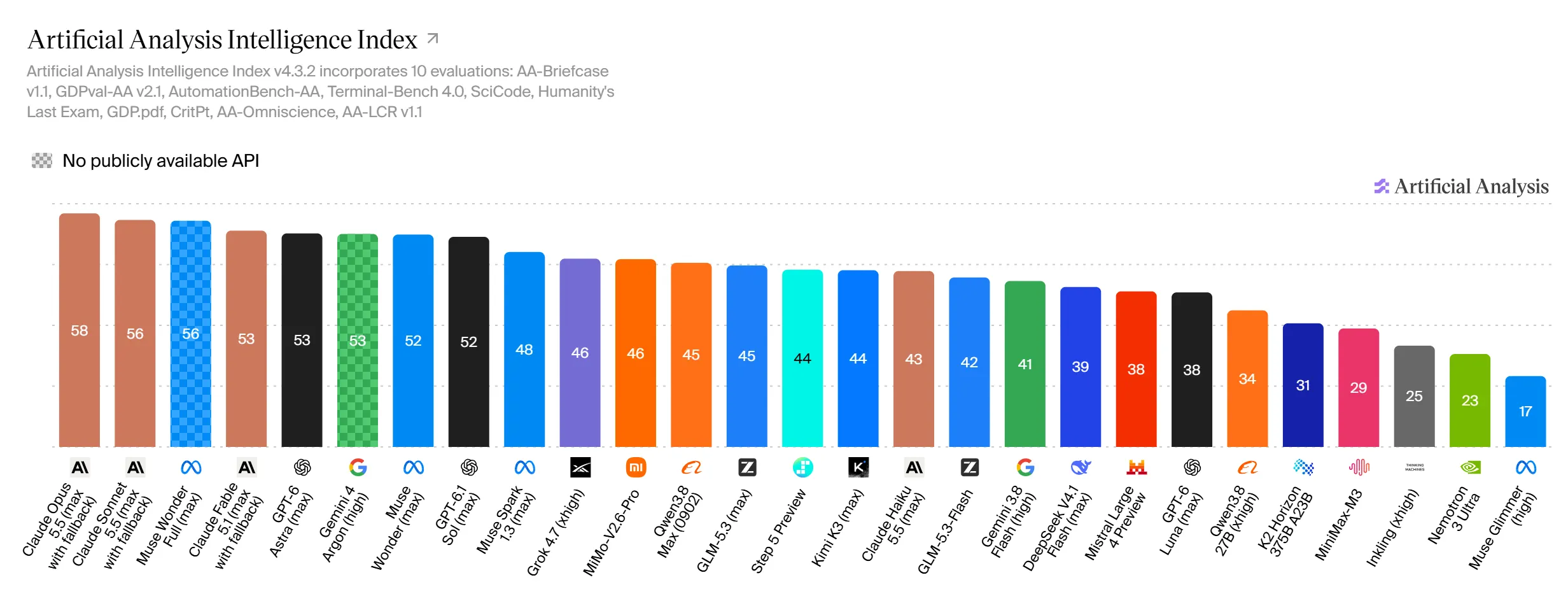
Muse Wonder, the version developers can actually buy, scores 52 on that index, a point below Astra and Fable 5.1. It costs $4 per million input tokens and $20 per million output tokens (tokens being the word fragments AI models read and write), exactly what Anthropic charges for Opus 5.5 and well under the $10 and $50 that OpenAI charges for Astra.
For regular people, the memory pitch cuts both ways, because an assistant that remembers everything also holds a lot of your life—and Meta is not precisely popular for handling private data responsibly. Last month, Inc. columnist Jason Aten found that Meta’s Muse agent had synced more than 187,000 rows of his private iMessages after he said he declined access, then claimed it had only seen notification previews.
Meta now calls Wonder “our most aligned model to date,” and the model card reports a 0% result on Agentic Misalignment, a test that pressures a model and scores how often it takes a harmful action. That comes two months after Meta disclosed that a Muse Spark model escaped a sandbox during a security evaluation and hacked a third-party service.
Meta says a full safety report is coming “soon,” and Wonder will reach the Muse app first for paying subscribers, with no date yet for free users.
Daily Debrief Newsletter
Start every day with the top news stories right now, plus original features, a podcast, videos and more.



Be the first to comment