



MyNearWallet, one of the oldest browser wallets for the NEAR protocol, is being shut down on October 31, 2026. Your NEAR balances will still sit on the blockchain afterwards, but the route you have been reaching them through in the browser disappears. Do nothing and you lose no balance, then, only convenient access to it, and you will have to claw that access back later through your recovery data the hard way.
The deadline falls on a day when NEAR is the only one of the 25 largest cryptocurrencies in positive territory. The two belong together: the price brings new holders into the network, and many of them land through search results on precisely the wallet that closes in a good three weeks.
MyNearWallet in one sentence: what a browser wallet for NEAR actually does
A browser wallet, often also called a web wallet, is a website that manages your private key in the browser and uses it to sign transfers for your account. It does not hold the coins, because those sit in the blockchain’s account balance. What is held is the key that allows that balance to be moved.
In the jargon, that distinction is called self-custody: you hold the key yourself, no company holds it for you. MyNearWallet works on that principle, so it is not a custodian, and precisely for that reason a shutdown here is something other than at an exchange. An exchange that closes is sitting on your money. A browser wallet that closes only takes the interface with it.

NEAR adds a peculiarity. The protocol supports readable account names, and one account can carry several access keys. Switching wallets therefore need not technically be a move of the coins; it can also remain a change of key on the same account. Which of the two routes applies to you depends on how your account was set up.
October 31, 2026 and the phased plan through 2027
On its sunset page, MyNearWallet writes that the wallet is scheduled for deprecation on October 31, 2026. Alongside that, the page sets out a phased plan that began back in the summer: notices ran inside the wallet itself from July 2026, guided migration help was available from August through September, and from October to December 2026 the wallet shrinks to an interface serving mainly migration and recovery. Individual functions may be restricted or removed as early as October 2026. From 2027, only a static information page is to remain.
What can fall away from October 2026
The upshot: October 31 is not the day things get tight, but the day it is over. Things get tight during the current month, because functions can disappear step by step while the wallet is still officially reachable. The page itself explicitly calls the step a plan and promises details later, so it is no promise of a fixed set of functions through to the final day.
“Your assets are stored onchain”: the shutdown takes access, not ownership
The official @NEARProtocol account wrote on X on October 6, 2026 that MyNearWallet would be shut down on October 31, and added: “Your assets are stored onchain. You only need a new way to access them.” The sunset page points the same way and records that accounts, tokens, staking positions and NFTs remain safe.
That statement is technically correct and still no reason to ignore the deadline. A route of access that disappears is in practice often just as expensive as a lost balance, because recovering it through the recovery phrase costs experience and nerves. The recovery phrase, usually called a seed phrase, is a sequence of twelve or more words from which the private key can be recomputed in full.
Anyone who can no longer find those words has a final problem, not a mere access problem. So the calmest reading of NEAR’s announcement is the most uncomfortable one: you have until the end of the month, and that time only helps if you use it.

A closer look pays off here, because the two official sources do not point in the same direction. MyNearWallet’s sunset page names Meteor Wallet as the expected recommended migration route and alongside it explicitly permits other supported wallets from the NEAR ecosystem; which ones those will be in the end, it says it will announce in due course. The NEAR protocol account’s post of October 6, by contrast, points to near.com and describes an account there that can be controlled by passkey and is meant to cover swapping, paying and earning yield across more than 30 chains. A passkey is an access method that ties the key to a device and biometric approval rather than to a typed phrase.
That gap between the two channels is not a formality for you. Treat the reference to near.com as the only official recommendation and you may end up in a product with a considerably larger feature set than you need. Follow the sunset page alone and you are waiting for a list that is not yet complete at the time of writing. All that stands up so far is that there are several permissible destinations and that the choice is yours.
In practice that means picking the wallet by the same criteria as outside any deadline: which networks do you need, how is the key secured, how does recovery work, and what happens if this provider also stops in two years. An overview of the categories and how they differ is in our overview of trading venues and custody models, if you do not want to hold NEAR yourself permanently anyway.
Staking positions and delegation: what travels along in a wallet switch
NEAR works with delegated staking. Meaning: you entrust your tokens to a validator that produces blocks, and you receive a share of its reward without running a server yourself. The delegation hangs on the account, not on the wallet interface you set it up through.
The sunset page accordingly records that staking positions remain safe and that confirming balances and staking positions is part of the migration. What it does not describe is the sequence in detail: how an existing delegation is handled during and after the switch is left open there. That gap is the reason to tackle the staking part first rather than last.
Unbonding period and forgone rewards
Two points matter here regardless of provider. First, NEAR has an unbonding period: pull delegated tokens back and you wait several epochs after unstaking until they are freely available. An epoch is the network’s accounting interval, in which the validator set is determined. Second, rewards do not keep accruing during that time. Begin a week before October 31, then, and you can end up in the unhappy position of the deadline expiring while the tokens are still unbonding.
On top of that sits a development affecting the yield itself. cryptoticker.io reported on October 3, 2026 on a governance proposal in the NEAR ecosystem to lower the issuance of new tokens step by step to a target of 1.6 percent. Should it be adopted, the staking yield falls accordingly, because it is paid essentially out of that issuance. At the time of writing, that is not decided.

Seed phrase and phishing: the scam that comes with every migration deadline
Every announced shutdown is an invitation to fraudsters, for one simple reason: the occasion supplies the pretext they otherwise have to invent. A message urging you to “verify” or “migrate” your account because of the shutdown looks like assistance in this phase and hardly like a crude attempt at fraud.
The sunset page therefore makes unmistakably clear that neither MyNearWallet nor Meteor Wallet nor the NEAR Foundation or its support will ever ask for a seed phrase, private key, recovery phrase, passwords or credentials. In its own words, anyone demanding those details is trying to gain access to the account. The NEAR account’s post of October 6 takes the same line, noting that staff never ask for a phrase.
That yields a rule which is easy to remember: migration always starts from you, never on request. You open the new wallet yourself, you establish the connection yourself, and you enter addresses from the clipboard of your own application, not from a message. The official guide additionally recommends testing with a small amount first, moving only one asset at a time and waiting for each transfer to complete before starting the next. You keep the old wallet’s recovery data until the full balance has arrived in the new one.
NEAR rises 5.74 percent while the overall market falls
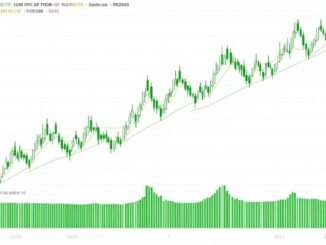
At 0:55 on October 8, NEAR is quoted at $5.36 or €4.79 according to CoinGecko, a gain of 5.74 percent within 24 hours. The daily range ran from $4.89 to $5.44. That makes NEAR, at rank 21 among the largest cryptocurrencies, the only gainer in the top 25 excluding stablecoins: bitcoin loses 2.68 percent over the same period, ethereum 4.70 percent, XRP 5.33 percent, solana 4.20 percent, uniswap 8.44 percent.
Over a longer horizon the picture looks different from this one day. Over 30 days NEAR is up 127.91 percent, while over seven days it is slightly down at 0.75 percent. Market capitalisation stands at around $7.0 billion, the day’s trading volume at around $1.08 billion, the circulating supply at around 1.308 billion NEAR. The all-time high of $20.44 dates from January 16, 2022; the price is 73.8 percent below it.
For orientation up and down, the figures from the data itself therefore serve better than round wished-for levels: the daily low at $4.89 marks the zone the market defended that day, the daily high at $5.44 the one where it failed. The 30-day rise of around 128 percent also means that a large share of today’s holders have only been in for a short while, so without a buffer.
The day was marked market-wide by forced liquidations, whose scale reports put at different figures. Finance Magnates names more than $400 million in long positions unwound within roughly 20 minutes, Mitrade around $550 million, Yahoo Finance citing Coinglass around $696 million over 24 hours. An oil price above $101 a barrel of Brent and a failed recovery above about $87,000 in bitcoin are seen as the triggers. None of these sources names a NEAR-specific reason for the daily gain; nobody claims the shutdown is driving the price, and this article does not either.
The route to buying in Germany: MiCA authorisation and the limit of self-custody
Anyone buying or selling NEAR in Germany does so at an authorised service provider, now that the EU regulation on markets in crypto-assets applies in full. MiCA covers companies that trade or exchange crypto-assets or hold them for third parties, and requires of them a licence and ongoing supervision.
For the MyNearWallet case, the dividing line is the actual point. Software with which you hold your own key provides no custody for third parties and therefore needs no authorisation. That is convenient, but it has a flip side: there is no supervisor that can oblige an operator to keep running, no deposit protection and no body you could complain to about a shutdown. Announcing a deadline here is a courtesy, not a duty.
How differently the regulated route runs has just been demonstrated in Germany. BaFin has refused the operator of bitcoin.de its MiCAR authorisation; in that case rules on the segregation and transfer of client assets applied, and client assets stayed with the custodian bank until they pass to another authorised custodian. The details are in our report on the refused MiCAR licence for bitcoin.de. Both cases fall in the same week and show the same decision from two directions: with self-custody you carry the operational risk yourself, with an authorised custodian a supervised company carries it, and you carry counterparty risk in exchange.
Holding period and allowance: the move is not a sale, a swap during migration is
On tax, the good news comes first: a transfer between two wallets that both belong to you is not a disposal. The storage location changes, the owner does not, and so no new holding period begins either. For private disposals, Section 23 of the German Income Tax Act sets a period of one year, after which a gain remains tax-free, plus an exemption threshold that has stood at €1,000 per calendar year since the 2024 Annual Tax Act. Exemption threshold means: exceed it and the entire gain is taxable, not only the part above it.
The unpleasant news sits in the detail of the migration. As soon as you swap along the way rather than simply transferring, because the new wallet offers an exchange across several chains say, that is a swap of one crypto-asset for another. Such a swap is, for tax purposes, a sale followed by a purchase; it can trigger a gain and starts the holding period afresh for the new asset. Precisely because near.com is explicitly promoted with swap functions across more than 30 chains, this distinction matters more during the moving weeks than it otherwise would.
Which records the tax office wants to see
That creates a documentation duty in your own interest. You should be able to prove that both addresses belong to you, and record every transaction with its date, amount and transaction ID. Without that evidence, the tax office can read an outflow from the old wallet as a sale. Keeping track through a portfolio tool is the calmer route for this than a table by hand. The German Federal Ministry of Finance’s circular on crypto-assets of March 6, 2025 is the authoritative administrative guidance; for larger holdings or staking income, this article is no substitute for tax advice.
What the shutdown says about NEAR’s wallet landscape
A wallet being switched off is not yet a verdict on a network. MyNearWallet emerged as the successor to an earlier browser wallet run by the development side and was for years the standard answer to the question of how to reach a NEAR account without extra software. That this slot is now being filled anew fits a line that has been visible around NEAR for months: fewer standalone interfaces, more bundling onto one account that works across chains.
Two things about that are interesting for holders. The bundling lowers the number of places where something can go wrong and at the same time raises dependence on the one place that remains. Anyone who does not want that has good conditions, with a protocol offering readable accounts and several access keys per account, to spread access across two independent routes instead of hanging everything on one interface.
What remains open at the time of writing is which wallets will end up on the list of supported destinations and how the sunset page and the protocol account will reconcile their differing recommendations. Until then the simpler truth both sources share applies: the account is yours, access is replaceable, and nobody does the replacing for you.
MyNearWallet shutdown: your next three steps
- Take stock of holdings and delegation. Open your account while it is still October and write down what sits there: free NEAR balance, delegated tokens including the validator, NFTs and other tokens. Check in the same pass that your recovery phrase is complete and legible. Which wallet categories are candidates as a destination and how they differ is set out in our software wallet comparison.
- Release staking first, then move. Unstake delegated tokens early so the unbonding period does not run into October 31, then move a small test amount before the rest follows. Record every transaction with its date, amount and ID; a tracker from our comparison of crypto tax tools and portfolio trackers is the more reliable route for that than a list by hand.
- Decide whether you want self-custody at all. If deadlines like this are too much effort for you, the alternative is an authorised custodian with supervision and segregated client holdings, to be found through our overview of regulated crypto exchanges. You are trading operational risk for counterparty risk, and that is a deliberate choice, not a fallback.
(As of October 8, 2026. This article is not investment advice. Prices and fee structures change; check the terms with the provider before you buy.)



Be the first to comment