

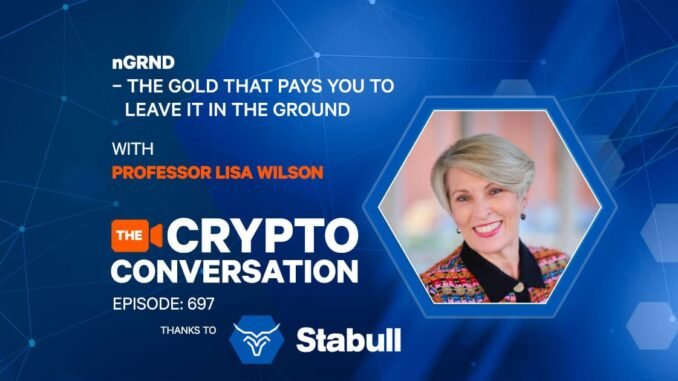

Professor Lisa Wilson is CEO and co-founder of nGRND, a gold protocol that turns verified but unmined “in-ground” gold into a fully backed, reward-bearing digital asset rather than digging it up. An Australian who holds a South African professorship and lives in France, Wilson is a genuine mining insider — she has written operational and hazard-standards systems for the likes of Rio Tinto and BHP — with a parallel career in blockchain, where she helped list the world’s first actively managed certificates for investment-grade carbon assets.
Why you should listen
Wilson’s pitch is a contrarian one: the best place to keep gold may be exactly where it already is. Billions of ounces of verified gold sit classified as resources that can’t economically advance to production, with mine timelines now stretching toward two decades once permitting, First Nations consultation and environmental compliance are factored in. Gold, she argues, is unusual among metals — it has almost no industrial use, so above-ground stock is mostly worn or stored, which means an ounce in the ground is functionally the same store of value as an ounce in a vault. nGRND acquires long-term rights (30 to 100 years) to independently verified deposits, leaves the metal “in situ,” and monetizes it without the environmental decimation of extraction. The mechanics are concrete: for every 35,000 tokens in circulation, at least one ounce of preserved gold is held in the protocol treasury, and every ounce left undisturbed avoids an estimated 792kg of CO2.
The more interesting half of the model is what happens on the surface. Because the land above each deposit stays untouched, nGRND layers a second income stream on top of gold’s own appreciation — what Wilson calls alternative land-use monetization. That can mean soil-carbon and avoided-mining carbon credits, ecotourism, data cables routed across otherwise off-limits ground, or wind and solar microgrids, with a single site capable of generating millions a year across a multi-decade rights agreement. Brownfield sites are their own opportunity: in Australia a decommissioned site can carry a reclamation bond north of $20 million, and nGRND positions itself as the party that cleans up tailings and restores biodiversity while still capturing the value sleeping below. The token itself is tokenized through a VARA-regulated issuer in Dubai and backed by resources verified to NI 43-101 standards — a structure aimed squarely at the institutional real-world-asset crowd having its moment right now.
For all the heavy machinery of the model, nGRND’s on-ramp is deliberately playful: its sponsored mobile games Dig It and Gold Fest have pulled in more than 855,000 players across 200-plus countries and accrued roughly $6 million in rewards ahead of the token launch, with TON Foundation backing and a Base expansion planned. Wilson is adamant the ecosystem isn’t just for stakers and gamers — she describes participation streams spanning impact, learning and governance, including immersive digital twins of actual project sites. In the closing hot-take round she leans to the Bitcoin side of the spectrum as a self-described early mover, makes the case that crypto literacy should be embedded education for everyone, and sketches a ten-year future in which wealth migrates away from a USD-hedged system toward assets people actually control — before signing off with a charmingly vintage sci-fi pick in the British fantasy series Catweazle.

Supporting links
If you enjoyed the show please subscribe to the Crypto Conversation and give us a 5-star rating and a positive review in whatever podcast app you are using.



Be the first to comment