


Nike’s long slide has now cost it a place in one of America’s most exclusive blue-chip indexes.
S&P Dow Jones Indices will remove Nike from the S&P 100 on Sept. 21, while Dell Technologies, Palo Alto Networks, Arista Networks and SanDisk join the mega-cap benchmark. Nike will remain in the broader S&P 500.
The timing is brutal.
Nike closed Friday at $38.40, near a 12-year low and roughly 78% below its November 2021 record. Its market capitalization has fallen to about $57 billion, from roughly $264 billion at the end of 2021.

Coinpaper previously examined the 12-year low, but the index exit adds a different dimension: Nike is no longer being treated as one of the market’s dominant mega-cap blue chips.

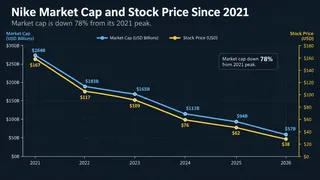
Nike’s Exit Shows How Much the Mega-Cap Club Has Changed
The rebalance is bigger than Nike.
Nike, Colgate-Palmolive, Simon Property Group and Honeywell Aerospace are leaving the S&P 100. Their replacements are Dell, Palo Alto Networks, Arista Networks and SanDisk.
That is a striking shift toward technology, cloud infrastructure, cybersecurity and AI-linked data-center demand.
Arista is now worth about $244 billion, more than four times Nike’s current valuation. Palo Alto Networks is valued near $272 billion, almost five times Nike.
Arista shares are also up more than 40% this year as data-center networking demand accelerates, while Dell recently traded near a 52-week high after another AI-driven earnings surge.
The contrast is hard to miss: capital has migrated toward the companies building the infrastructure behind AI, while Nike has spent years losing market value.
| Nike | Removed | Consumer turnaround |
| Arista Networks | Added | AI networking |
| Palo Alto Networks | Added | Cybersecurity |
| Dell | Added | AI servers |
| SanDisk | Added | Data storage |
The Index Exit Does Not Fix—or Break—the Turnaround
The S&P 100 removal itself should not be confused with a new fundamental problem.
Nike still remains in the S&P 500, and the largest ETF directly tracking the S&P 100, iShares OEF, holds about $20.5 billion in assets. That limits the scale of potential index-related selling compared with an S&P 500 deletion.
The real problem remains the business.
Nike generated $46.4 billion in fiscal 2026 revenue, essentially flat year over year. Fourth-quarter currency-neutral revenue declined 4%, while Nike Direct sales fell 9%. Greater China and digital sales remained major weak spots.
The company is trying to repair the direct-to-consumer strategy by rebuilding wholesale relationships, cleaning up inventory and shifting attention back toward sport and new products.
There are some signs of progress. Wholesale revenue rose 4% in the fourth quarter, and North America improved. But Greater China remains under pressure, while competitors such as Hoka and On continue taking share in performance running.
That problem was already visible when we covered China weakness after Nike’s latest results.
The parallel pressure at Lululemon also shows this is not simply a Nike problem. Premium athletic brands are facing more fragmented consumer demand and stronger competition.
Nike’s S&P 100 exit therefore does not prove the stock has bottomed.
But it does crystallize just how far expectations have fallen.
A company once valued above $260 billion is now worth around $57 billion, while technology companies tied to AI infrastructure are taking its place in the market’s blue-chip tier.


Be the first to comment