

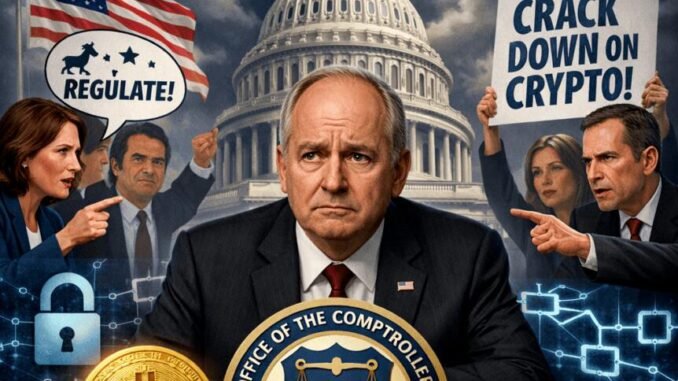

Regulatory scrutiny of crypto licensing intensified as lawmakers scrutinized the handling of a national bank trust charter application tied to World Liberty Financial, a Trump-family affiliated crypto venture. During a House Financial Services Committee hearing on the oversight of prudential regulators, OCC Comptroller Jonathan Gould—nominated by Donald Trump—faced questions about potential conflicts of interest and the potential influence of political considerations on licensing decisions. The hearing underscored ongoing debates over how closely regulatory actions should align with political and familial ties in the context of the evolving U.S. crypto framework.
Representative Gregory Meeks of New York pressed Gould on World Liberty’s connections to foreign governments and to the Binance exchange, arguing that the company’s co-founders include members of the president’s family. World Liberty Financial had submitted an OCC charter application in January, prompting significant Democratic pushback over perceived conflicts of interest. At issue was whether the OCC would apply the same standards to World Liberty as it does to other applicants seeking a national trust charter, which affects the regulatory treatment of certain crypto-services providers.
Meeks asserted that World Liberty’s actions “actively line the pockets of the president’s family,” urging the OCC to demonstrate that its decision would be in the public interest and not influenced by political considerations. Gould and Meeks spoke past one another at times, with the lawmaker urging that the OCC head be held to prove he was acting on behalf of the American people rather than serving as a political intermediary for the Trump family. Gould responded that political pressure had been the only pressure he perceived from lawmakers outside the Senate.
Even before this hearing, the OCC had already approved or conditionally approved several national trust charter applications from crypto companies, signaling a growing regulatory pathway for the sector. Names cited included Coinbase, Ripple, BitGo, Circle, Fidelity Digital Assets and Paxos. The OCC’s openness to national trust charters has been framed as a way to provide regulated access to stable operations and banking-like services for crypto firms, albeit amid intense regulatory and policy scrutiny. Gould began his tenure in July 2025, having been confirmed by the Republican-dominated Senate along party lines. In January, shortly after World Liberty’s application was submitted, Gould stated the agency would be “apolitical and nonpartisan” in its review process. Massachusetts Senator Elizabeth Warren, who had also urged pausing the review, argued that the approvals appeared to be directed at “seemingly ineligible companies,” potentially contravening federal banking laws.

World Liberty’s case sits within a broader trend of tightly watched efforts to integrate crypto firms into traditional banking-style oversight through national trust charters. In parallel, crypto exchange Kraken’s parent company, Payward, filed a similar application with the OCC in May, highlighting the ongoing push among several market participants to obtain the same regulatory treatment as established banks for certain crypto activities.
Key takeaways
- OCC Comptroller Jonathan Gould asserted that there was no presidential instruction directing or pressuring him to approve or favor World Liberty Financial’s national trust charter application.
- The House Financial Services Committee hearing spotlighted perceived conflicts of interest linked to World Liberty’s Trump-family ties, with lawmakers urging equal regulatory scrutiny for the charter application.
- The OCC has previously approved or conditionally approved a slate of national trust charter applications from major crypto firms, including Coinbase, Ripple, BitGo, Circle, Fidelity Digital Assets, and Paxos; Kraken’s Payward also pursued similar oversight.
- Regulatory debate centers on whether national trust charters create a lighter or different set of banking requirements for crypto firms, and how those standards align with federal banking laws and AML/KYC expectations.
- The broader policy environment remains contested, with calls for enhanced anti-corruption provisions and tighter enforcement, as conservative and progressive lawmakers weigh the costs and benefits of expanded crypto bank-charter access.
- Two key committees advanced the CLARITY Act in the Senate, signaling movement toward a comprehensive digital-asset market-structure framework, with timelines discussed for passage in the coming months; observers note the importance of aligning U.S. policy with global standards.
Regulatory neutrality, charters, and the path forward
The hearing showcased how the OCC’s decisions on chartering crypto firms sit at the intersection of regulatory design, political accountability, and market integrity. The concept of a national trust charter—allowing crypto firms to offer certain services with banking-like protections—continues to be debated for its practical implications, including licensing standards, consumer protection, and systemic risk considerations. Critics warn of potential conflicts of interest when a governing official has personal or familial ties to an applicant, while proponents emphasize the need for clear, consistent regulatory frameworks that enable compliance-oriented firms to operate with adequate oversight.
From a compliance and enforcement perspective, the case underscores several critical issues for crypto firms and financial institutions alike. First, licensing pathways such as national trust charters shape the regulatory runway for crypto-service providers, with implications for AML/KYC requirements, consumer disclosures, and supervisory regimes. Second, the treatment of politically connected entities raises governance questions about independence, transparency, and the risk of regulatory capture. Finally, the ongoing movement toward a formalized digital asset market structure—exemplified by the CLARITY Act process—could redefine the boundary between crypto activities and traditional banking, influencing licensing, custody, settlement, and cross-border operations.
According to Cointelegraph, the CLARITY Act’s consolidation in the Senate represents a deliberate step toward a unified framework for digital assets, which could affect how banks, exchanges, and crypto firms navigate licensing, custody, and interoperability requirements. The administration’s stated aim for summer passage, as cited in reporting, signals a potential shift in legislative momentum and regulatory tempo, with significant implications for compliance programs and cross-border activities. As the regulatory landscape evolves, institutions must monitor not only domestic policy developments but also how international standards—such as MiCA and U.S. enforcement actions—intersect to shape risk, governance, and operational resilience.
Looking ahead, the central issue remains how regulators will balance innovation with risk management and consumer protection, while ensuring transparent governance and consistent application of standards across entrants to the charter framework. The coming months will be pivotal for determining whether the United States can sustain a robust, enforceable regulatory regime that accommodates crypto-native business models without compromising integrity or market stability.
Closing perspective: ongoing congressional scrutiny, evolving licensing standards, and the CLARITY Act’s trajectory will define the U.S. regulatory posture for crypto firms and their access to traditional banking rails. Stakeholders should watch how enforcement priorities and governance practices adapt to these developments, as policy choices will reverberate through licensing decisions, cross-border operations, and institutional compliance programs.



Be the first to comment