


A strange thing has happened to Bitcoin’s derivatives market over the past five years. The market is larger, institutions play a much bigger role, exchanges offer more sophisticated products, and traders have become far better at moving risk around. At the same time, one of the products that helped build that market has almost disappeared from the crypto-native venues where Bitcoin derivatives first took off.
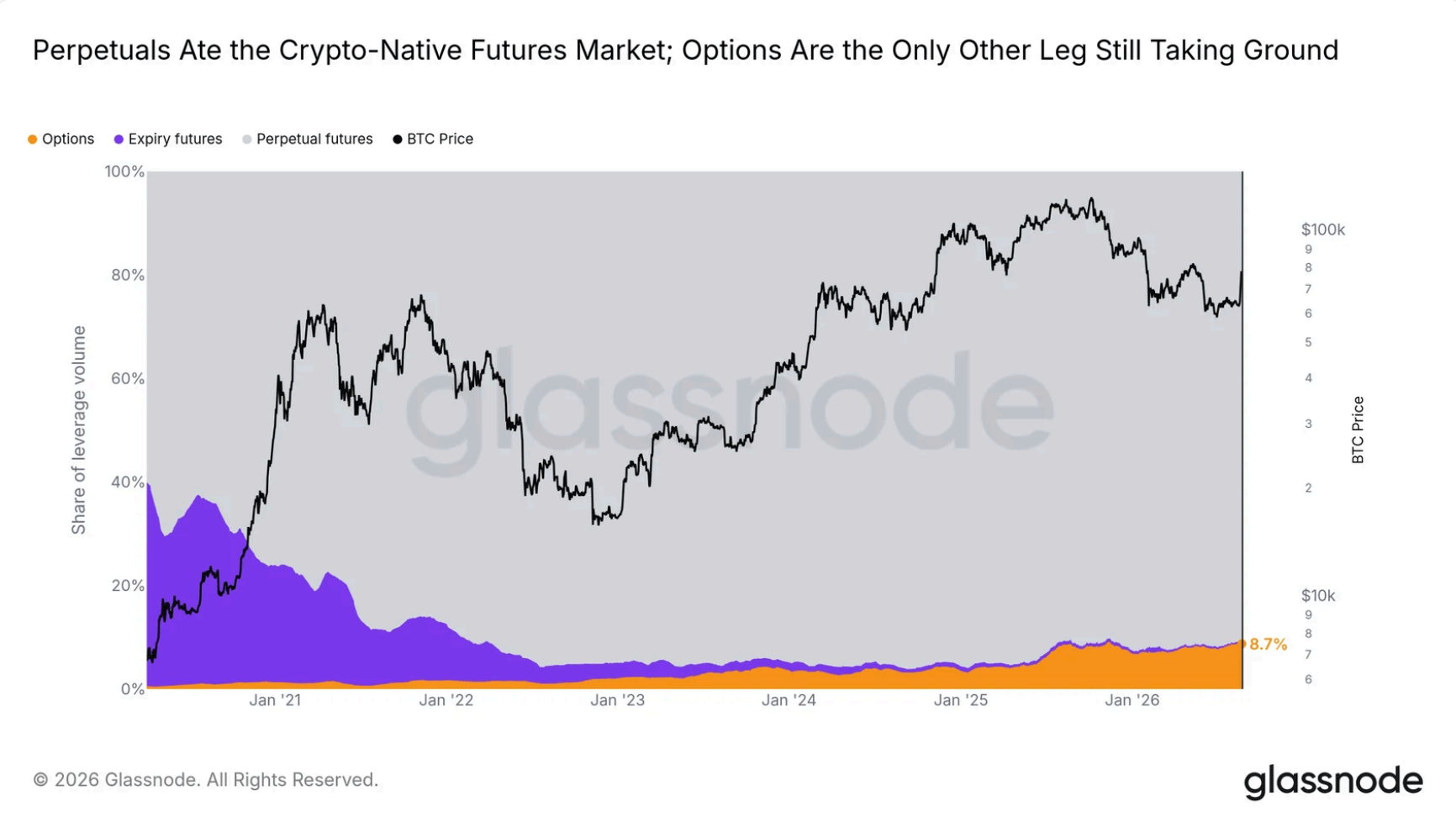
Dated futures volume across the offshore venues tracked by Glassnode is now about 97% below its 2021 level. Options, meanwhile, have expanded from roughly one-quarter of crypto-native Bitcoin derivatives open interest to nearly half, gaining share during four of the five market regimes Glassnode studied since 2019.
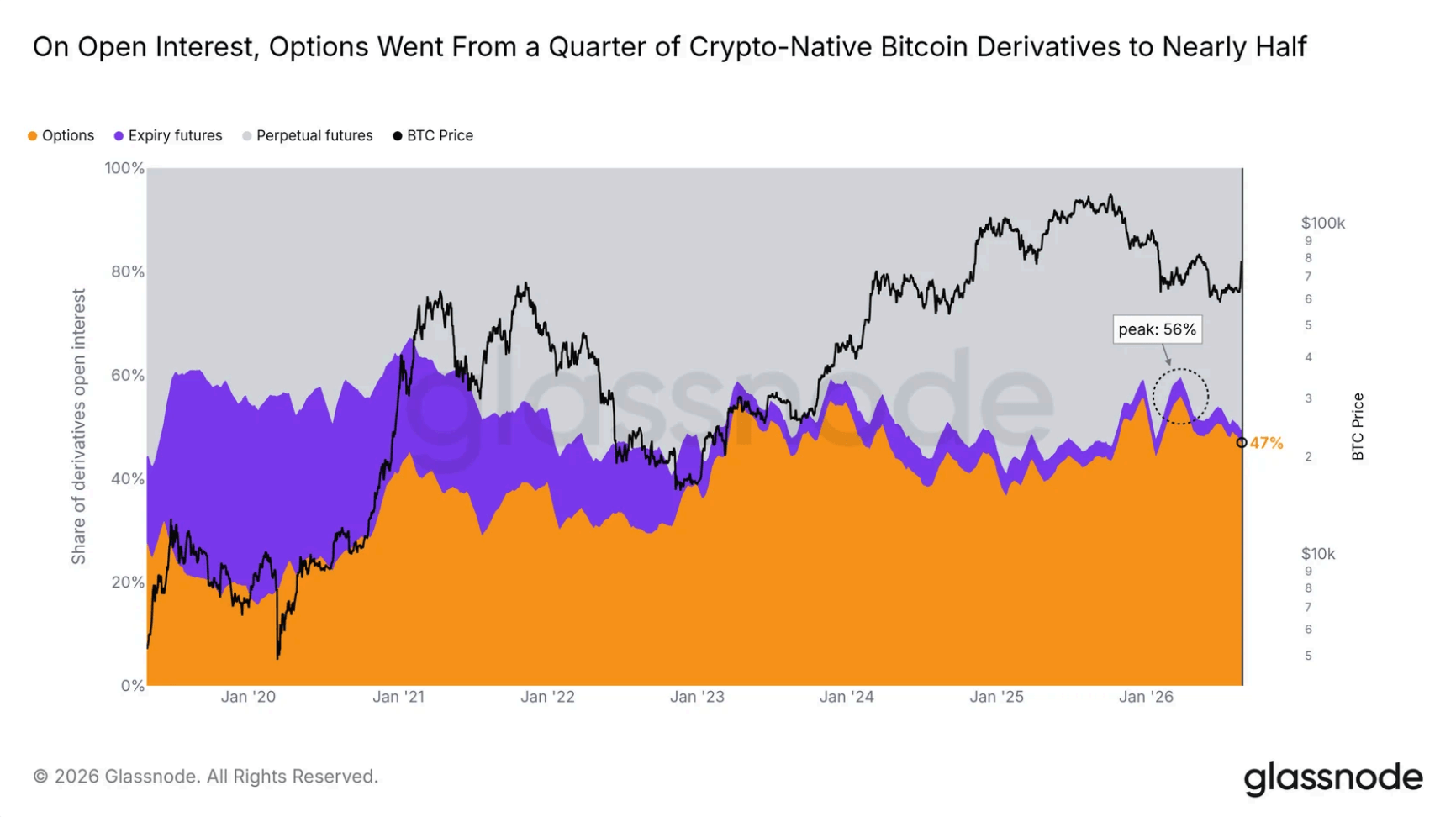
It would be easy to describe that as options replacing futures, but that’s not really what happened. Bitcoin derivatives have split the old futures market between two products that are better suited to different kinds of risk, with perpetuals becoming the easiest way to make a leveraged directional bet without worrying about expiry, while options take more of the work around hedging, volatility, downside protection, and trades built around a particular price or date.
That division has squeezed dated futures between them.

CryptoSlate has been watching the process for years. A 2024 market report on how Bitcoin options affect the crypto market looked at how large expiries were already rearranging open interest and influencing short-term trading. By March 2025, Bitcoin’s options-to-futures open interest ratio had climbed from 57.8% to 69.6% in less than a week, while Ether’s stayed much lower, according to CryptoSlate’s options-to-futures analysis.
The ratio finally flipped in January 2026, when Bitcoin options open interest reached about $74.1 billion against roughly $65.22 billion in futures, the first time CryptoSlate recorded options carrying the larger position inventory. CryptoSlate’s January derivatives report captured the shift as it happened.
The new Glassnode data adds something those snapshots couldn’t because it shows the reordering across several market cycles and, more importantly, makes it easier to see where the old futures activity went.
The futures market split in two
Conventional futures have a date attached to them. Buy a December Bitcoin future and the contract eventually expires, which means the trader has to settle it, close it, or roll the position into another maturity.
That structure still works extremely well in traditional markets built around standardized monthly and quarterly contracts. Crypto, however, trades every hour of every day and eventually created a product that fit that environment better.
The perpetual future removed the expiry date, allowing a trader to keep the position open for as long as there’s enough margin, while recurring funding payments between longs and shorts help keep the contract near the underlying spot price.
That’s hard to beat for someone who simply wants leveraged Bitcoin exposure, because there’s no contract roll to manage and no decision over which maturity has the deepest liquidity. The largest perpetual can simply become the obvious place to trade.
A Sept. 18 snapshot of Binance’s market shows how far that preference can go. At around 03:25 ET, the exchange’s BTCUSDT perpetual carried about 108,289 BTC of open interest, while the BTCUSDC perpetual carried another 19,465 BTC. At their respective mark prices, those two contracts represented roughly $9.93 billion of outstanding positions.
Binance’s two USD-margined dated Bitcoin contracts, expiring Sept. 25 and Dec. 25, carried only about $77 million combined, putting open interest in those two major stablecoin-margined perpetuals at roughly 129 times the amount in the corresponding quarterly contracts.
It’s only one exchange and one snapshot, so it shouldn’t be treated as a market-wide ratio. But it does show why the collapse in dated futures activity on crypto-native venues isn’t especially mysterious, because traders who want linear leverage already have another instrument with deeper liquidity and less maintenance.
Glassnode’s broader derivatives data points in the same direction. Dated futures activity fell sharply from its 2021 levels, while perpetuals absorbed much of the leverage that once lived there. Options expanded alongside them, but they aren’t competing for exactly the same trade.
That’s an important distinction because open interest can otherwise make very different products look interchangeable. A dollar of perpetual open interest and a dollar of options open interest don’t represent the same risk, because a perpetual is mostly linear while an option’s payoff depends on strike, expiry, volatility, and where Bitcoin trades in relation to all of them.
That lets a holder protect a large Bitcoin position without selling it or cap downside while keeping some upside, while a trader who expects a large move without knowing the direction can isolate volatility itself rather than make a simple call on direction. Once the market became deep enough to support those trades, there was less reason for dated futures to do everything at once.
Why options became much more valuable
The simplest explanation for the growth of options is that Bitcoin ownership itself changed.
Earlier crypto cycles were dominated by participants making relatively direct bets. They bought because they thought Bitcoin would rise, shorted because they thought it would fall, or added leverage to either side, and futures were excellent for that.
A market with large pools of Bitcoin that owners don’t intend to sell creates a different problem. US spot ETFs hold Bitcoin for investors who may keep that exposure for years, corporate treasuries hold it on their balance sheets, and funds run mandates around it while market makers and structured-product desks carry inventory because they’re providing liquidity or packaging returns for someone else.
Those holders don’t always want more or less Bitcoin because sometimes they simply want to alter the risk around what they already own, which is where options become much more attractive.
Funds worried about a drawdown can buy puts instead of selling their Bitcoin, while holders who are willing to give up some upside can sell calls against the position. Desks that expect a large move without knowing the direction can trade volatility instead of choosing long or short, giving the market a way to separate the risk of owning Bitcoin from the decision to own it.
Options also become part of the way the rest of the market moves because dealers have to hedge them. A market maker that sells options can end up buying or selling Bitcoin or futures as the option’s delta changes, which means the options book starts feeding directly into spot and perpetual liquidity.
That makes options more important even when the person buying them isn’t making a directional bet at all.
Glassnode’s data makes this look less like something that only happens during bull markets because options gained share in four of the five regimes it studied since 2019, and some of the fastest expansion took place during the long bear-market period.
That fits a product that doesn’t need prices to rise to become valuable because it becomes more important when investors care about the shape of their risk.
The collateral underneath the market changed too, because early crypto derivatives were often margined in Bitcoin itself, which created a nasty feedback loop during selloffs because a trader’s position could lose money at the same time as the collateral backing it. A leveraged trade became more fragile precisely when volatility was accelerating.
Stablecoin and cash-like margin separate those two risks. Glassnode describes the derivatives market as moving away from coin-backed leverage toward stable-value collateral, which makes it easier for professional desks to manage positions across products without having the margin itself fall alongside Bitcoin.
The options venues have also become much deeper than they were a few years ago. Glassnode’s four-venue comparison found Bybit’s share of tracked Bitcoin options volume reaching 28%, up from below 10%, while its options book expanded from $529 million in its first month to $2.33 billion. Ethereum accounted for roughly one-third of Bybit’s options turnover over the previous 90 days.
Those exchange-specific figures come from research produced with Bybit and should be read with that relationship in mind. The broader point, though, is harder to dismiss: liquidity is no longer concentrated in a single options venue to the degree it once was.
As spreads tighten and professional market makers operate across more exchanges, the product stops feeling exotic and starts functioning as ordinary market infrastructure.
Dated futures still have a place
There’s one important boundary around the Glassnode data because its options comparison covers crypto-native venues, while the futures study looks at offshore exchanges and explicitly excludes CME.
So the claim that dated futures are disappearing shouldn’t be stretched across the entire Bitcoin market.
CME futures serve a different customer and often a different purpose. A regulated asset manager, hedge fund, bank, or basis trader may prefer a standardized CME contract because it already fits into established collateral, clearing, compliance, and risk systems.
Spot ETFs made that institutional futures market more relevant in another way. Funds can hold spot exposure and short futures against it, while basis traders can buy Bitcoin or an ETF and sell a future when the spread is wide enough to cover financing and execution. Market makers can also use CME positions against exposure held elsewhere.
That can create enormous short positions without telling us much about whether those traders are bearish on Bitcoin, which is why CFTC leveraged-fund shorts need to be read alongside basis conditions and the rest of the trade.
Dated futures therefore aren’t disappearing everywhere, but their role is becoming more specialized. Offshore crypto-native exchanges built a better instrument for continuous directional leverage and called it the perpetual; regulated institutions still have reasons to use standardized futures through CME, and options expanded into the large space between those two markets where investors need to manage volatility, downside, expiry-specific risk, and portfolios they don’t actually want to sell.
The result looks very different from Bitcoin’s derivatives market five years ago. Perpetuals carry much of the raw leverage, options increasingly carry the more complicated risk around that leverage, and CME futures preserve a regulated route for institutions that need standardized contracts and established clearing.
Dated futures didn’t lose all of their business to one replacement because their old role was broken apart, and that says more about how Bitcoin trading has matured than the size of any single derivatives market. A market dominated by one leveraged contract is mostly built around making a bet, while a market with deep spot ownership, perpetual liquidity, regulated futures, and a large options surface is built around holding Bitcoin for longer while continuously deciding which parts of the risk are worth keeping.



Be the first to comment