



The war sent BTC to decline while premium that sent crude oil prices screamed above $110 is now disappearing almost as quickly as it arrived.
During the disruption, Riyadh leaned heavily on Red Sea routes to keep exports moving while Gulf shipping routes faced uncertainty. That workaround suddenly looks far less important.
Saudi Aramco has resumed loadings at Ras Tanura, the world’s largest oil terminal, after a near four-month interruption. At the same time, shipping analytics firm Kpler estimates traffic through the Strait of Hormuz has recovered to roughly 40 vessel crossings per day.
The UAE has already returned to pre-war export levels. Considering the waterway handles roughly 20% of global seaborne oil trade, markets wasted little time stripping the conflict premium out of crude prices, according to EIA data.


Strait Reopens And Traders Hit Reverse
The biggest signal came from Saudi Arabia’s exports. Four Bahri-operated supertankers reportedly exited the Gulf carrying around 8 million barrels of crude after the US-Iran truce reopened the Strait of Hormuz. The kingdom is now recording its strongest shipping activity since the conflict disrupted regional energy flows.
Exports had fallen to roughly 4 million barrels per day during the fighting after exceeding 7 million barrels per day in February. Shipments are once again moving toward the 6.3 million barrels per day pace recorded before tensions escalated.
Oil Price Fall Accelerates Below Key Levels
The oil price fall gathered momentum on Thursday as WTI crude slipped below $68 for the first time in 125 days.
Only weeks ago, traders were pricing in supply disruptions, tanker shortages, and the possibility of a prolonged regional conflict. Those fears are now being unwound as supply routes normalize and crude begins trading below levels seen when US strikes on Iran first began in late February.
Cheaper Energy Revives Risk Appetite Again
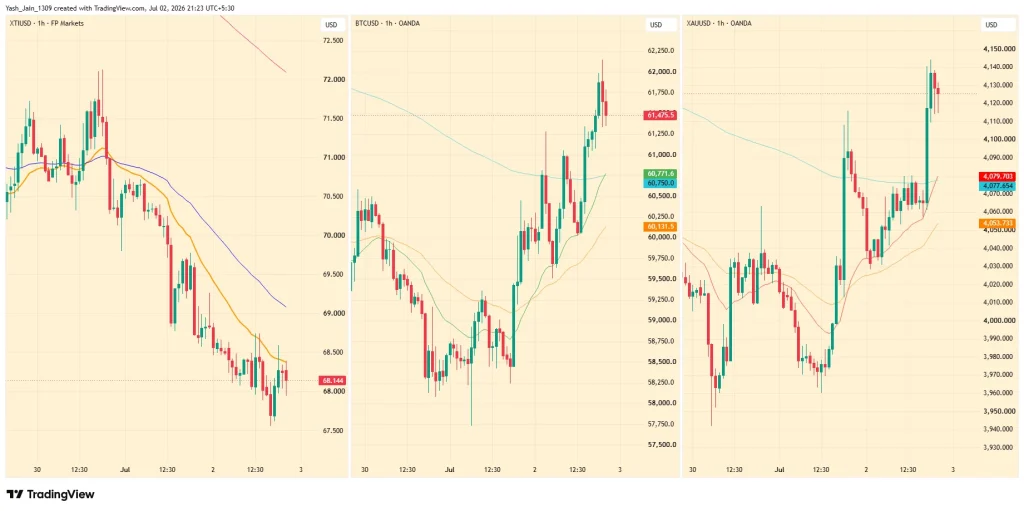
As crude prices cooled, risk assets found fresh momentum. BTC price climbed more than 5% over the past 24 hours to trade near $61,649, while gold extended gains beyond $4,000. Lower energy costs tend to ease inflation expectations and reduce pressure on interest rates, conditions that typically encourage investors to move back into higher-risk markets.
That doesn’t mean the market has declared the crisis over. The current roadmap rests on a 2 month truce agreement, and insurers remain cautious about Gulf shipping exposure. For now, though, the oil price fall has become the clearest sign yet that markets are betting on normalization rather than escalation.
Was this writing helpful?
Story Ends Here
Trust with CoinPedia:
CoinPedia has been delivering accurate and timely cryptocurrency and blockchain updates since 2017. All content is created by our expert panel of analysts and journalists, following strict Editorial Guidelines based on E-E-A-T (Experience, Expertise, Authoritativeness, Trustworthiness). Every article is fact-checked against reputable sources to ensure accuracy, transparency, and reliability. Our review policy guarantees unbiased evaluations when recommending exchanges, platforms, or tools. We strive to provide timely updates about everything crypto & blockchain, right from startups to industry majors.
Investment Disclaimer:
All opinions and insights shared represent the author’s own views on current market conditions. Please do your own research before making investment decisions. Neither the writer nor the publication assumes responsibility for your financial choices.
Sponsored and Advertisements:
Sponsored content and affiliate links may appear on our site. Advertisements are marked clearly, and our editorial content remains entirely independent from our ad partners.
Read the Next News



Be the first to comment