




TLDR
- Oil prices were mostly flat Friday ahead of the U.S. July 4 holiday weekend
- Brent crude sat at around $71.96 a barrel; WTI traded below $70
- Oil is on track for its fourth straight weekly loss as Strait of Hormuz shipping recovers
- Iran has rejected a U.S. proposal to renounce claims over the Strait of Hormuz
- The Brent futures curve is in contango, signaling near-term oversupply expectations
Oil prices were largely flat on Friday as traders balanced cautious optimism over U.S.-Iran negotiations against growing signs of oversupply in the market.
Brent crude was up 0.2% at $71.96 a barrel early Friday. West Texas Intermediate traded just under $70. Both benchmarks were still heading for a fourth consecutive weekly loss.
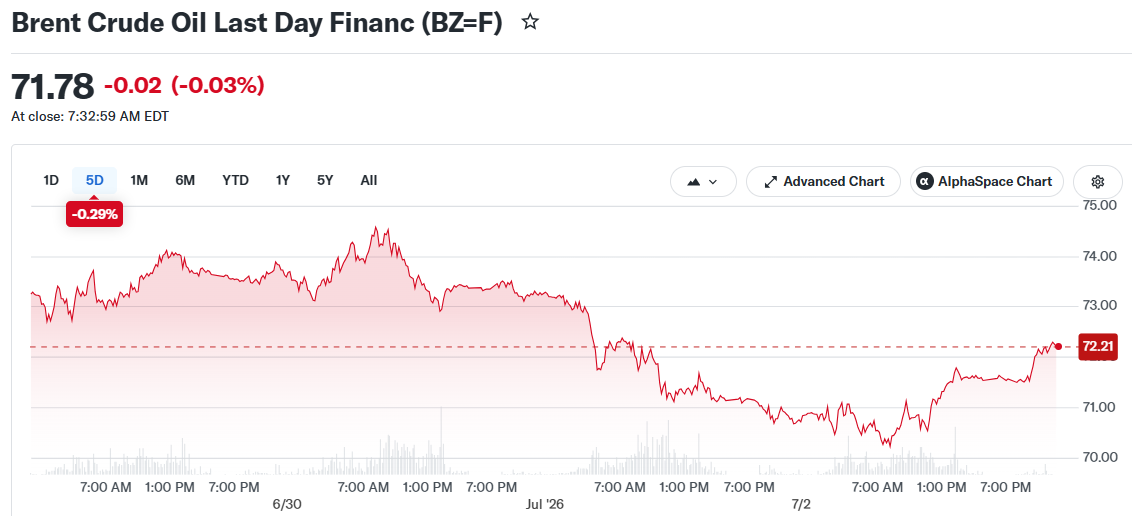
Prices have dropped back to near pre-war levels over the past three weeks. The reopening of the Strait of Hormuz has been a key driver of that move lower.
The U.S. and Iran signed a memorandum of understanding to negotiate a broader deal. That news alone shifted market sentiment, with traders pricing in a return of more physical supply in the weeks ahead.
President Donald Trump said he believed Iran had “agreed to just about everything we need.” His comments pointed to progress in the talks, though major sticking points remain.
The Wall Street Journal reported that Iran has rejected a U.S. proposal to formally renounce its claims over the Strait of Hormuz. Washington had offered access to billions in frozen Iranian funds in exchange. Iran has so far said no.
Control of the strait became a central issue after Tehran effectively closed it following a joint U.S.-Israeli military operation in late February. Shipping activity in the waterway is now showing signs of recovery.

Gulf Producers Rush to Export as Window Narrows
Saudi Arabia has pushed over 10 million barrels of crude through the Strait of Hormuz in recent days. Supertankers are loading at the Saudi port of Ras Tanura, and the country is ramping up exports to Asia. Saudi exports have recovered to around 90% of pre-war levels.
Gulf producers, including Iran, are rushing to ship oil while the negotiation window is open. That window is set to expire in August, and there is uncertainty about what happens after.
The Brent futures curve has moved further into contango. That means near-term contracts are cheaper than longer-dated ones — a structure that signals the market expects near-term supply to be plentiful.
ING commodities strategists Warren Patterson and Ewa Manthey said the rise in oil flows is putting growing pressure on the front end of the Brent forward curve.
ANZ noted a build-up in short positions has also weighed on crude prices. Some bearish bets were trimmed ahead of the holiday weekend.
Iran continues to struggle to sell its own crude. More than 58 million barrels remain in floating storage, with over 90% yet to find a buyer, according to shipping data firm Vortexa.
Lower crude prices have drawn in buying from China’s independent refiners, helped by more flexible pricing from Saudi Arabia and Kuwait.
Some analysts believe oil has moved into oversold territory, but the near-term supply picture continues to improve.
🚨 Our July Stock Picks Are Live!
A new month means new opportunities. Our analysts have just released their top stock picks for July, highlighting companies with strong momentum that rank highly on our KO Score algorithm. We’re also now sharing trade ideas for both long-term and short-term investors, giving you more ways to spot potential opportunities in the market.
Sign up to Knockout Stocks today and get 50% off to unlock the full list and see which stocks made the cut.
Use coupon code Special50 for your exclusive discount!



Be the first to comment