


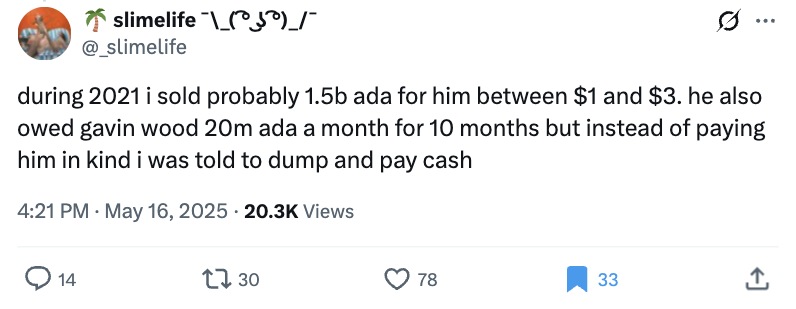
A new Cardano onchain trace has revived a May 2025 post that claimed Charles Hoskinson sold roughly 1.5 billion ADA during the 2021 bull cycle and that a separate payment stream involved 20 million ADA a month for 10 months.
The claim under review came from a screenshot of an older post by X user @_slimelife. The post alleged that ADA was sold “for him” between $1 and $3 and that a monthly ADA obligation tied to Gavin Wood was settled in cash instead of tokens.
The chain cannot verify a private sale agreement, a cash payment, or the real-world identity of a receiving wallet. The checkable part is narrower: whether Cardano’s 2021 ledger contains large transfers matching the claimed size, timing and downstream movement.
The Genesis Trail case file maps nine payments of about 20.2 million ADA each between April and November 2021. The payments arrived roughly 28 days apart, totaled about 184.8 million ADA, and landed in one collecting address that was active only during 2021.
That address did not retain the funds. The full monthly stream was forwarded to a downstream consolidation address, creating a pass-through pattern rather than a long-term holding wallet.
925M ADA Burst Lands In Same Downstream Path
The same analysis also maps a separate 925 million ADA burst from February to March 2021. That flow reached the same downstream consolidation address through 33 deposits, creating a second large 2021 pattern beside the monthly payment stream.
The 925 million ADA burst does not prove the full 1.5 billion ADA claim. A broad sale across exchanges or OTC desks cannot be isolated from Cardano’s public ledger alone. Still, the case file argues that the burst, the monthly stream and other large inflows create more than 1.2 billion ADA of traced value into the same consolidation structure.
Cardano’s official genesis distribution allocated 2,463,071,701 ADA to IOHK, alongside allocations to EMURGO and the Cardano Foundation. The new trace claims both the 925 million ADA burst and the nine-payment stream converge, through dominant-input tracing, on a Byron genesis wallet matching that IOG allocation.
Dominant-input tracing is not the same as proof of ownership or intent. Cardano’s UTxO model can combine and split funds across transactions, and large inputs can move through many hops before reaching a final address. The strongest part of the analysis is the repeated convergence pattern across multiple flows, not any single transaction.
Gavin Wood Name Remains Unverified
The original tweet named Gavin Wood, the Ethereum co-founder and Polkadot creator. The case file itself flags a possible issue with that name, noting that a recurring payment obligation connected to Charles Hoskinson could instead point to Jeremy Wood, Hoskinson’s IOHK co-founder.
The ledger does not settle that question. Cardano addresses are pseudonymous, and the receiving address is not publicly linked to Gavin Wood, Jeremy Wood, Hoskinson or any named party through a signed message, exchange record, legal filing or official disclosure.
That distinction is central to the story. The chain can show a payment pattern. It can show timing. It can show amounts. It can show forwarding behavior. It cannot show who controlled the recipient address, whether ADA was sold for cash, who directed any sale, or whether the payments were tied to a private agreement.
Prior Genesis ADA Audit Addressed A Different Dispute
The new trace lands after a separate 2025 controversy over Cardano voucher redemptions and unclaimed Genesis ADA. A McDermott and BDO investigation requested by Input Output concluded that allegations about insiders stealing or misusing voucher-holder ADA had no basis.
That report focused on voucher redemptions, the Allegra-era sweep of unredeemed ADA, manual redemption efforts and the later use of remaining unredeemed funds. It said 99.7% of ADA sold through the voucher program had been redeemed as of August 15, 2025, and that the redemption process was still ongoing.
The latest 2021 flow trace is a different question. It is not about whether voucher holders were redeemed. It is about whether IOG-linked genesis ADA moved through large 2021 transfer patterns while ADA was in its bull-market cycle.
That distinction keeps the controversy alive even after the redemption audit. One dispute concerns whether early buyers received their ADA. The other concerns early-holder transparency, market timing and whether large founder-linked flows were visible or disclosed during the cycle.
Cardano Scrutiny Returns To Founder Transparency
The thread arrives during another tense period for Cardano. Hoskinson recently denied Cardano exit rumors after ecosystem pressure intensified, while separate concerns over funding and app sustainability followed warnings that more Cardano projects could fail after TapTools began winding down.
The new ADA flow debate is older, but it hits the same trust layer. Cardano has long marketed itself around formal methods, transparency and governance discipline. Large historical flows from genesis-linked wallets therefore carry more weight than normal whale transfers because they raise questions about disclosure, public messaging and early-holder behavior during a retail-heavy bull market.
The verifiable record remains narrower than the claim. The public ledger contains a matching nine-payment series, a separate 925 million ADA burst, a shared downstream consolidation route and a dominant-input path back to IOG’s genesis allocation. The unresolved parts remain offchain: the recipient identity, the purpose of the transfers, whether any ADA was sold for cash, who directed the movement and whether any disclosure obligation existed.



Be the first to comment