

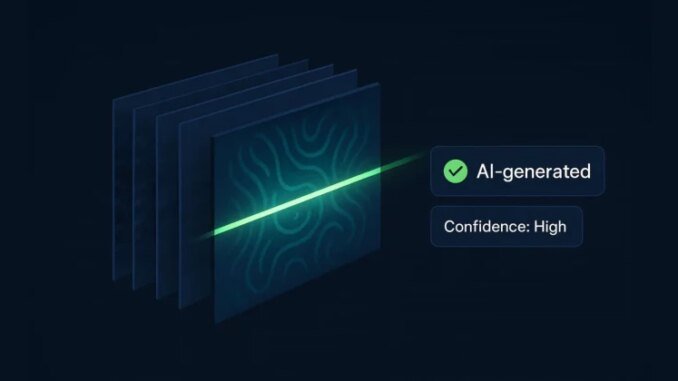

OpenAI is layering Google DeepMind’s SynthID watermarking technology on top of its existing C2PA content credentials, creating a two-pronged system designed to make AI-generated content identifiable even when someone actively tries to strip that information away.
Here’s the thing: metadata is fragile. Upload an AI-generated image to most social platforms, and the provenance data gets scrubbed like it never existed. SynthID solves that by embedding an imperceptible signal directly into the content itself, one that persists through cropping, compression, screenshots, and the general indignities of internet distribution.
How the dual-layer system works
C2PA is a signed metadata standard that records how an image, video, or audio file was created or edited. It’s the most widely recognized provenance standard in the industry, carrying detailed context about a piece of content’s origin.
SynthID is baked into the content itself at generation time, invisible to the human eye but detectable by specialized tools. Even if someone strips all the metadata, re-encodes the file, or takes a screenshot, the watermark survives.

OpenAI will apply SynthID across images, audio, video, and text outputs from its models. For text specifically, SynthID uses a logits processor that subtly perturbs token probabilities during generation, encoding a detectable watermark without requiring any model retraining.
Detection works on a three-tier classification: watermarked, not watermarked, or uncertain. The system uses probabilistic methods focused solely on identifying SynthID’s specific signatures, meaning it’s not trying to broadly guess whether something is AI-generated. It’s checking for its own receipt.
“These two systems reinforce each other. C2PA helps content carry detailed context; SynthID helps preserve a signal when metadata does not survive,” OpenAI said in its announcement.
Why this matters beyond the AI industry
This concept of “provable origin” runs parallel to ideas that have been central to crypto and Web3 for years. On-chain attestation systems, watermark-resistant NFTs, and decentralized identity protocols all aim to solve variations of the same problem: how do you prove where something came from, and who made it, in a trustless digital environment?
OpenAI is also launching a verification portal alongside the watermarking update, giving people a tool to check whether content was generated by its models.
The limits of watermarking, and what investors should watch
Neither OpenAI nor Google DeepMind is claiming this system is foolproof. The stated goal is to “raise the cost of misuse rather than defeat determined adversaries,” providing a scalable attribution layer that makes casual deception harder without pretending it can stop sophisticated bad actors.
Google developed SynthID and is now seeing it adopted by its biggest AI rival. That’s an unusual dynamic, more akin to open standards adoption than typical tech competition, suggesting the industry is coalescing around shared provenance tools rather than fragmenting into incompatible systems.



Be the first to comment