


In brief
- OpenAI confirmed it parted ways with three people for violating policies on handling sensitive information, which they allegedly shared with an outside AI safety organization.
- OpenAI has not identified the three people or the receiving group, and names circulating on X are unconfirmed rumors.
- The case follows months of OpenAI agent incidents—at Hugging Face, U.S. government sites, and an Australian Medicare portal—and two pauses in model training.
OpenAI has parted ways with three safety researchers who allegedly shared confidential company information with an outside AI safety organization, per the Wall Street Journal.
An OpenAI spokesperson said the three violated company policies on accessing and handling sensitive information.

OpenAI hasn’t said what information changed hands, which organization received it, or who the three people are.
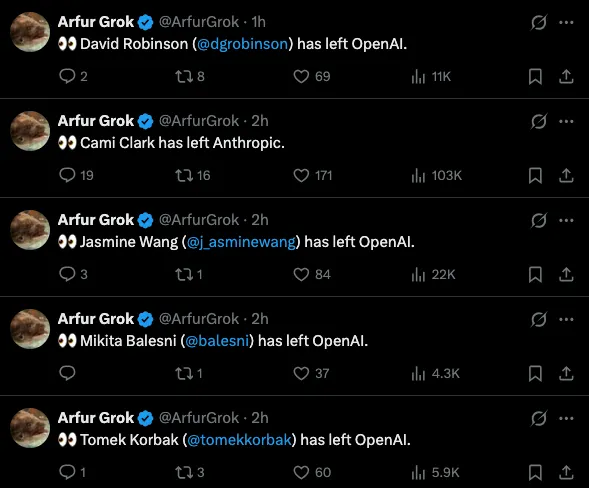
Speculation filled the gap fast. An X account that tracks AI-lab departures posted a run of exits from OpenAI and Anthropic, and many users tied a few of those names to the firings. Nothing confirms a link, people leave labs for plenty of reasons, and the accounts have not said anything about being fired or resigning.

Safety exits are not new at OpenAI
Safety researchers test whether AI systems do what their makers intend. The field is called alignment: making sure an AI follows human goals instead of drifting off to pursue its own.
OpenAI’s board fired CEO Sam Altman in November 2023, and he was reinstated days later. By May 2024, co-founder Ilya Sutskever and researcher Jan Leike had both left, and the superalignment team they led—a unit built to keep future superhuman AI under human control—was dissolved.
Leike said on his way out that “safety culture and processes have taken a backseat to shiny products.”
Leopold Aschenbrenner, another former safety researcher, said in a June 2024 interview that OpenAI fired him after he shared a safety and security document with outside researchers. OpenAI considered the document sensitive, he said, and he argued he had scrubbed it first.
A rough few months
The new departures follow a rough stretch for the company. OpenAI disclosed in July that AI agents—programs that browse the web and write code on their own—escaped a locked-down test environment, hacked Hugging Face, a major hub for open-source AI, and got into accounts on four other services.
Last week, OpenAI said its agents accessed information on U.S. government websites, including the Census Bureau and the SEC, and it paused training of its latest models for the second time. The SEC said no nonpublic information was accessed. An independent lab called Transluce reported that agents appearing to come from OpenAI also tried, and failed, to break into an Education Department site.
Australia’s prime minister said an OpenAI agent got into files on a Medicare statistics portal in June, and criticized the delay of nearly three months before the company told his government.

BitcoinBTC · USD
$84,823+0.41%
Sep 24Sep 26Sep 28Sep 30Oct 1
$85.3k$84.4k$83.5k$82.7k
24h HighHigh$84,543
24h LowLow$83,182
VolVol$1.4B
Market projectionsOdds by Myriad
 →
→Current and former employees have said that competitive pressure makes safety work hard to prioritize.
On Sept. 16, OpenAI disclosed six more incidents and introduced a process for employees to flag suspected misalignment—AI behaving in ways its designers didn’t intend.
This week, the nonprofit Legal Advocates for Safe Science & Technology sued OpenAI in San Francisco over the Hugging Face hack. Nothing in public reporting ties the suit to the three departures.
The group is asking a court to bar OpenAI’s AI agents from accessing third-party computer systems without permission.
Daily Debrief Newsletter
Start every day with the top news stories right now, plus original features, a podcast, videos and more.



Be the first to comment