

The launch of Open USD, the 140-plus company stablecoin consortium backed by Visa, Mastercard, Stripe, Coinbase, and BlackRock, drew a direct response from the person with a lot to lose.
Key Takeaways
- Circle CEO Jeremy Allaire publicly argued Open USD won’t dethrone USDC.
- He cites Artemis data putting USDC at 80% of on-chain dollar stablecoin volume.
- His sharpest point: consortium products have a “dismal” track record at scale.
- It’s the incumbent’s rebuttal, not neutral proof, and he has a clear stake.
Circle co-founder and CEO Jeremy Allaire, whose company issues USDC, laid out a methodical argument via post on X for why he isn’t worried, which is itself a signal that the launch registered as a genuine competitive event worth answering.
The Market Is Already Asking the Question
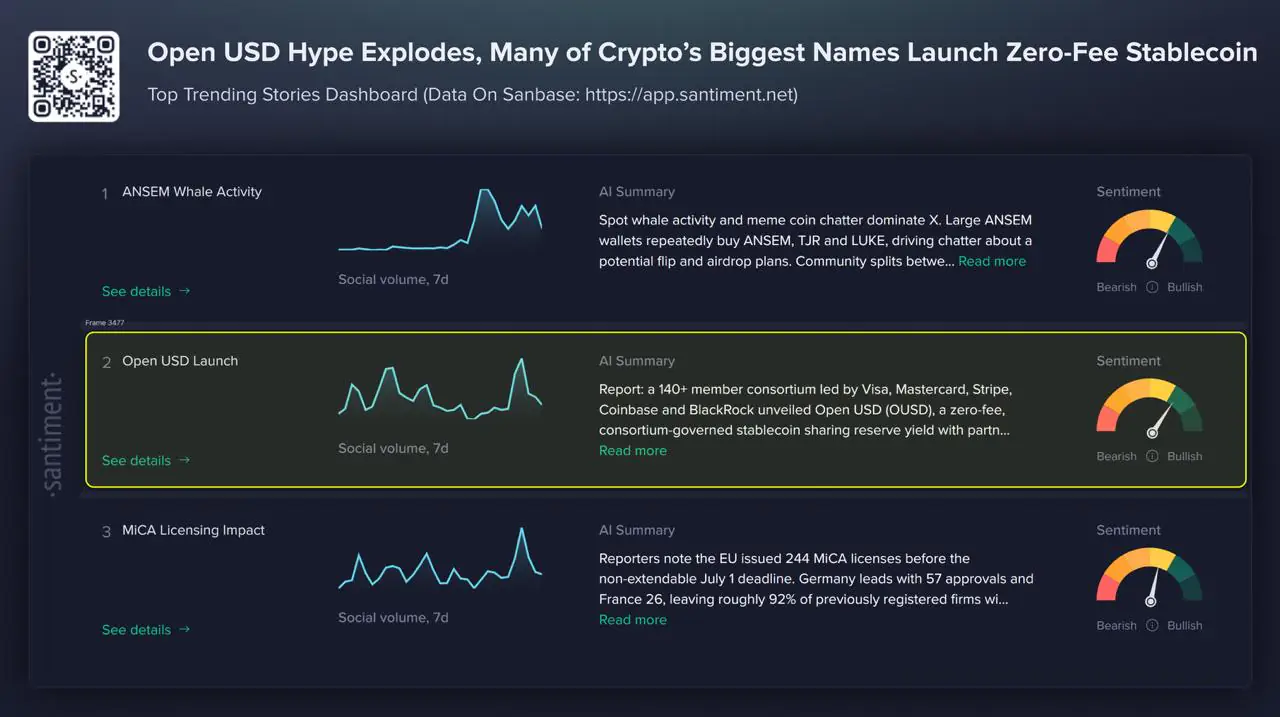
The timing tracks with the data. Per Santiment’s trending dashboard, the Open USD launch was one of crypto’s top trending stories, sitting alongside whale activity and MiCA licensing, with social volume spiking sharply and sentiment leaning mixed-to-bearish. The dashboard framed the open question plainly: whether another major stablecoin can truly compete with USDC and USDT. Allaire’s post is the incumbent’s direct answer to exactly that question, and the accurate read is that the market hasn’t resolved it, it has simply heard the market leader’s strongest case for why the answer is no.
His Core Argument: Stablecoins Are Winner-Take-Most
Allaire’s foundational claim is that stablecoin networks behave like internet platform utilities, tending toward winner-take-most market structures built over long periods. The strength, in his framing, isn’t the token but the number and range of applications integrated to it. Every developer integration compounds network effects, which drives currency demand, which reinforces liquidity, a loop he argues a new entrant can’t simply buy its way into with a big logo list. As he put it, stablecoin networks “tend towards winner-take-most market structures.”
The Market-Share Numbers
His hardest weapon is usage data. Citing third-party info from Artemis , Allaire states that in Q1 2026, USDC handled nearly $30 trillion in on-chain transactions, which he frames as “80% of all dollar stablecoin transactions on blockchains,” with USDT handling the remaining 20% and all other dollar stablecoins combined accounting for effectively zero, under half a percent. On the other hand Circle’s report declares USDC onchain transaction volume in Q1’26 of $21.5 trillion grew 263%. His point is that other stablecoins may have circulation, but real usage is minimal because they lack liquidity and network utility. These are his cited figures via Artemis, not independently verified here, and they are the incumbent’s strongest data point precisely because they measure usage rather than announcements.
The Liquidity Moat
Allaire extends that into a liquidity argument. He contends USDC is a top-three most liquid digital asset alongside Bitcoin and USDT, with liquidity falling off sharply after those three. The closest competing dollar stablecoins, in his telling, are roughly 10 times smaller, with liquidity concentrated in promotional order books on single exchanges rather than dispersed across dozens of venues the way USDC’s is. It’s a direct counter to Open USD’s implicit pitch that a coalition of large companies can manufacture liquidity: his claim is that liquidity is earned over a decade, not assembled by consortium.
We’ve had lots of questions from our investor community looking for thoughts on OUSD, and so I thought I’d share my direct views here for anyone.
Stablecoin networks are platform and network effect businesses that are established over a long period of time, tend towards…
— Jeremy Allaire – jerallaire.arc (@jerallaire) July 1, 2026
The Consortium Critique
This is his sharpest and most pointed argument, and it targets Open USD’s core differentiator directly. Allaire’s claim is that the track record of consortium products achieving scale, product-market fit, or basic agility is, in his words, “absolutely dismal.” Large groups of large companies, he argues, coordinate poorly, carry misaligned incentives, move slowly, and starve the venture out of self-interest. He notes Circle tried a consortium model in USDC’s early days, even with a small group, and hit endless complexity.
From there he makes a prediction: smaller, tighter commercial partnerships with a market leader will outcompete large consortiums, and the same firms lending their logos to Open USD will, in practice, direct their operating units to partner with USDC because that serves their customers best. It’s worth being precise that this is a forecast of how Open USD will struggle, not evidence that it has, but as a structural argument it’s his most persuasive, because it reframes Open USD’s main selling point, broad shared governance, as its main weakness.
His Rebuttals to Open USD’s Selling Points
Allaire also pre-empts Open USD’s three headline pitches:
- On “free mint and burn”: he argues the payments industry runs on small basis-point fees, and that a stablecoin with strong redemption facilities and no fees simply becomes the off-ramp for its competitors. Circle, he says, handles this through contractual mechanisms instead of blanket fee exemption.
- On “everybody shares the reserve income”: he counters that giving away all reserve income starves infrastructure investment, and that Circle already shares the majority of its income with distribution partners while retaining enough to keep investing.
- On shared governance: the consortium critique above.
The Diplomatic Close
Notably, Allaire doesn’t dismiss Open USD outright. He says Circle’s partnership with Coinbase “remains as strong as ever,” that Circle works closely with many Open USD founding members he expects will stay large USDC partners, and he welcomes Open USD “as a new member of the community.” Welcoming a competitor rather than attacking it is a posture only the market leader can afford, and it’s part of the message: confidence, not alarm.
The Honest Read
Allaire’s argument is strong precisely because it leans on the two things Open USD can’t replicate overnight: cited market-share dominance, 80% of on-chain dollar volume by his Artemis figures, and a decade of accumulated liquidity and regulatory licensing, including USDC’s availability across all of Europe and Japan. The consortium critique is his most compelling point because it’s structural rather than defensive.
But it should be read as the incumbent’s perspective, not settled fact. Allaire has an obvious interest in dismissing a competitor backed by Visa, Mastercard, and BlackRock. The Artemis figures are his citation, and the consortium critique, however well-argued, is a prediction about how Open USD fails, not proof that it will. The Santiment data captures the real market uncertainty his confidence is designed to counter. The honest conclusion is that the question, can a new consortium stablecoin challenge USDC, remains open. What Allaire has provided is the clearest version of the market leader’s case for why it can’t.
This article is for informational purposes only and does not constitute financial advice. Consult a professional before making investment decisions.

Kosta has reported on cryptocurrency markets and blockchain infrastructure since 2020, bringing over six years of hands-on experience in the crypto industry built through daily tracking of markets, trends, and emerging blockchain developments. Specializing in Bitcoin on-chain analysis, institutional ETF flows, and digital asset price action, his work at Coindoo has been cited by other news agencies and consistently covers market developments with a focus on data-driven reporting across Bitcoin, Ethereum, Solana, and XRP.
Over the years, Kosta has contributed to multiple crypto media outlets in different regions, authoring over 6,000 articles across the sector. His reporting spans cryptocurrency markets and the broader fintech industry, tracking not only price action but also the technological and regulatory forces shaping the ecosystem.
To support his analysis, Kosta actively leverages on-chain data and metrics from leading platforms such as Santiment, Glassnode, and CryptoQuant, enabling deeper, evidence-based market insights. He believes in the power of transparency and the data that underpins the blockchain ecosystem.
His academic background in Marketing Management from Denmark further complements his analytical approach, adding a strong understanding of communication strategy and content positioning to his work.


Be the first to comment