

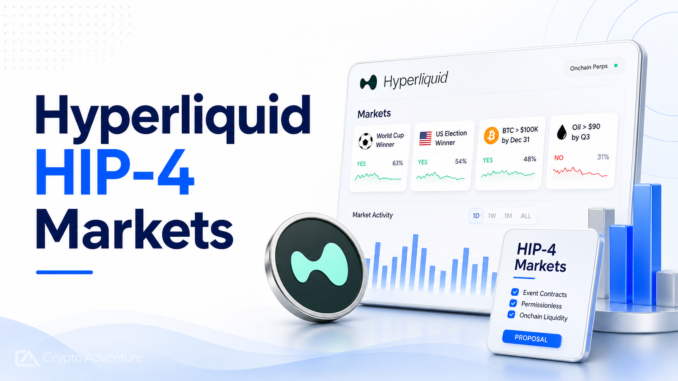

Hyperliquid HIP-4 At A Glance
| Category | Review |
|---|---|
| Product Type | Native outcome markets and prediction-style contracts on Hyperliquid |
| Core Use Case | Trading event outcomes, binary markets, and bounded payoff contracts |
| Settlement Asset | USDH for outcome market PnL settlement |
| Main Advantage | Outcome markets sit beside Hyperliquid spot and perps inside the same trading environment |
| Main Limitation | Limited-feature rollout, early liquidity, creator access, oracle risk, and regulatory uncertainty |
| Best Fit | Active Hyperliquid traders, market makers, builders, and advanced users who understand event-contract risk |
| Risk Level | High |
| Editorial Score | 8.3/10 |
What HIP-4 Is
Hyperliquid HIP-4 adds outcome markets to Hyperliquid, giving traders a way to buy and sell contracts tied to defined results rather than only spot tokens or perpetual futures. In simple terms, a YES/NO contract prices the market’s implied probability of an outcome, then settles inside a fixed range when the event resolves.
That makes HIP-4 closer to prediction markets and bounded options than normal perp trading. A perpetual futures position can keep running, use leverage, pay funding, and face liquidation. A HIP-4 outcome contract is fully collateralized, dated, nonlinear, and designed to avoid leverage-based liquidation. Hyperliquid’s limited-feature mainnet release started with a recurring binary BTC outcome that settles daily at 06:00 UTC against the BTC mark price on Hyperliquid.

The early product is deliberately narrow. That is the right decision. Outcome markets are not just another listing format. They need clean resolution rules, market integrity, pricing depth, settlement reliability, and user education. The first BTC daily binary market gives Hyperliquid a controlled way to test the primitive before broader event categories and market-deployer workflows expand.
How HIP-4 Works
HIP-4 outcome contracts sit inside Hyperliquid’s trading architecture rather than living as a separate consumer prediction app. Hyperliquid already runs fully on-chain spot and perp order books through HyperCore, where orders, trades, cancels, and liquidations execute on the L1 with one-block finality. The same order-book-first DNA matters because outcome contracts need tight spreads, fast fills, and market-maker participation to become useful.
The basic payoff is easy to understand. If a YES outcome token trades at 0.60, the market is pricing that outcome around 60%. If the event resolves YES, the token settles at 1. If it resolves NO, it settles at 0. The trader’s risk is the purchase cost, not an open-ended leveraged loss.
The deeper mechanism is more interesting. Outcome markets can create probability exposure that interacts with existing spot and perp positions. A trader long BTC perps could buy a NO outcome on a daily BTC level as a short-dated hedge. A trader expecting volatility around a macro event could use an outcome market for nonlinear exposure without using liquidation-prone leverage. That connects HIP-4 to the same decision path as spot vs perps, but with event-based payoff instead of continuous price exposure.
The Permissionless Market-Creation Angle
The most aggressive HIP-4 pitch is permissionless market creation. Polymarket has the consumer distribution and brand lead, but users cannot directly create their own markets; they can suggest ideas through the platform’s market-creation flow. HIP-4’s builder model is designed around a heavier but more open structure: a deployer stakes 1M HYPE to create outcome-market infrastructure, with the stake exposed to slashing if market operation attempts oracle manipulation or invalid state transitions.
That capital requirement is not small. It prevents spam and gives deployers skin in the game, but it also means HIP-4 is not “anyone creates any market” in a casual retail sense. It is permissionless for capitalized builders, market operators, and teams that can absorb the opportunity cost of locking HYPE. That is a better model for serious market infrastructure, but it may limit long-tail market experimentation unless staking pools, delegation, or builder partnerships emerge around the 1M HYPE hurdle.
This is the cleanest difference from Polymarket. Polymarket is curated and consumer-friendly. HIP-4 is more infrastructure-native. The former starts from distribution and market selection. The latter starts from trading architecture, collateral alignment, and deployer accountability.
Fees, USDH, And The Trading Flywheel
HIP-4’s fee design is one of its strongest user-facing hooks. Outcome token trading does not charge fees when opening positions, with fees applying when positions are closed or settled. That structure is meaningful for active traders because prediction markets often involve repeated entry, adjustment, and exit around changing information.
Polymarket’s fee model is more category-specific. Polymarket trading fees use taker fees calculated in USDC, with rates varying by category and share price, while makers can earn rebates in fee-enabled categories. That is not automatically worse, and Polymarket still has deep consumer liquidity in many markets. HIP-4’s advantage is that its fee logic can plug directly into Hyperliquid’s volume tiers, maker rebates, aligned quote assets, and existing trading habits.
USDH also matters. USDH-quoted markets receive lower taker fees, stronger maker rebates, and better volume contribution under Hyperliquid’s aligned quote asset framework. If HIP-4 volume grows, outcome trading could deepen USDH usage and make Hyperliquid less dependent on isolated perp activity. That is why zero-open-fee outcome tokens are more than a fee headline. They are part of a larger attempt to turn Hyperliquid into a broader financial execution layer.
Polymarket Comparison: Where HIP-4 Wins And Where It Does Not
HIP-4 has three clear advantages over Polymarket from a trader’s perspective. First, outcome markets live inside the same Hyperliquid account where active users already trade spot and perps. Second, the CLOB architecture is better suited to professional market makers than a lightweight consumer-only prediction experience. Third, outcome positions can be combined with existing derivatives strategies, especially for traders already thinking in terms of funding, hedging, and basis.
Polymarket still has advantages that HIP-4 should not be expected to erase quickly. It already owns mindshare in prediction markets, has deep coverage across politics, sports, crypto, culture, weather, economics, and live event narratives, and has built a user experience around browsing questions rather than managing a trading account. Its order lifecycle also combines off-chain order handling with on-chain settlement, which can feel fast enough for many users while hiding complexity.
HIP-4 is stronger as a trading primitive. Polymarket remains stronger as a mainstream prediction market destination. That distinction matters. Hyperliquid can win active traders before it wins casual forecasters.
Strengths
HIP-4’s strongest feature is composability inside Hyperliquid’s existing liquidity environment. The Hyperliquid trading stack already has active users, market makers, APIs, portfolio workflows, and perp-native traders. Adding outcome contracts to that base gives the product an immediate audience that understands risk, spread, order books, and position management.
The second strength is fully collateralized outcome exposure. Traders can still lose their entire stake in a wrong binary contract, but they do not face liquidation mechanics, hourly funding, or margin calls in the same way they do with perps. That makes HIP-4 a cleaner tool for fixed-result speculation, especially when the event has a defined expiry.
The third strength is market-operator alignment. The 1M HYPE stake requirement may reduce low-quality deployment and gives validators an enforcement path if a deployer damages market integrity. That does not remove oracle risk, but it does make malicious or careless market operation more expensive.
Weaknesses And Risks
The main weakness is early-stage scope. HIP-4 has moved to mainnet, but the rollout is still limited-feature. The first market is useful for proving mechanics, not for proving that Hyperliquid can immediately compete with Polymarket’s broad event catalog.
The second risk is oracle and settlement quality. Prediction markets live or die on clear questions, clean resolution sources, dispute handling, and user trust. A market can have perfect execution and still fail if the event wording is ambiguous or the resolution path creates controversy.
The third risk is regulatory exposure. Prediction markets can cross into gambling, derivatives, sports betting, politics, event contracts, or financial products depending on jurisdiction and market type. Hyperliquid’s permissionless architecture may make market creation more open, but it does not make every event category legally simple.
The fourth risk is trader behavior. Outcome contracts avoid liquidation, but they can still encourage high-frequency overbetting, thin-liquidity chasing, and poor probability pricing. The same users who get hurt by funding rates on perps can also lose money in outcomes if they mistake a displayed probability for fair value.
Verdict
Hyperliquid HIP-4 is one of the most important product expansions in the current perp DEX war because it moves prediction markets from a standalone app category into a professional on-chain trading environment. The product is not only trying to copy Polymarket. It is trying to make event contracts another native instrument beside spot and perps.
The review score is 8.3/10. The architecture, account-level composability, USDH alignment, fee design, and market-maker fit are strong. The score is not higher because the rollout is still early, public market creation remains capital-intensive, oracle governance will be tested only under real disputes, and broad consumer prediction-market liquidity still belongs elsewhere.
Conclusion
HIP-4 gives Hyperliquid a credible path beyond being only a perp DEX. It turns outcome markets into native trading instruments that can share wallets, collateral flows, APIs, order-book behavior, and trader attention with Hyperliquid’s existing markets.
The strongest case is not that HIP-4 instantly replaces Polymarket. The stronger case is that active traders may prefer outcome contracts inside the same high-performance environment where they already manage spot and perp exposure. If liquidity, market creation, and resolution quality improve over time, HIP-4 could become a serious on-chain prediction-market layer.
The risk is that prediction markets are harder than they look. Speed and fees matter, but clear event design, trusted settlement, legal caution, and sustained liquidity will decide whether HIP-4 becomes a durable product or just another bullish narrative attached to HYPE.



Be the first to comment