

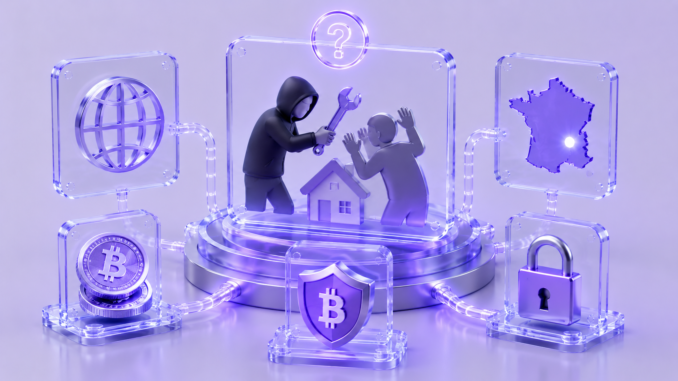
A crypto wrench attack is a physical coercion attack against a crypto holder. Instead of hacking a wallet, cracking encryption, or exploiting a smart contract, the attacker pressures the person who controls the funds. The target may be threatened, robbed, kidnapped, extorted, followed, or forced to unlock a device, reveal a seed phrase, sign a transaction, withdraw from an exchange, or transfer assets to an attacker-controlled address.
The name comes from the security idea that strong cryptography can be bypassed if an attacker uses physical force against the person holding the keys. In crypto, the risk is especially serious because transactions are usually irreversible, wallets can hold large value, and public information can make wealthy holders easier to identify.

A wrench attack is not a blockchain exploit. Bitcoin, Ethereum, Solana, or another network may keep working perfectly while a user loses funds because they were forced to cooperate. The attack targets the human layer: identity, location, habits, public boasting, custody setup, recovery material, and the ability to move funds under pressure.
This is why self-custody needs physical-security thinking. A broader guide to crypto self-custody helps explain the ownership model, but wrench attacks show the harsher side of direct control. If one person can move everything, one person can also become the pressure point.
Recent data suggests that France alone accounts for more than 70% of all reported crypto wrench attacks world wide.
Why Crypto Holders Face This Risk
Crypto creates a unique security problem because digital value can move quickly, across borders, and without bank-style reversal. A person who controls a wallet may control assets that are easier to transfer than cash, jewelry, real estate, or bank deposits. If an attacker can force a transaction, the funds may leave within minutes.
Public exposure increases the risk. Social media posts about profits, screenshots of balances, public wallet addresses, conference appearances, luxury purchases, influencer activity, and identifiable business roles can all make a person more visible. On-chain transparency can add another layer because public addresses may reveal balances, transaction history, NFT holdings, DeFi positions, and treasury movement.
Crypto wealth can also be misunderstood. A person may talk casually about holding Bitcoin, running a project, trading memecoins, or managing a DAO treasury. Others may assume that person can instantly access more money than they actually can. Even false assumptions can create physical risk.
A practical crypto wallet safety checklist should therefore include more than phishing and device security. It should also include privacy discipline, balance separation, travel habits, duress planning, and avoiding unnecessary public signals about wallet value.
How Crypto Wrench Attacks Work In Practice
A wrench attack usually follows a simple pattern. The attacker identifies a target, pressures the target physically or psychologically, and tries to force access to crypto. The access path can vary. The attacker may demand an exchange withdrawal, a wallet transfer, a hardware-wallet signature, a seed phrase, a phone unlock, a laptop login, or a transaction from a mobile wallet.
The exact method is less important than the pressure point. Crypto custody often depends on one or more secrets: passwords, seed phrases, hardware-wallet PINs, exchange logins, recovery codes, device unlocks, passphrases, or private keys. If the attacker believes the target can access those secrets, the attack becomes a human security failure rather than a technical one.
Attackers may also exploit urgency. A victim under threat may not think about withdrawal limits, multisig approval, timelocks, decoy balances, exchange holds, address verification, or legal reporting. The attacker wants fast movement before the victim can alert anyone or trigger controls.
A strong custody setup reduces what one person can do under pressure. If a wallet requires multiple independent approvals, time delays, or institutional controls, a single coerced user may not be able to move all funds immediately. That does not remove danger, but it reduces the value of forcing one person to act alone.
Why Single-Key Wallets Create A Bigger Target
A single-key wallet is simple. One seed phrase, private key, device, or wallet account can control the funds. This is convenient, but it also creates a single point of failure. If one person knows the recovery phrase or can unlock the signing device, that person becomes the entire security perimeter.
Single-key self-custody may be acceptable for small balances, daily spending, or learning. It becomes more dangerous as value grows. A user with large holdings in one hot wallet, one hardware wallet, or one exchange account has made the attacker’s goal easier. The attacker does not need to understand the whole portfolio. They only need to pressure the one person who can move it.
Hardware wallets still help because they reduce remote key theft, but they do not solve coercion by themselves. A hardware wallet can protect private keys from malware while still allowing a person to sign a transaction under pressure. The most common hardware wallet mistakes involve digital seed exposure, unsafe sourcing, and careless signing, but physical coercion adds another layer: the user may be forced to use the device correctly for the attacker’s benefit.
Large balances need a stronger model than one device and one memory-backed secret. They need separation, policy, and limits.
Multisig And Shared Control As A Defense
Multisig wallets reduce single-person failure by requiring more than one approval before funds move. A 2-of-3 setup might require two keys from three independent signers. A 3-of-5 setup might require three approvals from five signers. This structure can protect families, founders, treasuries, high-net-worth holders, and businesses because one compromised or coerced signer cannot move the full balance alone.
Multisig works best when signers are independent and keys are stored in separate locations. If all signers live together, travel together, keep devices in the same safe, or use the same email and phone recovery, the setup is weaker than it looks. Multisig is not only a wallet feature. It is an operating procedure.
A guide to best multisig wallets is useful because different tools fit different needs. Bitcoin holders may prioritize air-gapped signing and coin-control discipline. Ethereum teams may use smart contract wallets for treasury operations. Businesses may need role-based approvals, audit trails, and signer rotation.
Multisig also creates a safer answer during coercion. A signer can truthfully lack the ability to move the entire balance alone. That does not make the situation safe, and personal safety must come first, but it lowers the reward for targeting one person.
Seed Phrase Safety And Physical Storage
Seed phrases are especially sensitive in wrench-attack scenarios because they can restore wallet access anywhere. A hardware wallet can be hidden, destroyed, or wiped, but a stolen seed phrase can recreate the wallet on another device. Anyone who controls the correct recovery words can usually control the funds.
The safest storage plan protects against both theft and loss. A phrase stored in one obvious home safe may be easy to target. A phrase split carelessly across locations may become impossible to recover. A phrase stored digitally may be stolen remotely before physical security even matters.
A strong seed phrase safety process should consider who knows the storage location, whether the phrase is visible during emergencies, whether heirs can recover funds, whether a thief can use one item alone, and whether backups survive fire, water, moving, renovation, travel, or family confusion.
Users should also avoid telling others where recovery material is stored. A backup location can become a target if too many people know it. Operational privacy matters as much as metal backups or safes.
Duress Wallets, Decoy Balances, And Self-Destruct Features
Some wallets support duress or decoy concepts. A user may have a small visible balance, a hidden wallet behind an additional passphrase, or device behavior that wipes local access after repeated failed attempts. These features can help in narrow situations, but they can also create dangerous false confidence if the user does not understand exactly how they work.
A duress wallet is not a magic shield. If an attacker already knows or believes the user controls more funds, a small decoy balance may not end the pressure. A self-destruct or wipe feature can protect local wallet data if a device is stolen, but it does not help if the attacker already has the seed phrase. It can also lock out the real owner if backups are weak.
A guide to self-destruct features on crypto wallets helps separate realistic device protection from myths. These features belong inside a wider plan that includes multisig, balance separation, safe backups, and emergency procedures.
Users should test advanced wallet features with small amounts before relying on them. A feature that is misunderstood can become a self-inflicted loss.
Privacy Habits That Reduce Targeting Risk
The best wrench-attack defense often starts before any threat appears. Avoid becoming an obvious target. Do not post wallet screenshots, exact portfolio sizes, home office setups, private keys, recovery setups, luxury signals tied to crypto profits, or public wallet addresses connected to personal identity. Avoid making casual comments that imply immediate access to large liquid balances.
Address privacy matters too. If a public wallet shows large holdings, the person connected to that wallet may become a target. Founders, influencers, traders, NFT collectors, DAO signers, and public treasury managers should be especially careful about linking personal identity to wallets that reveal value.
Privacy wallets can reduce some on-chain visibility, but they cannot hide every metadata leak or public behavior mistake. A user who posts a wallet address in a profile, withdraws from a KYC exchange, and then shares balance screenshots has already weakened privacy before any wallet tool can help.
The safer habit is to separate identities, accounts, devices, wallet roles, and public communication. A public business wallet, private long-term storage wallet, trading wallet, and spending wallet should not all point to the same identity when avoidable.
Exchange Custody Vs Self-Custody In Wrench-Attack Risk
Exchange custody and self-custody create different physical-risk profiles. An exchange account may have withdrawal limits, account reviews, whitelists, security holds, identity checks, and customer support. Those controls can slow forced withdrawals, but the user still faces risk if an attacker can force login access or account changes.
Self-custody gives more direct control, which can be safer against platform failure but more dangerous under coercion if one person can move everything instantly. The right choice depends on balance size, user skill, threat model, jurisdiction, privacy needs, and recovery planning.
A guide on whether to keep Bitcoin on an exchange or in a wallet fits this decision because custody is not only about fees or convenience. Physical coercion risk changes the answer for people with public profiles, concentrated wealth, or family-security concerns.
A split setup is often stronger. Keep trading balances on reputable exchanges, small spending balances in hot wallets, long-term assets in cold storage, and larger reserves behind multisig or institutional custody. No single location should expose everything.
Practical Protection Checklist
A wrench-attack plan should reduce exposure, reduce single-person control, and reduce instant transfer ability. It should also protect the person first. Crypto is not worth physical harm, and users should prioritize personal safety in any real threat situation.
| Protection Layer | Practical Goal |
|---|---|
| Balance Separation | Keep spending, trading, and long-term funds in different wallets or accounts |
| Multisig | Prevent one coerced person from moving the full balance alone |
| Withdrawal Limits | Slow down forced exchange withdrawals where possible |
| Address Privacy | Avoid linking personal identity to high-value wallets |
| Seed Phrase Control | Store recovery material so one discovery does not expose everything |
| Hardware Wallet Discipline | Verify device screens and keep long-term wallets away from daily activity |
| Travel Wallet | Carry only small balances when traveling or attending public events |
| Emergency Contacts | Make sure trusted people know how to respond without exposing keys |
| Public Silence | Avoid sharing portfolio size, security setup, or wallet addresses unnecessarily |
The best plan is boring and layered. A user should not rely on one dramatic feature. They should reduce attention, reduce accessible value, reduce instant control, and keep recovery realistic.
What To Do If Threatened Or Targeted
Personal safety comes first. If someone is under immediate physical threat, avoiding harm matters more than protecting coins. After the threat passes, the victim should contact local law enforcement, preserve evidence, document wallet addresses, record transaction hashes, notify exchanges if funds moved toward identifiable platforms, and rotate any potentially exposed credentials or keys.
If a seed phrase was exposed, remaining funds should move to a new secure wallet as soon as it is safe to do so. If an exchange account was compromised, the user should lock the account, change passwords, revoke sessions, update 2FA, check withdrawal addresses, and contact support. If a hardware wallet was stolen but the recovery phrase remains safe, funds may still be recoverable to a new device, depending on whether the attacker knows the PIN or passphrase.
Victims should avoid fake recovery agents. After public losses, scammers often appear with promises to recover funds for upfront fees. Real investigation can trace funds and help prepare reports, but nobody needs a seed phrase, private key, or random wallet signature to begin a legitimate tracing process.
Conclusion
A crypto wrench attack is a physical or coercive attack against the person who controls crypto, rather than a technical attack against the blockchain. It works because crypto wealth can be liquid, irreversible, and controlled by keys that may sit with one user, one device, or one recovery phrase.
The strongest defense is layered custody. Reduce public exposure, separate balances, use multisig for serious holdings, protect seed phrases carefully, avoid linking identity to high-value wallets, set withdrawal friction where possible, and keep only small balances in daily-use wallets. Hardware wallets, privacy tools, duress features, and self-destruct settings can help, but only when they sit inside a realistic operational plan.
Crypto security is not only about stopping hackers. It is also about making sure no single person, device, phrase, or account can become an easy physical target. A safer setup protects funds while also reducing the chance that the holder becomes the weakest point in the system.



Be the first to comment