


What to know:
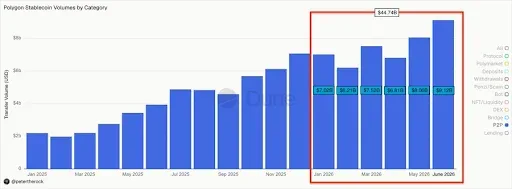
- Polygon processed a record $9.12 billion in peer-to-peer stablecoin transfers in June, pushing first-half 2026 volume to $44.74 billion.
- Growing direct user transactions highlight Polygon’s increasing role as a payments-focused blockchain rather than only a DeFi network.
- Analyst Globe of Crypto says POL is approaching a key falling wedge breakout, with a successful move potentially targeting a 70%–80% recovery.

Polygon is showing stronger signs of real-world blockchain usage after recording its highest-ever monthly peer-to-peer stablecoin transfer volume. According to Polygon Foundation CEO Sandeep Nailwal, users transferred $9.12 billion worth of stablecoins directly between wallets in June, marking a new record for the network.
The highlight of Polygon’s journey is that it has made significant headway in making real-world payments, rather than merely trading. The first half of 2026 was when the highest volume of P2P stablecoin transactions occurred on the network, totaling $44.74 billion.
Also Read: XRP Price Nears Decision Zone as $1.20 Breakout Test Looms

Why Stablecoin Growth Matters for Polygon’s Future
Stablecoins are turning out to be one of the use cases of cryptocurrencies. Stablecoins make it possible to transfer dollars very quickly without the involvement of traditional banking systems.
There have been increasing instances of activities related to stablecoins on the Polygon platform, indicating that it may be a suitable settlement layer for businesses and payments.
Consistent Growth Shows Rising Network Adoption
Growth in Polygon’s data on its stablecoins has been slow and not due to any single major market event. From around $2.1 billion in monthly transfer volume in January 2025 to $9.12 billion in June 2026, there is more than a fourfold increase.

Source: X
Throughout the first six months of 2026, Polygon remained highly active despite a slight decline in activity in every consecutive month.
The volume of stablecoins that have been transferred via Polygon was $7.02 billion in January, $6.21 billion in February, $7.52 billion in March, $6.81 billion in April, $8.06 billion in May, and hit a new peak at $9.30 billion in June.
Such dynamics clearly indicate an increasing demand for this service among users, rather than a short-lived spike in activity.
POL Price Faces Critical Technical Test
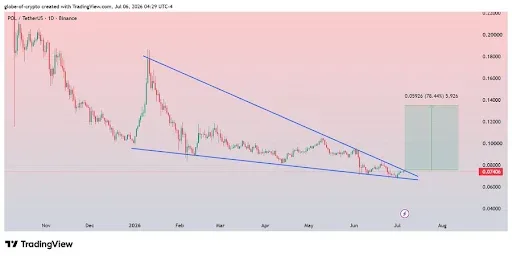
Even though Polygon’s network performance continues to improve, its coin, POL, is struggling to find support and break free from the downtrend it’s in. As mentioned by Globe Of Crypto, the daily chart of POL has been encountering resistance within a massive falling wedge formation.

Source: X
This has occurred despite months of lower lows and lower highs, indicating the presence of selling but also weak bearish momentum. POL has tried to remain constant around the area of $0.074.
According to the analyst’s chart analysis, an upside breakout from the resistance level of the ascending wedge may trigger an expected recovery by approximately 70%-80% to the price of $0.133-$0.135; however, this breakout requires confirmation. In case of low buying interest, POL will likely reject and retrace to $0.068-$0.070.
What Happens Next for Polygon and POL?
The future for Polygon depends on the potential that increased use of stablecoins can bring growth to the ecosystem and enable POL to reverse its prolonged downtrend.
If payments become mainstream, then Polygon has the potential to become involved in practical applications of blockchain technology. The price for POL will be influenced by demand and trading volume.
This article contains market analysis and price predictions. These are not guarantees. Crypto markets are volatile. Always DYOR. Not financial advice.
Also Read: Strategy Sells 3,588 Bitcoin Worth $216M to Fund Digital Credit Dividend Payments



Be the first to comment