



Polygon revenues have been over $1.3 million within the last 30 days, revealing the emergence of more economic activity within its proof-of-stake chain. Even though the amount is rather insignificant in comparison with the fees that are collected by Ethereum, Polygon’s business strategy implies huge transaction processing at reduced user costs.
Data collected by various blockchain data providers demonstrate even greater revenues from Polygon. DeFiLlama has been reporting approximately $2.15 million during a recent 30-day period, while Token Terminal has recorded $1.7 million of monthly revenue in August 2026 and $2.6 million in July.
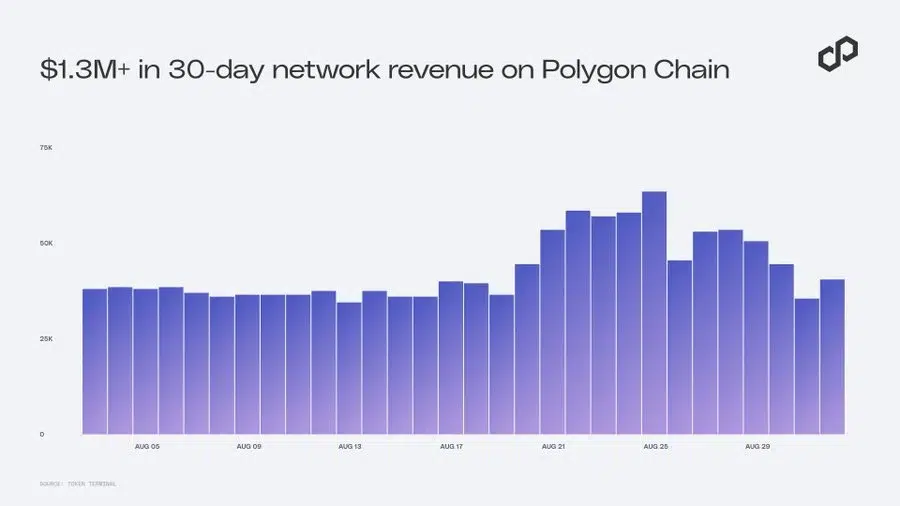
However, the disparity results from the way that each of these platforms measures the network revenue. But from the numbers, there is one pattern: Polygon is earning revenue through network activity.
Also Read | SUI Price Eyes $1 Rally as Kravata Brings Stablecoin Infrastructure to Sui

Polygon Revenue Grows Through High Transaction Volume
Transactions processed by Polygon range from 5 million to 6 million daily transactions, implying that the number of transactions is one of the core parameters in Polygon’s network model.
Up to the beginning of September 2026, Polygon PoS processed over 1.83 billion transactions during the current year. Transactions produced about $24.7 million in fees.
The main difference between Polygon and other blockchains lies in the fact that Polygon does not make money through expensive transactions but seeks to make money on many cheap transactions.
POL Burn Adds Another Layer to Polygon’s Model
There is also an inherent connection between the network activities and the POL token by Polygon.
All base transaction fees on the network are burned, which means that when people transfer stablecoins or mint NFTs and use DeFi applications, the base transaction fee of their transactions is burned away from the total supply of POL tokens.
With about $24.7 million in fees earned this year, the burning mechanism of Polygon has become a significant factor for its tokenomics.
The more transactions that take place on the network, the more money could be made due to the higher transaction costs and, at the same time, the lower number of available POL tokens.
Polygon Pushes Further Into Crypto Payments
Polygon Labs is also widening its scope from blockchain infrastructure to include payments and adoption into the mainstream.
This company made acquisitions in the form of Coinme and Sequence, which cost around $250 million in total. Coinme has crypto ATMs and cash-to-crypto infrastructure, whereas Sequence offers wallet solutions and development tools that make blockchain applications easier.
There are stablecoins, which are another key element of the ecosystem. The amount of stablecoins circulating on the platform has now exceeded three billion dollars.
Stablecoins may be utilized for purposes such as remittance, payroll, international transfers, or online commerce. In light of their increasing use cases, Polygon could benefit from the fact that it is capable of handling large volumes of transactions at fairly low costs.
In general, the Polygon revenue stream is consistent with a scale-based business model. The platform does not rely on large fees paid by users individually. It tries to use low transaction fees, activity, stablecoin utilization, and POL token burns to generate value over time.
Also Read | CAKE Price Prediction: Falling Wedge Sets Up Potential Rally to $2.30


Be the first to comment