

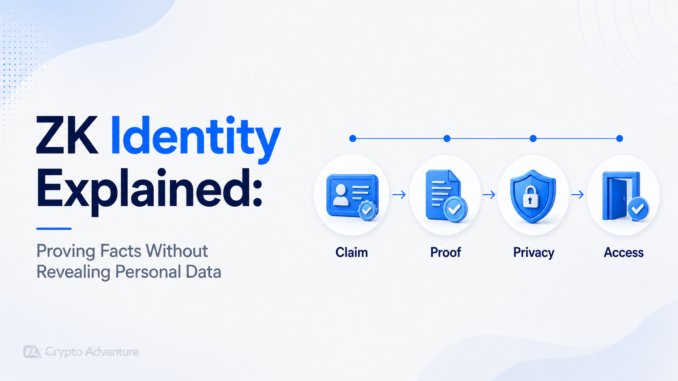
ZK identity uses zero-knowledge proofs to verify something about a person or account without revealing the underlying personal data. The user proves a fact, while the verifier receives only the result needed for the interaction.
That is different from normal identity checks. A standard KYC process may collect name, address, date of birth, passport details, biometric information, proof of residence, and other documents. Even when only one fact is needed, the user often hands over far more data than necessary. ZK identity changes the model by making the proof narrower than the document.

A user may prove they are over 18 without revealing their exact birthday. They may prove they are a unique human without revealing their name. They may prove they belong to an approved group without revealing which member they are. They may prove they passed a check without exposing the full identity file behind it.
That is the core promise: verification without unnecessary disclosure.
Why Crypto Needs Better Identity
Crypto has always had an identity tension. Public wallets make activity traceable, but wallet addresses do not prove who controls them. That creates problems for airdrops, voting, compliance, fraud prevention, sybil resistance, private access, undercollateralized credit, DAO governance, and regulated financial activity.
The usual answer has been KYC. That works for custodial platforms and regulated businesses, but it brings heavy privacy trade-offs. Users give sensitive data to centralized providers, who then become targets for hacks, leaks, misuse, and surveillance. Once identity data is exposed, it cannot be rotated like a wallet address.
ZK identity gives crypto a better middle ground. It lets applications verify limited facts without forcing users to reveal full identity packages. That can improve compliance, governance, and user safety without turning every wallet into a public passport.
How Zero-Knowledge Proofs Fit
A zero-knowledge proof allows one party to prove that a statement is true without revealing why it is true. In identity, the statement could be “this user is in an approved group,” “this user is not already registered,” “this user is over a required age,” or “this user has a credential from a trusted issuer.”
The raw credential stays hidden. The verifier checks the proof. The application gets the assurance it needs without collecting more information than the use case requires.
Semaphore is one of the clearest examples of this pattern. Users can prove group membership and signal once, such as voting or endorsing, without revealing which group member they are. The design also prevents double-signaling, which matters for private voting, anonymous feedback, sybil-resistant claims, and DAO participation.
World ID uses zero-knowledge proofs to let users prove humanity and uniqueness without sharing personal information with the application requesting the proof. That model shows how ZK identity can support bot resistance, access control, and proof-of-personhood without exposing every identity attribute.
The Main ZK Identity Use Cases
ZK identity is useful when an application needs assurance, not full identity exposure. The strongest use cases include proof of humanity, age verification, residency checks, credential-based access, private voting, one-person-one-claim airdrops, compliance screening, reputation, DAO permissions, and event access.
In crypto, sybil resistance is especially important. A project may want to limit one airdrop claim per real user without collecting passports from everyone. A DAO may want private voting where only eligible members can vote once. A private DeFi protocol may want users to prove they are not on a restricted list without publishing their wallet history.
This is where ZK identity overlaps with crypto self-custody. Users can keep control of wallets and credentials while revealing only the facts needed for a specific action.
Selective Disclosure Vs Full Disclosure
Traditional identity verification often defaults to full disclosure. The user hands over documents, and the platform stores or processes the data. Selective disclosure is different. It reveals only the required attribute.
For example, a user entering an age-restricted crypto app may not need to reveal name, address, passport number, or exact birthdate. The app may only need proof that the user meets the age threshold. A lending platform may need proof of accreditation or jurisdiction eligibility without storing every supporting document.
This does not remove trust entirely. The system still needs credential issuers, proof standards, revocation rules, wallet security, and verifier logic. But it reduces the amount of sensitive data exposed during each interaction.
That reduction matters because identity data creates long-term risk. A leaked email can be changed. A leaked passport, biometric template, or government ID is much harder to replace.
ZK Identity And Compliance
ZK identity can help compliance become more proportional. Regulated businesses may need to verify sanctions status, residency, age, source of funds, accredited-investor status, or customer eligibility. The question is whether they need to store every underlying detail for every interaction.
In some cases, laws or internal controls may still require full KYC records. ZK identity does not erase those obligations. It can, however, reduce repeated disclosure. A trusted issuer can perform the detailed check once, then issue a credential that lets the user prove narrow facts across compatible applications.
This could be useful for DeFi, tokenized assets, private stablecoin payments, gated markets, and compliant self-custody flows. The same broader role played by crypto audit and KYC providers may evolve toward systems that verify more while exposing less.
Risks And Limits
ZK identity still has serious limitations. A proof is only as trustworthy as the credential behind it. If the issuer is weak, corrupt, compromised, or careless, the proof can validate poor data. If revocation is not handled properly, expired or fraudulent credentials may keep working. If wallet security fails, a credential can be misused.
There are also privacy footguns. A proof can be mathematically private while the surrounding app leaks metadata. IP addresses, wallet reuse, timing, device fingerprints, analytics scripts, and repeated identifiers can still connect activity. ZK proofs protect a specific statement. They do not automatically make the full user journey private.
Biometric identity systems require extra caution. Proving uniqueness can help fight bots, but biometric collection raises sensitive-data, consent, exclusion, and governance concerns. Users and developers should separate the cryptographic proof from the entire identity lifecycle.
What Good ZK Identity Should Look Like
A strong ZK identity system should collect as little data as possible, reveal only what is necessary, prevent linkability across apps when possible, support credential revocation, protect against double-use where needed, and make the user experience understandable.
It should also minimize centralization. If one issuer, registry, app, or hardware provider can control access to the identity layer, the privacy benefit may come with a new gatekeeper. The best systems will combine privacy, portability, user control, and clear recovery paths.
Security matters as much as cryptography. Credential contracts, issuer systems, wallets, proof verification, and front ends all need careful review. Broader smart contract audit discipline remains important because a flawed identity system can damage users even if the ZK concept is sound.
Conclusion
ZK identity lets users prove facts without exposing full personal data. That makes it one of the most important privacy tools for crypto, where applications need better sybil resistance, compliance, access control, governance, and user protection.
The strongest use cases are narrow and specific: prove uniqueness, age, group membership, eligibility, or non-duplication without turning every interaction into a full identity handover. That is a better fit for digital finance than forcing users to disclose complete identity files whenever a platform needs one small fact.
ZK identity is not magic. It still depends on issuers, wallets, revocation, app design, metadata protection, and law. Used carefully, it can make crypto more usable and more privacy-preserving at the same time.



Be the first to comment