

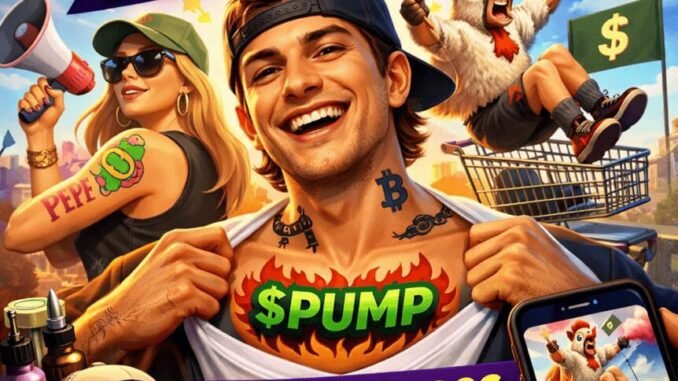

Solana-based memecoin launchpad Pump.fun has unveiled an open bounty platform that pays crypto rewards for promotional tasks—ranging from jaw-dropping stunts to deeply controversial acts. The system operates with funds escrowed and submitted tasks reviewed by Pump.fun, with payouts released only if a submission passes review and is accepted.
Among the most eye-catching bounties are a $57,000 offer to skydive into a World Cup match as a memecoin mascot, and a $25,000 bounty to interview the family of Henry Nowak’s killer. There’s also a $3,000 incentive to quit one’s job live on camera. The platform’s ledger at the time of reporting showed an unclaimed pool of about $115,000 across 225 live bounties and 509 total submissions, indicating both high interest and a crowded field of proposals.
Open bounties on Pump.fun are listed with expiration dates, detailed deliverables, and the ability for participants to submit attempts. Users can sort by reward, remaining time, or the number of submissions to gauge popularity and urgency. When a task is accepted, the payout is disbursed to the submitting participant, with funds held in escrow during review.
However, the platform’s ambitious scope has raised questions about moderation, safety, and potential legal exposure. Critics have pointed to the risk that some tasks could be exploitative or harmful, underscoring the need for robust safeguards and clear boundaries around acceptable conduct. In its Terms and Conditions, Pump.fun notes that bounties deemed spam by the platform’s hosting environment may be disallowed, signaling an attempt to curb reckless or abusive use of the system.

“This is a horrible market. It’s like playing with poor people’s lives and paying them to entertain you.”
That sentiment was echoed by observers on social media, who warned that the platform could resemble a modern, crypto-flavored variant of contestants’ stunts from reality shows. Another commentator drew a parallel to dystopian tropes, noting the stark power imbalance between high-stakes promotions and participants willing to take on risky or degrading tasks for a payout.
As Pump.fun frames it, the platform exists to channel human energy and financial rewards across a global network, enabling participants to pursue bounties for virtually any deliverable. Open listings include tasks with captions and explicit deliverables, requiring video proof or other verifiable evidence to qualify for payment. The open-bounty model relies on a blend of creator trust, platform oversight, and escrowed funding to mitigate risk and ensure accountability.
Platform listings show the breadth of creative possibilities—and risks. One task offers a $3,572 bounty to spray-paint the ticker symbol “$memecoin” on a car and ignite it, provided the participant dons a memecoin mascot and documents the entire process. Another listing proposes a $2,630 bounty for tattooing the ticker symbol “$boutywork” on a participant’s forehead, with a video proof requirement. Each bounty is structured with a deadline, deliverables, and a payout condition if approved by Pump.fun’s review process.
At present, Pump.fun’s bounty pool is far from empty, but a sizable portion remains unclaimed. The platform’s public view shows $115,000 in unclaimed rewards while listing 225 live bounties and 509 submissions from participants. The sheer scale of interest illustrates how quickly meme economies can incubate incentive campaigns when combined with crypto funding and a streamlined escrow workflow.
Key takeaways
- Pump.fun has launched an open bounty marketplace on Solana that pays crypto rewards for promotional tasks, with funds held in escrow and reviewed by the platform.
- High-profile bounties include a $57,000 skydiving stunt into a World Cup match and a $25,000 interview with the family of a killer—highlighting the platform’s willingness to fund extreme promotional acts.
- As of reporting, there is about $115,000 unclaimed across 225 active bounties and 509 total submissions, signaling strong participant interest but ongoing liquidity concerns for some tasks.
- Moderation and safety concerns persist, with Terms indicating that bounties deemed spam by social platforms may be disallowed and critics warning about potential exploitation or legal exposure.
- The marketplace illustrates a broader dynamic: meme-driven incentives can rapidly mobilize large-scale marketing stunts, but the ethical and regulatory implications remain unsettled.
A new marketplace for memecoin stunts
Pump.fun positions the platform as an open marketplace to “complete bounties for ANY task and leverage the power of humans & money across the globe.” Submissions are reviewed by Pump.fun, and funds stay in escrow until a bounty is accepted and paid out. This model aims to provide a structured pathway for creative marketing while preserving a check on submissions through defined deliverables and expiration windows. In its Terms, the company makes clear that tasks that may constitute spam on other networks are not allowed, signaling an intent to set some boundaries around the kinds of stunts allowed on the platform.
Notable listings and what they reveal about incentive design
Several listed bounties underscore the carnival-like quality of crypto marketing, but also the potential for harm. A task offering $3,572 encourages painting a car with the ticker symbol for a memecoin and then setting it on fire, with the participant required to wear a memecoin mascot and film the process. A separate offer of $2,630 seeks participants willing to tattoo the ticker “$boutywork” on their foreheads, accompanied by video proof. Each task has a defined deadline and deliverables, and all are subject to Pump.fun’s review and escrow-based payout model.
Beyond these spectacle-driven promotions, other high-value listings reveal a more provocative edge. The $25,000 bounty to interview the family of Henry Nowak’s killer is a stark example of how meme-driven campaigns can intersect with real-world narratives, raising questions about consent, privacy, and the line between marketing and sensationalism. These listings illustrate how the platform acts as a rapid-launchpad for creative, if controversial, promotional campaigns that leverage crypto as a payoff mechanism.
Community responses have been mixed. Some users criticize the platform for wagering with vulnerable participants—calling it an extreme form of entertainment economics—while others see it as a new front in the evolution of meme-driven marketing and incentive design. For now, Pump.fun’s escrow-backed framework and explicit deliverables provide a level of guardrails that could help distinguish legitimate campaigns from reckless stunts, but the long-term viability will hinge on how well safety, consent, and legal risk are managed as the catalog of tasks grows.
“This is a horrible market. It’s like playing with poor people’s lives and paying them to entertain you.”
Meanwhile, other comments captured the surreal nature of the platform’s offerings. “Yep, reminds me of Squid Game,” one observer remarked, underscoring the sensational vibe that such bounty listings have cultivated within crypto communities. Whether these reactions signal skepticism or curiosity, they reflect a broader tension between provocative marketing and responsible promotion in a space where incentives are amplified by cryptocurrency rewards.
As with any new incentive system, the key questions will revolve around moderation, safety, and the legal environment. Pump.fun’s Terms explicitly aim to filter out spam and ensure that tasks meet acceptable standards, but observers will be watching to see how these rules are enforced as the bounty pool scales and as more users participate with diverse risk appetites.
For investors and builders, the platform’s emergence signals a broader trend: meme-powered incentive models can accelerate marketing reach far beyond traditional channels, often at a rapid pace. Yet the authenticity and sustainability of such campaigns will ultimately depend on governance, participant protection, and clear boundaries around what constitutes acceptable promotional activity in different jurisdictions.
Source: Pump.fun
Related coverage: South Korea police probes Polymarket users over illegal gambling claims, illustrating how regulatory scrutiny looms over crypto-backed promotional activities and prediction markets.


Be the first to comment