

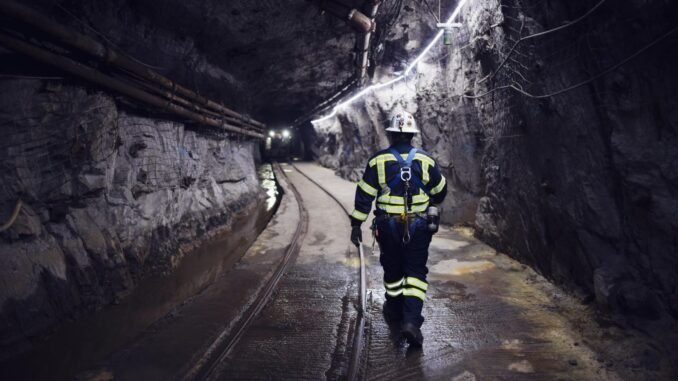


A worker at the Resolution Copper mine inspects an underground tunnel.
Rio Tinto
As artificial intelligence reshapes the global economy and electrification accelerates, copper’s status as the foundational metal of the 21st century becomes magnified. Demand is surging, yet domestic U.S. supply continues to lags after decades of stagnation. Resolution Copper – a joint project by major mining companies Rio Tinto and BHP – in Arizona offers a rare, high-impact solution: one of the world’s largest undeveloped copper deposits with the potential to deliver up to 25% of current U.S. copper needs while creating thousands of jobs and enhancing national security.
Vicky Peacey, President of Resolution Copper, captures the project’s strategic value, calling it “a rare combination of geology, location and national need. It is one of the largest undeveloped copper resources in the world, located in a historic mining district in Arizona.” Resolution is a brownfield redevelopment in the heart of Arizona’s Copper Triangle which is set to build on a century of responsible mining heritage.
Resolution Copper President Vicky Peacey delivers keynote address at AEPA Event.
Rio Tinto
Copper: An Economic and Strategic Imperative
At full production, Resolution could yield more than 40 billion pounds of copper over decades, along with critical co-products including molybdenum, silver, tellurium, indium, and bismuth. Economically, it promises to add roughly $1 billion to $1.2 billion annually to Arizona’s economy, supporting about 3,700 jobs with $270 million in combined annual compensation. Local hiring is already strong: approximately 90% of the current workforce lives within 40 miles of the site.
These figures matter in a region which has long served as a home to the mining industry. Over a 60-year lifespan, studies project up to $61 billion in total economic value for Arizona through wages, taxes, and local spending.

Global copper demand is projected to climb from around 28 million metric tons today to 42 million by 2040, a nearly 50% increase driven by demand from AI/data centers, electric vehicles, renewables, grid expansion, and defense needs.
Data centers alone could consume 330,000–420,000 tons annually by 2030, with hyperscale AI facilities requiring tens of thousands of tons each for wiring, cooling, and power infrastructure. America’s future needs for copper are now considered so critical to the country’s energy and national security that the Trump administration decided to add it to its list of critical minerals in 2025.
Peacey highlights the supply challenge: “Copper resources exist globally, but bringing on new supply continues to be very challenging right around the world. Copper demand is growing structurally because of AI, data centers, electrification, grid expansion, advanced manufacturing, and national security. Meeting that demand will require more responsible mining, faster and more predictable permitting, more domestic processing capacity, more recycling and new technologies.”
No. 9 Headframe at the Resolution Copper Project in Superior, Arizona
Rio Tinto
U.S. copper production has stagnated for decades, leaving the nation increasingly reliant on imports, often from geopolitically risky sources. Resolution directly addresses this vulnerability by keeping value in America.
Copper Mining Must Satisfy Rigorous Oversight
The project reached a historic milestone in March 2026 with the completion of a congressionally mandated land exchange. Resolution received access to 2,422 acres near the historic Magma mine, while conveying more than 5,400 acres of environmentally and culturally sensitive land into permanent conservation. This followed over a decade of environmental review, extensive Tribal consultation, a favorable Ninth Circuit ruling, and Supreme Court decisions clearing key hurdles.
Peacey credits recent federal focus: “The Trump administration’s federal permitting streamlining has made a difference in terms of focus, transparency and accountability. FAST-41 did not waive the law or shortcut environmental review… But it put the project on a public federal permitting dashboard, created clearer timelines and improved interagency coordination. The renewed federal focus on critical minerals has helped bring greater understanding and urgency to the need for the domestic production of copper.”
With federal permitting milestones achieved and a recently approved $500 million investment in the project including a new drilling program already underway, the timeline targets production in the mid 2030s.
Cultural Heritage and Responsible Development
Satisfying cultural and environmental concerns, particularly around Oak Flat (Chi’chil Bildagoteel), has been crucial to the project’s advancement. Resolution has invested more than a decade in consultation, leading to major mine plan changes that avoid hundreds of ancestral sites. Underground block caving will limit surface disturbance compared to traditional open-pit methods.
Resolution Copper President Vicky Peacey in project tunnel.
Rio Tinto
“Cultural heritage has been central to the project from the beginning. We have spent more than a decade consulting with Tribal Nations, local communities and federal agencies, to co-design the mine plan,” Peacey says. “That collective voice has resulted in major changes to the mine plan to avoid hundreds of ancestral sites… Practical steps include a Tribal Monitor Program… protections for Apache Leap… Co-management… and the Emory Oak Restoration and Conservation initiative… We also recently announced that Oak Flat campground will be managed by 4Winds Contracting, a San Carlos Apache-owned business.”
Apache Leap itself receives permanent protection as a Special Management Area. These measures demonstrate a commitment to balancing development with respect for heritage.
Domestic Processing and Copper Supply Chain Security
Resolution’s plan prioritizes keeping copper concentrate in the U.S. Rio Tinto’s Kennecott operations in Utah, one of just two copper smelters still active in the U.S., offers a ready pathway, already processing third-party material. “Our plan is to keep Resolution’s copper concentrate in the United States and feed it into the domestic supply chain,” Peacey affirms, adding that the objective is to “strengthen domestic copper supply from mine to metal.”
American Copper for America’s Future
As Peacey summarizes: “Resolution Copper is exactly the kind of project America needs: American copper, mined by American workers, supporting American AI investments, data centers, advanced manufacturing and energy security… This is about American copper for America’s future – produced responsibly, processed domestically where possible, and developed in a way that supports jobs, communities and supply-chain security.”
In a world of intensifying competition for critical minerals, delaying or obstructing Resolution would represent a strategic error. America’s AI leadership, manufacturing renaissance, and energy security depend on securing reliable supplies of copper here at home. Following decades of meeting permitting demands and satisfying cultural heritage concerns, Resolution Copper now stands ready to deliver.


Be the first to comment