


TL;DR:
- Global humanitarian crisis: More than two billion people worldwide currently lack access to safe drinking water in their homes.
- Tech consumption: According to estimates by the U.S. Environmental Protection Agency, direct water consumption by data centers in that country will rise to 73 billion gallons by the year 2028.
- Digital philanthropy: The alliance incorporates the use of stable digital assets to channel funding into emerging markets through local microfinance institutions.
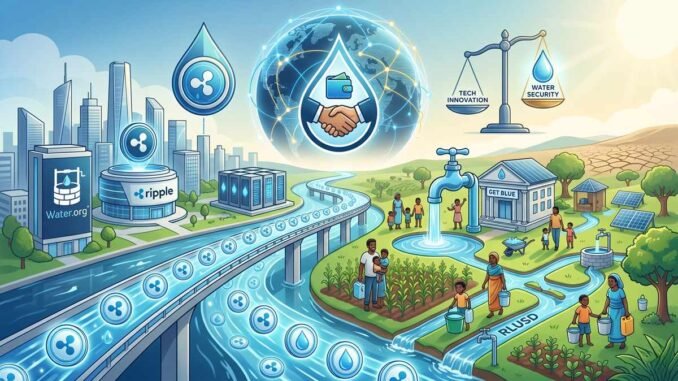
This Tuesday, Ripple formalized its addition to the Get Blue campaign by the non-profit organization Water.org, integrating its institutional stablecoin RLUSD to optimize the transfer of resources aimed at mitigating the global drinking water crisis.
More than 2 billion people worldwide lack access to safe water at home.💧 Addressing the global water crisis requires collective action.
We’re proud to join @Water in support of Get Blue, a campaign helping expand access to safe water for communities around the world.
Find…
— Ripple (@Ripple) June 9, 2026
Integration of Blockchain Infrastructure in Humanitarian Aid
The Get Blue campaign, co-founded by actor Matt Damon and engineer Gary White, is presented as a corporate coalition oriented toward mobilizing commercial and financial resources toward water and sanitation solutions. According to the official announcement, Ripple joins this foundational effort alongside multinational corporations such as Amazon, Gap, Starbucks, and Ecolab.
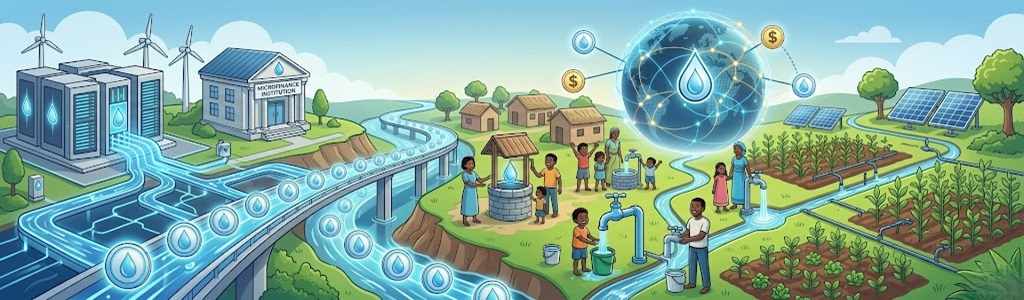
The initiative’s operational dynamics rely on the WaterCredit model developed by Water.org, which manages accessible financing for essential public services in vulnerable regions. The blockchain payment network will deploy its stablecoin pegged to the U.S. dollar, RLUSD, with the purpose of transferring funds to partner microfinance institutions operating in emerging markets.

Information from the United States Environmental Protection Agency (EPA) indicates that water demand by data processing facilities will increase substantially over the next two years. This increase in industrial consumption is mainly attributed to the expansion of artificial intelligence systems. While the project’s founders acknowledge that the Get Blue campaign does not directly mitigate the corporate water footprint, the strategy seeks to actively involve the tech sector in resolving the humanitarian impact derived from the scarcity of this resource.
The Stablecoin’s Track Record in Social Development Initiatives
This collaboration does not constitute the first deployment of the institutional stablecoin for charitable purposes or financial assistance. Company records confirm that, in September 2025, the entity made a donation equivalent to $15 million in RLUSD tokens to the Accion Opportunity Fund, with the purpose of supporting small business owners in underserved communities within U.S. territory.
Additionally, the tech firm recently committed the sum of $25 million in digital assets destined for the educational organizations DonorsChoose and Teach For America. The implementation in Water.org’s campaign responds to the technical need expressed by aid entities to accelerate the scale of international transactions and reduce the operational costs inherent to the traditional cross-border banking system.
The compliance and transparency of the reserve fund backing the token remain under periodic audits, in accordance with the issuer’s technical specifications. The development of the pilot program in selected markets will serve as a performance indicator to evaluate the efficiency of blockchain-based rails within the distribution of international philanthropic capital.



Be the first to comment