



Key Takeaways
- Ripple expanded its D.C. presence to deepen policy engagement in Washington.
- Digital asset rules could affect stablecoins, payments, treasury tools, and cross-border finance.
- Recent SEC and White House signals add relevance to Ripple’s timing.
Expanded Washington Presence Reflects Long-Term Policy Engagement
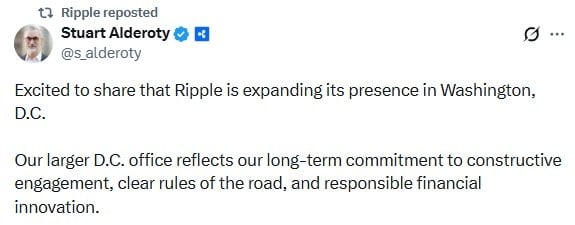
Ripple announced on June 2 that it expanded its Washington, D.C., office, reinforcing its long-term commitment to constructive engagement with policymakers, regulators, and industry partners in the nation’s capital. Digital asset rules remain central to debates over market structure, payments, and financial innovation.
The larger footprint gives Ripple more capacity to participate in policy discussions as blockchain adoption grows across finance. This matters for banks, payment providers, crypto firms, and consumers as new rules could affect blockchain-based payments and treasury products.
Chief Legal Officer Stuart Alderoty also posted about the expansion on X, describing the larger office as a commitment to clear rules and responsible financial innovation. He further emphasized:
“Ripple has always believed the future of digital assets should be built with policymakers and regulators, not around them.”

Broader industry trends also support Ripple’s Washington push. Executives have noted that institutional adoption is accelerating as financial firms move beyond pilot programs and deploy blockchain technology in real-world applications. Ripple’s payments network and XRP’s expanding use in institutional settings underscore the increasing importance of regulatory engagement as digital assets enter mainstream financial services.
Clearer Rules Could Shape Stablecoins, Payments, and Financial Innovation
Ripple said its policy work focuses on regulatory clarity, U.S. leadership in financial innovation, and sustained dialogue with public- and private-sector stakeholders. These priorities place Washington strategy within the company’s broader effort to support blockchain adoption in mainstream finance and highlight why stablecoins, payments, custody, and cross-border settlement remain central to the policy debate.
Lawmakers are weighing consumer protection, market oversight, and U.S. competitiveness as blockchain-based finance grows. Ripple’s larger D.C. presence positions the company to participate in those discussions. For the broader market, the outcome could influence how quickly payment, treasury, and cross-border tools enter regulated financial systems.
Alderoty said:
“As blockchain and digital assets become more integrated into the financial system, Ripple is committed to helping shape policy that protects consumers, supports responsible innovation, and keeps America competitive.”
Recent regulatory developments add another layer to the story. Ripple CEO Brad Garlinghouse has praised the U.S. Securities and Exchange Commission’s new direction, while President Donald Trump has called for a more durable U.S. crypto policy framework. That backdrop gives Ripple’s D.C. investment broader relevance as Washington reassesses oversight of blockchain-based finance.





Be the first to comment