


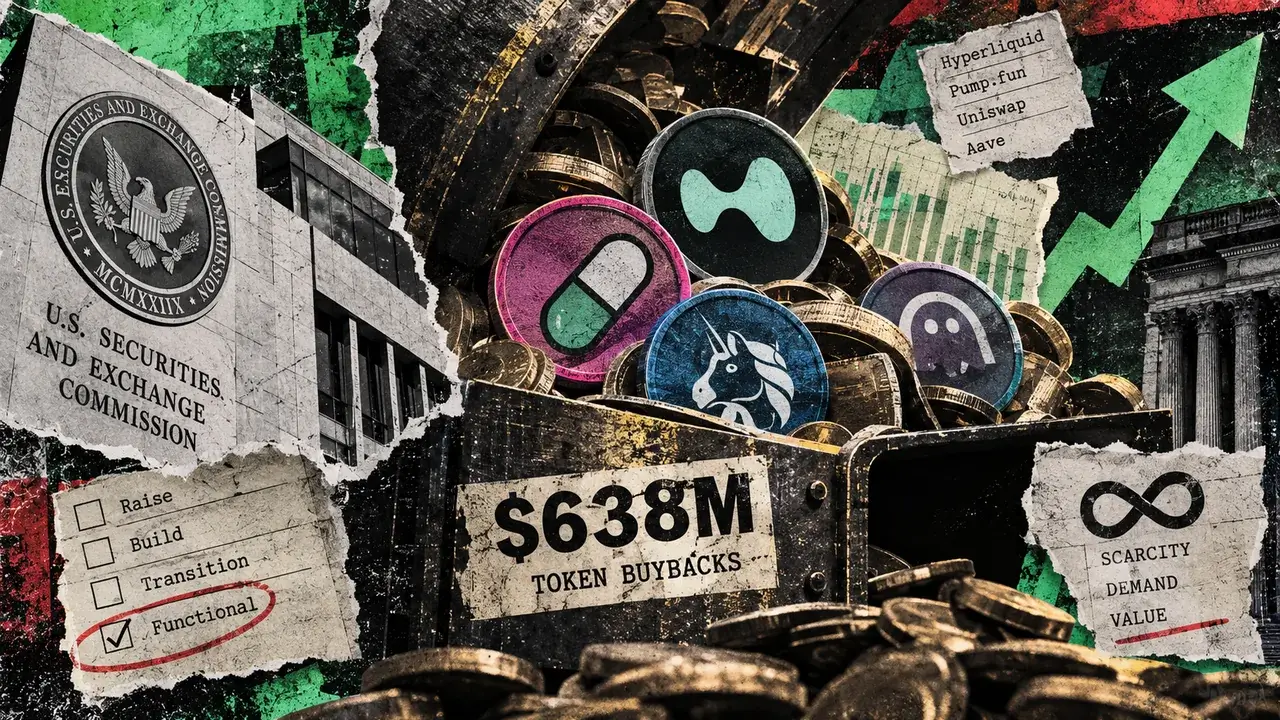
Crypto projects spent about $638 million with token buybacks through late August 2026, according to Allium Labs data.
That is already a record, up from $545 million over the same stretch of 2025. Hyperliquid accounted for roughly $370 million and Pump.fun for about $200 million, together close to 90% of the total.
On Sept. 25, staff at the Securities and Exchange Commission (SEC) addressed the legal tension that has shadowed those programs since they began. The more openly a project ties its token to business returns, the easier it becomes to argue that holders are investing in a security.
What SEC staff said
The SEC’s Division of Corporation Finance addressed buybacks in a new set of crypto FAQs covering networks that are already functional.

Staff said an issuer’s buyback announcement for a non-security crypto asset on such a network falls outside the promises of “essential managerial efforts” at the center of the Howey test for investment contracts.
The same answer warns younger projects that on a network yet to reach functionality, pitching a buyback as a source of yield or returns can feed into an investment-contract analysis.
The answer rests on two built-in assumptions, a functional system and a token that already sits outside securities law, and it carries the weight of staff views, which the SEC describes as lacking legal force.
Under the agency’s March interpretation, a network counts as functional when its native token can be used according to its programmed utility.
A regulatory life cycle takes shape
The SEC’s March interpretation says a token can be sold as part of an investment contract while a team raises money against promises of managerial work. That contract can end once buyers stop expecting profits from those promised efforts.
The pending Regulation Crypto Assets proposal would let projects raise up to $5 million over four years under a startup exemption. A larger fundraising exemption would allow up to $75 million every 12 months, with disclosure requirements attached to both.
Proposed Rule 400 adds a transition filing, the Form TR, in which an issuer certifies on EDGAR that it has completed or permanently ceased its promised managerial efforts and stopped making new ones.
The issuer files it directly, and the agency could later contest whether the conditions were met. In its paperwork estimates, the SEC assumes about 475 issuers a year could rely on that safe harbor, based on 15% of the roughly 3,165 projects launched in 2024. Comments on the proposal close Oct. 20.
Put together, the pieces sketch a path from securities-regulated fundraising to a mature network that can spend real revenue on its own token. The Form TR covers projects that abandoned their roadmaps as well as those that finished them, while the buyback FAQ applies only once a network is functional.
That structure rewards teams that define their build as a finite list of milestones they can eventually complete, and it discourages marketing that frames buybacks as returns before the product works.
| Stage | Regulatory position | What the project can do | Key constraint |
|---|---|---|---|
| Raise | Token sold as part of an investment contract | Raise capital against promised managerial work | Securities-law obligations attach to the fundraising arrangement |
| Build | Promised essential managerial efforts continue | Develop network and deliver disclosed milestones | Marketing returns or buybacks can contribute to Howey analysis |
| Transition | Promised efforts completed or permanently ceased | Proposed Form TR documents the transition | SEC can later challenge whether conditions were actually satisfied |
| Functional network | Token can perform its programmed utility | Operate without the original investment contract necessarily continuing | Token’s status still depends on facts and circumstances |
| Mature buybacks | SEC FAQ assumes a functional network and non-security token | Announce revenue-funded token repurchases | Buyback announcement alone is not an essential-managerial-efforts promise |
The money already flowing to token buybacks
Pump.fun says half its revenue goes to buying and permanently burning PUMP. Its dashboard shows roughly $500 million in annualized revenue, about $462.5 million in cumulative purchases, and 167.7 billion tokens destroyed, equal to 16.8% of the original supply.
At the current run rate and allocation, that implies around $250 million in annual purchases,
about 6.4% of Pump.fun’s displayed $3.91 billion fully diluted valuation. The figure measures purchasing power against valuation, with the cash going into open-market token purchases.
Hyperliquid has bought and burned roughly $1.3 billion of HYPE since launch, and its documentation says more than $1 billion in annualized fees now flows into programmatic HYPE purchases.
Uniswap switched on protocol fees on Ethereum mainnet in December 2025 and has since extended them to other chains, with outside searchers collecting accumulated fees only by burning UNI in exchange.
Hyperliquid funds staking rewards from a reserve of future emissions even as trading fees burn HYPE. A protocol that burns 5% of supply while issuing 8% through emissions and unlocks ends up diluting holders despite a large headline buyback.
A more useful measure for these tokens is net burns against new issuance before comparing the result to valuation.
Aave’s program shows how quickly treasury needs can override a buyback. It acquired more than 205,000 AAVE, about 1.28% of supply, for roughly $42 million in its first ten months.
Governance then debated cutting the annual budget from $50 million to $30 million as revenue softened. The DAO paused purchases on April 19, after the rsETH bridge incident, to preserve balance-sheet flexibility.
Crypto’s record remains small next to Wall Street, where S&P 500 companies spent $1.02 trillion on repurchases in the 12 months through September 2025. The growth pace sets crypto apart, rising from about $366,000 in 2024 to $638 million in under eight months of 2026, with mechanisms that automatically convert revenue into market purchases.
| Protocol | Buyback / burn mechanism | Scale cited in article | What can offset or interrupt it |
|---|---|---|---|
| Pump.fun | 50% of revenue allocated to open-market PUMP purchases and permanent burns | ~$500M annualized revenue; ~$462.5M cumulative purchases; 167.7B PUMP destroyed | Revenue declines; future token issuance/unlocks |
| Hyperliquid | Trading fees fund programmatic HYPE purchases and burns | ~$1.3B bought and burned since launch; >$1B annualized fees flowing toward purchases | Staking rewards and future emissions can offset supply reduction |
| Uniswap | Protocol fees accumulate; searchers obtain assets by burning UNI | Fee mechanism active since Dec. 2025 and expanded across chains | Governance controls fee deployment and future mechanism |
| Aave | Treasury-funded open-market AAVE purchases | >205,000 AAVE / ~$42M in first ten months | Treasury needs; program paused after rsETH incident |
What token holders own
The rights attached to these tokens remain thin. Uniswap’s documentation says value reaches UNI holders through the burn mechanism and whatever future mechanisms governance approves, with protocol revenue staying under the protocol’s control.
The SEC’s March interpretation describes digital commodities as assets whose holders lack any inherent right to passive yield, future income, or profits. A buyback can reduce supply and create steady demand, and governance can redirect or pause it at any point.
The same distance from securities law that makes a mature token easier to trade also keeps it apart from the cash flows investors use to value it.
Bitcoin, which the SEC lists as a digital commodity, runs without an issuer or protocol revenue to recycle, so revenue multiples and buyback ratios apply to tokens like HYPE, PUMP and UNI.
Where the token buyback model goes from here
If the SEC finalizes Regulation Crypto Assets close to its current form, teams can raise money under the exemptions, write finite roadmaps, file transition reports, and steer revenue into token purchases once their networks work.
Hyperliquid’s fee flows and Pump.fun’s allocation alone point to industry buybacks above $1 billion a year at current run rates. Revenue and dilution-adjusted buyback yield would become standard tools for valuing protocol tokens.
| Feature | Public-company shareholder | Mature protocol token holder |
|---|---|---|
| Ownership claim | Equity ownership in corporation | Generally no ownership of protocol/company merely from holding token |
| Right to profits | May receive distributions if declared; residual corporate rights defined by securities/corporate law | No inherent right to future protocol income or profits |
| Buyback effect | Company purchases outstanding shares | Protocol/DAO purchases or burns tokens, potentially reducing supply or adding market demand |
| Guaranteed buybacks? | No | No |
| Who can change the program? | Board/company subject to corporate and securities-law constraints | Governance, protocol rules or other authorized actors depending on design |
| New issuance can offset purchases? | Yes, through new share issuance/compensation | Yes — emissions, incentives and unlocks can overwhelm burns |
| Claim on underlying revenue | Share represents equity rights in the company | Buyback-linked token may have no contractual claim on the revenue funding purchases |
| Useful valuation metric | Earnings, free cash flow, buyback yield, dilution | Protocol revenue, gross buybacks and net issuance/dilution |
If the proposal stalls or emerges in weaker form, the nonbinding staff FAQ becomes the main source of comfort, and projects would keep return language out of their marketing while treating buybacks as discretionary.
Revenue-linked programs shrink mechanically when revenue falls, and a major exploit or bad-debt event could push other treasuries to conserve funds the way Aave did. Holders would then find that a buyback resembles a shareholder return in its market effect while remaining revocable, governance-dependent, and free of any contractual claim.
The SEC is building a route for crypto networks to spend their revenue on their tokens. Holders at the end of that route own an asset tied to a business’s success through scarcity and demand, while the business’s revenue stays with the protocol.



Be the first to comment