

An ETH holder can sell a liquid-staking token while the ETH behind it remains staked. A Sept. 25 SEC staff FAQ draws a conditional distinction between receipts that evidence ownership and protocol-issued tokens. Coinbase and Lido disclosures show the holder’s practical stake: a transferable token does not guarantee immediate unstaked ETH or a sale at the underlying position’s value.
The Securities and Exchange Commission’s Division of Corporation Finance said a qualifying staking receipt for a digital commodity may be a “digital tool.” A token issued by a protocol-based liquid-staking provider may instead be a “digital commodity.” The staff does not classify Coinbase’s cbETH or Lido’s stETH by name. Their terms determine who holds the deposited ETH, how the token can be redeemed and what can happen if its holder sells instead.
What counts as a receipt
The staff FAQ defines a receipt by the rights it represents. It evidences that an asset was deposited and that the depositor retains ownership. Under the FAQ’s description, ownership and control do not pass to the receipt issuer, which cannot transfer, lend, pledge, rehypothecate or otherwise use the deposited asset, or expose it to third-party claims. That is a description of the type of receipt the staff is discussing, not a new custody rule for every token sold as liquid staking.
The FAQ then distinguishes two possible classifications under the SEC’s March crypto-asset interpretation. A receipt for a digital commodity that is not subject to an investment contract can be a digital tool because its function is to evidence ownership. A receipt issued by a protocol-based liquid-staking provider may itself be a digital commodity when its value is linked to a functioning crypto system and market supply and demand. The word “may” matters: neither answer assigns a status to an individual product merely because it is called a staking token.

An earlier August 2025 staff statement described liquid-staking tokens as transferable evidence of deposited assets and their accrued rewards. It discussed both smart-contract protocols and third-party custodians, limiting its securities-law view to the arrangements it described. It did not address restaking or arrangements in which a provider controls staking choices, sets or guarantees rewards, or facilitates additional token returns. Falling outside that statement is not, by itself, a finding that an arrangement involves securities.
Those categories shape the staff’s securities-law analysis of the arrangements it describes; they do not certify access to the ETH underneath. Coinbase and Lido provide a practical comparison of different custody and redemption routes. The FAQ makes no determination about either product.
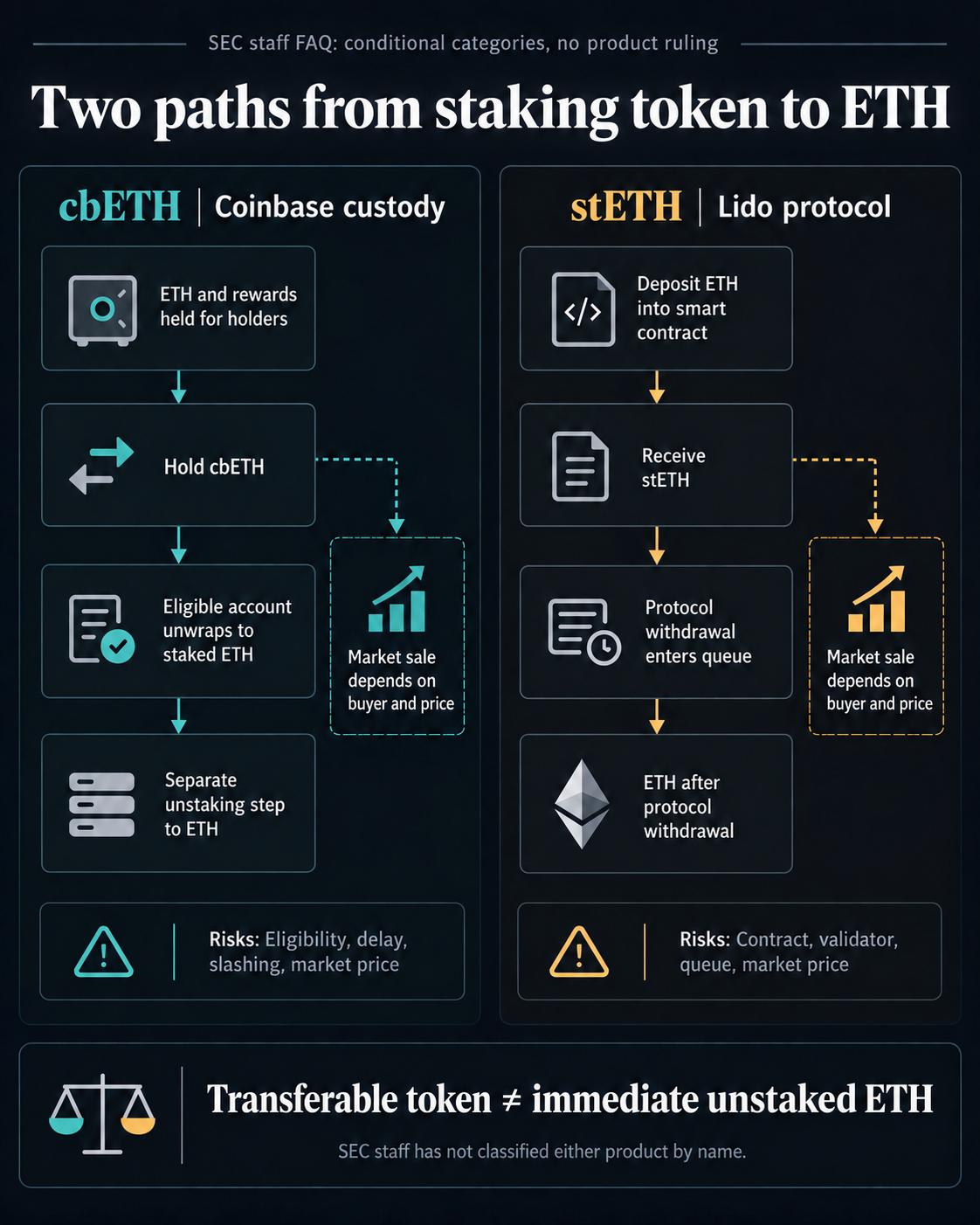
Two routes back to ETH
Coinbase’s custodial path
Coinbase’s US user agreement says cbETH represents ETH staked through Coinbase, including associated rewards and subtracting fees or slashing penalties. It says the staked ETH and rewards wrapped as cbETH are held by Coinbase on behalf of token holders and that ownership does not transfer to Coinbase. Selling or transferring cbETH transfers the underlying ownership interest and the contractual redemption right to the recipient.
That transferability gives a holder a way to seek an exit before the staked ETH is withdrawn. Coinbase’s product guidance says cbETH can be sold, sent or held in an external wallet. But selling it is a market transaction, and Coinbase warns in its agreement that the token’s price can diverge from ETH or staked ETH. Coinbase does not promise that a buyer will be available or backstop cbETH liquidity.
The contractual redemption route is different from a sale. The agreement says an eligible cbETH holder must have a Coinbase account in good standing and meet staking eligibility requirements to unwrap; geographic limits and processing delays may apply. Unwrapping returns staked ETH, with rewards less applicable fees and slashing, not immediately spendable unstaked ETH. Obtaining ETH after that requires a further unstaking request and completion of Ethereum’s process. A transferable token therefore does not give every holder the same immediate redemption route.
Lido’s protocol path
Lido’s contract documentation describes a different operating model. A user deposits ETH into the protocol’s smart contract and receives stETH. To reclaim ETH through the protocol, a holder submits a withdrawal request that enters a queue. The token can also be sold to another trader instead of waiting for that process.
Those routes expose the holder to different constraints. Lido’s risk disclosure says a protocol withdrawal can be slowed by queue capacity and Ethereum validator exits. The ETH ultimately received follows the protocol’s accounting and can be affected by adverse events such as slashing. A secondary-market sale is faster only if someone will trade at an acceptable price; spreads, slippage and a discount to ETH can widen when liquidity is strained. The disclosure also identifies smart-contract, governance and validator risks, and says stETH and wstETH have no general, protocol-level regulatory approval.
A label does not settle the exit
The two products illustrate why “liquid” describes a token’s ability to move, not a guaranteed conversion into unstaked ETH at a fixed value. With cbETH, the holder depends on Coinbase’s custody terms and eligibility process for contractual unwrapping, or on a market buyer for a sale. With stETH, the holder can use a protocol withdrawal queue or a market buyer. In either case, the secondary-market price can differ from the value of the underlying staked position.
The Sept. 25 FAQ does not classify either token by name, and its answers are nonbinding staff views that create no new obligations. Its useful distinction is narrower: before treating a liquid-staking token as interchangeable with ETH, a holder needs to know who retains ownership of the deposit, who operates the redemption path, what asset comes back first and which delays or losses can intervene. A regulatory category alone cannot answer those product-level questions.





Be the first to comment