

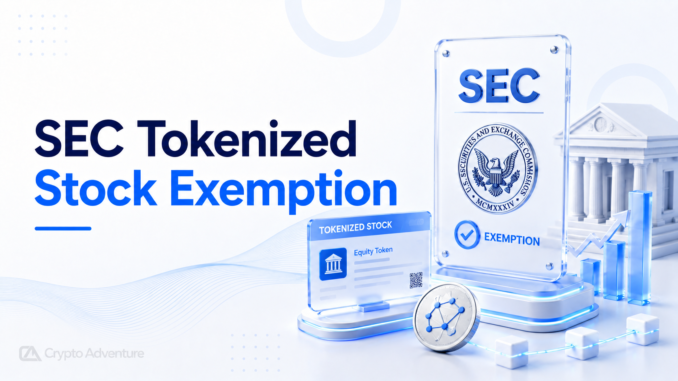
The U.S. Securities and Exchange Commission is reportedly preparing an innovation exemption that could allow trading in tokenized versions of stocks, opening a potential regulatory path for digital securities to move across crypto-native platforms. The reported SEC plan would cover tokenized or digital versions of securities and could be released as soon as this week, with Bloomberg cited as the original source.
The proposal has not been published in final form, and the SEC had not publicly commented on the report. Still, the direction fits months of public signaling from the agency’s current leadership. SEC Chair Paul Atkins had already said the commission was “on the cusp” of an innovation exemption for tokenized securities that would create a limited framework for onchain trading while longer-term rules are developed.

The reported exemption would mark a major shift because it could let tokenized assets trade on decentralized crypto platforms rather than only through traditional exchanges and broker-dealer infrastructure. The most aggressive version of that model would allow tokenized exposure to public companies to circulate onchain, potentially through automated market makers or other decentralized liquidity systems.
Tokenized Stocks Could Trade Without Traditional Share Rights
The most sensitive part of the reported plan is the rights structure. The Bloomberg-cited report said the SEC is leaning toward allowing tokens that may track public-company shares without the backing or consent of the companies themselves. Those tokens may also lack traditional shareholder rights such as voting power or dividends.
That structure would put tokenized stocks into a different category from ordinary stock ownership. A traditional shareholder owns equity through the regulated market plumbing that handles transfer, settlement, corporate actions, proxy voting and dividends. A third-party tokenized stock may instead offer economic exposure through a wrapper, receipt, entitlement or synthetic arrangement, depending on how the product is designed.
The SEC’s own tokenized securities statement has already made clear that stocks, bonds, notes, investment contracts, options and security-based swaps can be tokenized. The legal issue is not whether securities can exist onchain. It is whether the token gives investors the same rights, disclosures, custody protections, trading safeguards and remedies they expect from the traditional market.
The SEC’s Investor Advisory Committee has also warned that any tokenized equity framework should preserve core protections around ownership rights, regulated intermediaries and best execution. That recommendation does not reject tokenization. It argues that investors need clear disclosure on whether token holders receive voting rights, dividends, corporate-action treatment and equal standing with ordinary shareholders.
RWA Market Momentum Raises Pressure On Regulators
The timing is not accidental. Tokenized assets are expanding quickly, and tokenized stocks are becoming one of the most visible parts of the RWA market. Tokenized stocks recently crossed $1.5 billion in TVL, with Ondo Global Markets showing demand across Circle, S&P 500 ETF exposure, Micron, Nvidia and BlackRock’s spot Bitcoin ETF.
That growth puts pressure on U.S. regulators because the market is already forming outside the traditional U.S. retail framework. Platforms can offer tokenized exposure to eligible non-U.S. users, while U.S. investors remain more limited by securities rules, broker-dealer requirements and exchange regulation. An innovation exemption could create a controlled U.S. path instead of leaving the fastest experimentation offshore.
Atkins previously described the exemption as a way for TradFi firms and crypto-native firms to experiment, including with tokenized securities trading through automated market makers and public blockchains. He also suggested that buyers and sellers could go through a whitelisting process, while trading volume limits and tailored relief could keep the framework narrow rather than open-ended.
DeFi Trading Could Challenge Stock Market Plumbing
If the exemption is released in a broad form, the impact could reach beyond crypto. U.S. equities are still built around market hours, brokers, exchanges, clearing agencies, transfer agents, custodians and corporate-action systems. Tokenized stocks could introduce 24/7 settlement, wallet-based access, programmable collateral, DeFi liquidity and faster cross-border distribution.
The risk is that tokenized access can look simpler than the legal rights behind it. A token that tracks Apple, Nvidia or an ETF is not automatically the same as a share held through a brokerage account. Investors would need to know who backs the token, where the underlying asset is held, whether redemption exists, how pricing stays aligned, what happens during dividends or splits, and which courts or regulators can enforce claims if something breaks.
The reported SEC move would therefore be less of a green light for unrestricted onchain stock trading and more of a test of how far U.S. regulators are willing to let crypto rails touch the stock market before permanent rules are written. The next document from the SEC will decide the real scope: which assets qualify, who can list them, whether DeFi platforms can participate, what rights investors receive, and how much of Wall Street’s market plumbing can move onchain without weakening the protections that made U.S. equities the deepest market in the world.



Be the first to comment