



Key Takeaways
- Senators have four days before the August recess begins.
- The White House is reviewing a proposed digital asset ethics deal.
- Updated legislation combines Banking and Agriculture Committee work.
Industry Pressure Builds as Senate Faces Four-Day Deadline
The Senate has four scheduled session days to advance the CLARITY Act before beginning its August recess, prompting a renewed push from cryptocurrency advocates and industry organizations.
Stand With Crypto, a cryptocurrency advocacy organization representing more than three million supporters, urged senators to approve the legislation before the recess. The group argued that support spans Wall Street, the cryptocurrency industry, and other organizations.
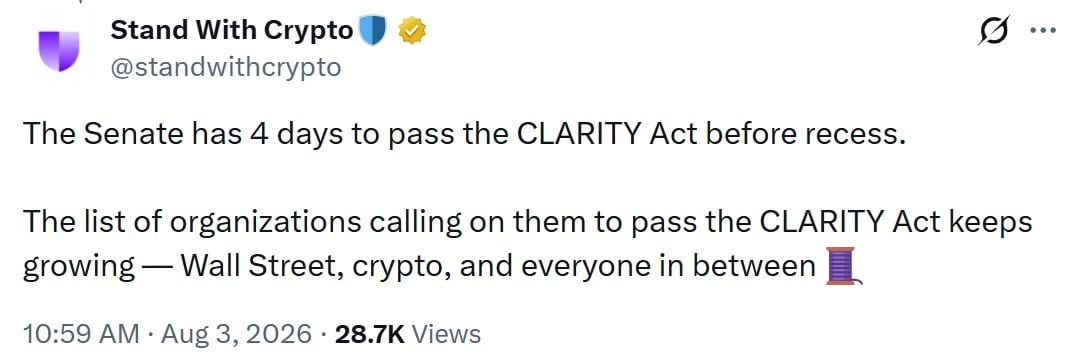
The organization also plans to score every senator’s vote on the CLARITY Act, adding political pressure as lawmakers work through the final legislative days before the August recess.

White House Response Remains Central to Negotiations
Attention has also turned to the White House as lawmakers await a response to an ethics counterproposal submitted by U.S. Senator Thom Tillis (R-NC) and U.S. Senator Ruben Gallego (D-AZ). Journalist Eleanor Terrett reported that the administration is reviewing the proposal, leaving one of the CLARITY Act’s final unresolved issues outstanding as the Senate enters its final legislative days before recess.
U.S. Senator Tim Scott (R-SC), chairman of the Senate Banking Committee, expressed hope that lawmakers could advance digital asset legislation soon. His remarks place the remaining negotiations within a compressed schedule that investors, digital asset firms, and financial markets are watching as Congress approaches its August state work period.
An agreement would influence how federal agencies oversee cryptocurrency exchanges, digital commodity brokers, token issuers, custodians, decentralized finance services, and other market participants. The unresolved ethics language has become a central component of negotiations connecting industry rules with restrictions governing digital asset transactions involving federal officials.
Updated Bill Advances Toward a Senate Vote
U.S. Senator Cynthia Lummis (R-WY) released updated CLARITY Act legislation on July 22, combining work from the Senate Banking and Agriculture committees after months of negotiations over consumer safeguards, enforcement authority, market supervision, national security, and federal oversight of digital assets.
The accompanying 616-page CLARITY Act text establishes registration frameworks for digital commodity exchanges, brokers, dealers, and qualified custodians. It also addresses customer assets, software developers, decentralized finance, stablecoin yield, cybersecurity, illicit finance, self-custody, bankruptcy protections, and ethics requirements.
Committee members previously advanced the legislation through a 15-9 bipartisan Senate Banking Committee vote, sending the proposal toward Senate floor consideration after lawmakers negotiated regulatory responsibilities, stronger consumer protections, enforcement tools, and policies intended to support digital asset innovation.
Support for the legislation has also expanded beyond Capitol Hill. U.S. Securities and Exchange Commission (SEC) Chairman Paul Atkins has voiced optimism that Congress can approve the measure, while Strategy Inc. (Nasdaq: MSTR) Executive Chairman Michael Saylor has endorsed the proposal as a step toward establishing clearer U.S. digital asset rules.
Four-Day Window Raises Stakes for Senate Action
The Senate’s official 2026 legislative schedule places the chamber on recess beginning Aug. 10. With four scheduled session days remaining from Aug. 4 through Aug. 7, lawmakers face a narrow window to advance the CLARITY Act before leaving Washington.
Supporters may need 60 votes to overcome procedural opposition before final consideration. Galaxy Research recently placed the bill’s chance of becoming law in 2026 at 30% as ethics negotiations and scheduling pressures continued.
The ethics section includes restrictions on certain digital asset transactions, reporting requirements, a Government Accountability Office study, an effective date, and a sunset provision. White House feedback could determine whether negotiators revise those provisions during the remaining four-day window or continue discussions after the Senate returns in September.





Be the first to comment