



- Sensex plunged over 2,000 points before recovering nearly 2,000 during the CAS.
- Thin BSE liquidity may have amplified the sharp move, say market participants.
- SEBI faces questions over CAS, but they do not plan to make changes.
SEBI’s new Closing Auction Session (CAS) is now under increased scrutiny as the Sensex plunged by more than 2,000 points. Although the index recovered within minutes, the surprising swing has raised concerns about liquidity. The move has now caught traders in a dilemma over whether the new closing system is creating additional risks, especially on expiry days.
Sensex Lost 2,200 Points — Then Recovered Almost 2,000
The Sensex reportedly witnessed an unusually sharp move during the BSE’s Closing Auction Session on August 27. Within minutes, the index fell by more than 2,000 points. It dropped from around 77,200 to nearly 74,983 before witnessing a recovery, closing at 76,933.6, down 539 points, or around 0.7%, from the previous close.
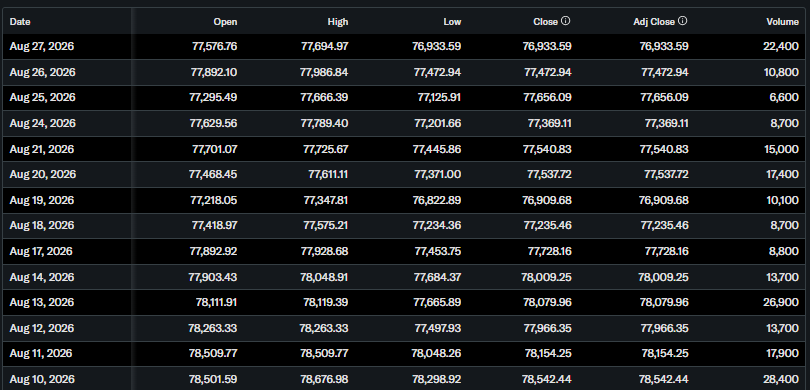
Source: Yahoo Finance
It is worth noting that the sharp swing came on the first monthly derivatives expiry since SEBI launched CAS. This brought the new closing mechanism under scrutiny. Experts highlighted possible reasons such as thin BSE liquidity and expiry-related positioning. At the same time, the development has also raised broader concerns about price discovery during the auction.

Why This Happened During the New CAS
Notably, the timing of the decline is particularly important. It came on the first monthly derivatives expiry under the CAS. The timing has raised questions about whether everyday positioning and the liquidity might have amplified the price movement.
BSE has lower trading activity than NSE. This means that there are fewer orders available during the closing session. So, a smaller number of orders during the auction could have a bigger impact on the prices. This is especially important on expiry days as trading activity will be more concentrated.
In addition to liquidity, expiry-day positions might also have contributed to the sharp move. But, as of now, it cannot be confirmed that low liquidity and positions are the only reasons for the Sensex fluctuations.
Why Sensex Was Hit While Nifty Stayed Relatively Stable
Significantly, the major difference between Sensex and Nifty is that they are traded on different exchanges. The Sensex is based on BSE stocks, while the Nifty tracks stocks on the NSE. Thus, the difference in liquidity and order flow between the two exchanges can lead to different price movements.
Nifty closed just 0.48% lower on August 27, whereas the Sensex fell by 0.7%. This means that the move was concentrated around the BSE closing process rather than a broader market sell-off. At the same time, it cannot be said that Nifty was unaffected. But it just remained relatively stable compared to the Sensex.
Former MP Kirit Somaiya Asks SEBI for an Inquiry
Amid these Indian stock market issues, former BJP MP Kirit Somaiya has asked SEBI Chairman Tuhin Kanta Pandey to study the sharp Sensex movement and to address the reasons. He asked whether the swing highlights the weakness in the new CAS framework. “The present architecture removes continuous trading liquidity at precisely the time when liquidity could be important,” added the MP.
Further, he asked SEBI to temporarily suspend and redesign CAS. He believes that the system should be reviewed for its structure that contributed to the volatility. However, in response, the SEBI Chairman stated that the regulator is not currently considering changing the CAS system.
Manipulation or a Structural Liquidity Problem?
It is still unclear whether the sharp swing in the Sensex during the CAS was caused by manipulation or liquidity-related issues. While ex-MP Somaiya has called for an inquiry into the issue to know whether it was deliberate, market participants point to thin liquidity and expiry-day positioning as key factors.
What SEBI Has Said About Changing CAS
So far, SEBI hasn’t made any plans to change the existing CAS system. The chairman stated that the system will continue as it is. He also stated that participation will increase as more brokers make CAS available on their trading platforms. With this move, investors will become familiar with CAS.
What Indian Traders Should Watch Before the Next Expiry
Indian traders are expected to keep a close eye on liquidity and order flow during the next CAS, especially the expiry period. They need to watch if a similar volatility will happen during the session to see whether the August 27 move was a one-off event. Traders are also supposed to watch the Sensex-Nifty difference. In addition, BSE trading volumes and expiry-day positioning could also give more understanding about the event.
Related: Indian Banks’ Bad Loans Hit a Record Low: What It Means for Credit, Markets and Crypto Investors
Disclaimer: The information presented in this article is for informational and educational purposes only. The article does not constitute financial advice or advice of any kind. Coin Edition is not responsible for any losses incurred as a result of the utilization of content, products, or services mentioned. Readers are advised to exercise caution before taking any action related to the company.



Be the first to comment