



Shibarium, the dedicated chain behind Shiba Inu, holds $50,639 of locked capital on October 10, 2026. The day before, the figure was $157,958. That is 68 percent less within a single day, and the price took no notice of it: SHIB trades at $0.00000545, or 0.00000487 euros, by Saturday midday, up 2.4 percent over 24 hours.
Anyone who reads that collapse as a signal of capital flight is measuring the wrong number. Behind the decline there is no withdrawal by a crowd of users, but one single liquidity position at one single decentralised exchange, which has been appearing and disappearing every one to three days for weeks. This article shows how the figure comes about, what it says about the chain’s actual utility, and which levels for SHIB follow from it.
Shibarium on October 10: $50,639 in the protocols after $157,958 the day before
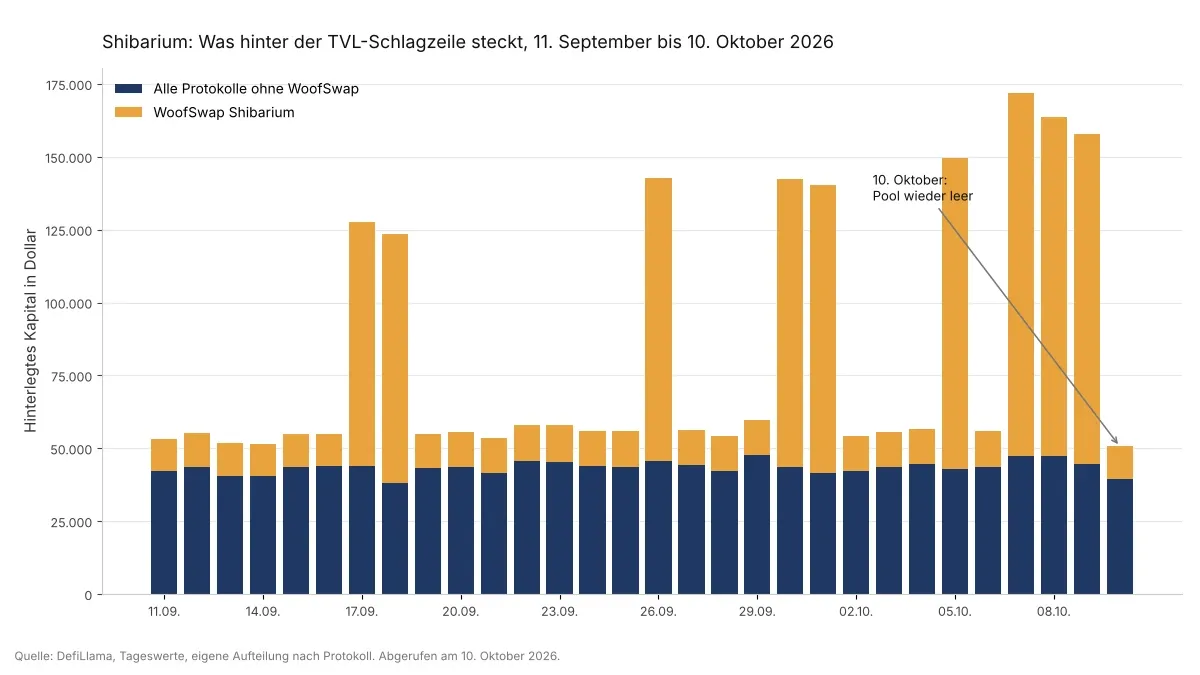
DefiLlama’s daily values for the chain read like an electrocardiogram over the first half of October. On October 4, Shibarium carried $56,770, on October 5 it was $149,644, on October 6 it was back down to $55,832, and on October 7 it stood at $172,020. Then came $163,757 on October 8 and $157,958 on October 9, before the value fell back to $50,639 on October 10.
Across the past 30 days, the average of that series is $55,867. The highest daily reading of the period was October 7 at $172,020, the lowest was September 10 at $49,740. For context: in December 2024, the same chain once carried $6,437,163, and the 2026 high was $1,481,811.

WoofSwap as the water gauge: a single pool carries 95 percent of the decline
DefiLlama breaks the capital down by protocol, which makes it possible to split the jump apart. WoofSwap Shibarium, a decentralised exchange on the chain, held $113,498 on October 9 and only $11,219 on October 10. That one entry accounts for $102,279 of the total decline of $107,319, which is 95.3 percent. The day before, it made up 71.9 percent of the entire chain capital.
The pattern repeats itself: on October 5, WoofSwap held $106,596, on October 6 it was $12,253, and on October 7 it was $124,556. A position of that size, swinging tenfold within a day, typically comes from a single market participant who provides liquidity and then pulls it out again. Large numbers of small investors do not move in lockstep by the hour.
Total value locked: what the metric says about a chain
Total value locked, or TVL, is the dollar value of all assets deposited in a chain’s contracts, meaning trading pools, lending markets and staking contracts. The metric measures tied-up capital, not turnover and not user numbers. The value also rises when a single actor pays money in, and it falls when the same actor collects it again.
Two further things distort the number. First, it counts in dollars: if the price of the deposited tokens rises, TVL rises without any new deposit at all. Second, Shibarium’s protocol list includes an entry for the trading platform Gate at $97,658, which DefiLlama assigns to the centralised exchange category and therefore does not count towards the chain value. Add the protocol totals up without that distinction and you arrive at $148,299, almost three times the figure actually reported.
The base without WoofSwap: $39,420 spread across thirteen further protocols
Strip out the swinging pool and a remarkably quiet remainder is left. On October 10 that remainder is $39,420. Over the past 30 days, this base has never left the range between $38,020 and $47,654, not on a single day. So the chain has not suffered capital flight; it has never held capital worth mentioning.
Broken down, the base looks like this: ShibaSwap V1 holds $20,952, Shibex $5,671, DogSwap $5,494, ChewySwap $2,862, PunkSwap $1,899 and ShibaSwap V2 a further $1,317. Behind those come seven more entries below $500 each. In total, DefiLlama lists 14 protocols on Shibarium. The in-house exchange ShibaSwap reaches $22,269 across both versions combined.
Since October 8: $159,561 turned into $50,639
Our Shiba Inu forecast of October 8 still carried a Shibarium figure of $159,561, alongside 1,323 transactions a day and a price of $0.00000528. Two days later, three of those numbers read differently, and they are moving in different directions.
The capital on the chain has fallen to a third. Over the same period, the price rose from $0.00000528 to $0.00000545, which is 3.2 percent. Chain usage has picked up: Shibariumscan counts 2,438 transactions for October 10 by 10:51 UTC alone. The level of $0.00000610 named back then still stands, but the distance to it has narrowed from 15.5 to 11.9 percent.
Fee burning through Shibarium: the burn hangs on chain turnover
The reason the capital on Shibarium matters at all for a SHIB forecast lies in how the project is built: a share of the chain’s transaction fees is meant to flow into the burning of SHIB. The more that happens on the chain, the more tokens disappear from circulation. That is the economic bridge between technology and price on which every forecast that argues from scarcity rests.
That bridge can be quantified. Shibariumscan reports gas consumption of 186,831,439 units for the current day. A simple transfer on an Ethereum-compatible chain costs 21,000 gas units, so the daily consumption corresponds roughly to 8,900 such transfers. In total, the chain has processed 736,027,044 transactions in 11,114,269 blocks since launch, at an average block time of 5.0 seconds. How much of that actually arrives in the burn is shown by a look at the burn addresses, which we last recalculated in the burn balance of October 9.

Slippage in thin pools: what to watch on a SHIB order
Slippage is the difference between the price you see when you submit an order and the price at which it is actually filled. The less capital sits in a trading pool, the more a merely mid-sized order moves the price against you. With a pool of $20,952, which is what ShibaSwap V1 currently holds, a four-figure amount is enough to do it.
In practice that means: for a SHIB purchase or sale of any meaningful size, the centralised venues are the more realistic address, not the decentralised pools on Shibarium. SHIB’s daily turnover across the market is $66.58 million, roughly 1,315 times the entire chain capital. Before placing an order, three points are worth a look: the stated slippage tolerance, the provider’s trading fee, and whether the provider is registered under MiCA in Europe. Our crypto exchange comparison gives an overview of the fee models.
On tax, the familiar position holds in Germany: under section 23 of the Income Tax Act, gains from selling SHIB are tax-free after a holding period of one year, and below that the exemption threshold of 1,000 euros per calendar year applies. Swapping SHIB for another token on Shibarium is a disposal and restarts the clock for the token received.
Market value against chain capital: $3.21 billion against $50,639
SHIB ranks 36th among cryptocurrencies with a market value of $3.21 billion, on 589.24 trillion tokens in circulation. The capital locked on its own chain amounts to $50,639. The market value is therefore around 63,400 times as large as the capital working in the associated infrastructure, and the TVL equals 0.0016 percent of the valuation.
A comparison within the segment helps to place that. Dogecoin trades at $0.085829, reaches a market value of $13.41 billion and daily turnover of $484.78 million, yet has no smart contract chain of its own at all and claims no utility of that kind either. Anyone who values SHIB above a pure meme token usually justifies it with Shibarium. That justification is exactly what has to be measured against the numbers above.

Levels for the coming days: $0.00000533 below, $0.00000552 above
The nearest support is the daily low of October 10 at $0.00000533. Below that lies the low of the past 30 days, reached on September 16 at $0.00000494. To the upside, the daily high of $0.00000552 caps things first.
The more telling level above that is $0.00000561. It marks half of the October decline, from the high of $0.00000592 on October 5 to the low of $0.00000529 on October 9. A price that recovers that half has neutralised the past week’s downward move. Only after that does the $0.00000610 from our October 8 forecast come back within reach, the high of the past 30 days set on September 23. Over seven days SHIB is down 3.5 percent, over 30 days it is up 5.7 percent.
Our assessment: the price follows the narrative, not the chain capital
In the editorial team’s view, the data speaks against any forecast that argues from Shibarium usage. The evidence for that sits in this article: the base of the chain capital has not left the range from $38,020 to $47,654 for 30 days, while the price rose 5.7 percent over the same stretch. On October 10, the reported TVL falls 68 percent, and the price gains 2.4 percent on the very same day. Between the two quantities, no connection is visible over the observation period.
This reading says nothing about the direction of the price; it makes a statement about the reasoning. Anyone holding SHIB should know that the movement currently comes from market sentiment and from whatever is happening across the wider crypto market, and not from measurable demand for the chain itself. A price forecast resting on Shibarium adoption has no foundation in this data. That is not a recommendation to buy or to sell. It is a warning about a particular kind of argument.
Three objections with numbers that argue for a different reading
First, TVL measures only tied-up capital. Chain usage has risen lately, from 1,323 transactions a day on October 8 to 2,438 transactions by midday on October 10. What counts for fee burning is the number of transactions, not the capital in the pools.
Second, the base is stable rather than shrinking. A project whose core business is collapsing normally shows a falling trend, not a horizontal line across 30 days. Third, one month is a short window. The chain already held $6,437,163 in December 2024 and $1,481,811 during 2026, so capital demonstrably can come back. What remains open is what is supposed to bring it back.
Shibarium capital: without turnover the burn stays a rounding error
- Check the number yourself before you believe it. The breakdown by protocol sits on DefiLlama under the chain’s entry, and the transactions and gas consumption sit on Shibariumscan. Tools that bundle data of this kind are in our overview of analytics platforms.
- Price in slippage and fees before you place an order. With pools in the four to five figure range, a larger on-chain order costs you more than the fee at a centralised venue; the terms are in the exchange comparison.
- Settle custody if you intend to hold SHIB for more than a year to use the clock under section 23 of the Income Tax Act. Which devices are suitable is covered in the hardware wallet comparison.
The raw data behind this article is publicly available at DefiLlama for the chain capital and at Shibariumscan for blocks, transactions and gas consumption.
(As of October 10, 2026. This article is not investment advice. Prices and fee structures change; check the terms with the provider before you buy.)





Be the first to comment