


What to know:
- Solana stakeholders vote on three proposals covering governance, fees, and inflation.
- SGP-0002 doubles disinflation and cuts projected SOL emissions by 18.9M over six years.
- SGP-0003 would split base fees, pay block leaders, and burn the full resource portion.
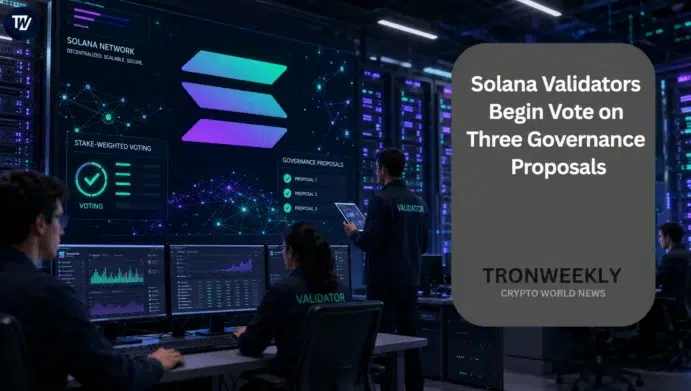
Solana validators and delegators began voting on three major governance proposals on August 23. The measures cover a proposed constitution, faster SOL disinflation, and a new transaction fee structure for the network’s operations and governance.
Voting on SGP-0001, SGP-0002, and SGP-0003 will remain open until epoch 1023 ends. Developers expect that point at about 15:30 UTC on August 27, but blockchain epoch timing can change as block production varies over time.
Also Read: Ripple CEO Backs Progress Toward Clear U.S. Crypto Rules

How Does Solana’s Stake-Weighted Governance Vote Work?
The stake-weighted vote only signals support, meaning approval would establish a mandate for further development work. Inflation and fee revisions would still require technical work, code review, and implementation before becoming active across the network.
SGP-0001 asks validators and delegators to ratify the Solana Constitution as the canonical framework for network-level decisions. Approval would also activate svmgov, the proposed on-chain governance system for recording stake-based decisions.
Voters will use the stake associated with their accounts as per the proposed guidelines. Voters can either opt for the delegation option for voting or vote independently via their own stake account.
The participation of votes must be at least one-third of the total stake in the network in order for voting to be considered valid. Two-thirds of the participating stake is required for approval, with abstentions being considered participating stakes but not approving stakes.
A Solana Governance Proposal provides a general direction rather than a technical specification. Technical specifications of protocols are made available via SIMDs.
SGP-0002 aims at doubling the annual rate of disinflation from 15% to 30%. This will help the rate of disinflation reach the existing 1.5% terminal floor faster.
Why Could Solana Burn Fees and Lower SOL Emissions?
According to SIMD-0550, the floor can appear in 2.8 years instead of 5.7 years. Furthermore, under the new timeline, SIMD-0550 predicts around 18.9 million fewer SOL emissions in six years than the current timeline.
This initiative is introduced after a previous conflict concerning the network’s security budget. An 80% inflation reduction scheme was not successful in March 2025 due to a failure of support from 61.39% of participating stakeholders.
In SGP-0003, the division of the network’s base transaction fee into inclusion and resource fees. The inclusion fee will go to block leaders, while all the resource fee will be burnt.
SIMD-0553 specifies the inclusion fee as 2,500 lamports per transaction. Meanwhile, the resource fee will vary depending on the required computational power from the user side.
This system will charge higher transaction fees in cases of higher demands for network resources. As opposed to the existing system, burning the variable fee will withdraw SOL from circulation.
What Could Solana’s Governance Vote Advance?
Validators and delegators can approve or reject or abstain from voting on both initiatives until epoch 1023 ends. Their votes will include the amount of active stake during the governance snapshot.
As of press time, Solana (SOL) is trading at $94.75 on August 24 after gaining about 1.83% in the past 24 hours. Its seven-day rise reached roughly 26%, alongside a broader cryptocurrency market rally.
Market data does not show that the governance vote caused the price increase. The outcome will show whether stakeholders support advancing Solana’s governance and technical proposals.
Also Read: BitMart Reviews Phased Restart as Trading Deadline Nears
This article contains market analysis and price predictions. These are not guarantees. Crypto markets are volatile. Always DYOR. Not financial advice.



Be the first to comment