


Solana’s staking network has shown significant geographic concentration, with 72.8% of delegated SOL assigned to validators operating in Europe, according to new research from Bitwise.
Summary
- Bitwise found that European validators account for 72.8% of Solana’s staked SOL, highlighting geographic concentration.
- North America holds 16.2% of delegated SOL, followed by Asia at 10.6% and South America at 0.4%.
- At 250-millisecond slots, European validators recorded 95.8% one-slot vote arrivals, compared with Asia’s 70.7%.
- Solana’s faster slot times have exposed regional performance differences, although overall network skip rates remain low.
- The concentration raises geographic decentralization questions, but validator location alone does not establish MiCA regulatory exposure.
According to the Bitwise Q4 2026 Staking Report, published on October 20, much of the network’s stake sits within a corridor connecting Amsterdam, Frankfurt and London. The findings come as Solana developers reduce block production intervals, creating new performance challenges for validators operating outside major network hubs.
European validators account for 72.8% of Solana stake
The report found that North American validators accounted for 16.2% of delegated SOL, followed by Asia at 10.6% and South America at 0.4%. European operators held more than four times the combined stake assigned to validators across the other three regions.
Bitwise mapped the distribution using data from Allium, Solana RPC and Marinade. Its geographic figures describe where validators operate, not where investors live or which jurisdictions ultimately control the underlying tokens.
Solana validators process transactions, participate in consensus and receive rewards for operating the network. Token holders can delegate their SOL to these operators without transferring ownership, meaning a validator’s location does not establish the nationality of its delegators.
The report identified Amsterdam, Frankfurt and London as major operating centers, alongside other European locations. However, the regional figures do not disclose how much stake belongs to each city, hosting provider or individual validator operator.
Recent Solana decentralization research examined a different concentration measure, finding that 19 validators held enough combined stake to cross a 33% threshold. That analysis used older geographic observations, making it unsuitable for directly comparing Europe’s current stake distribution.
Faster Solana slots expose regional voting differences
Bitwise examined geographic concentration alongside Solana’s decision to shorten its target slot time from 400 milliseconds to 250 milliseconds. The rollout began with a reduction to 350 milliseconds on August 21, followed by 300 milliseconds and the September 18 activation of 250-millisecond slots.
Moreover, the 250-millisecond slot upgrade shortened the time available for validators to process blocks and submit votes. Under the new setting, each validator’s four-slot leader window lasts approximately one second, compared with 1.6 seconds under the original configuration.
At 400 milliseconds, more than 98% of votes from European, North American and Asian validators arrived within a single slot. Once the target reached 250 milliseconds, Europe recorded 95.8% and North America 92.8%, while Asia fell to 70.7% and South America to 70.3%.
The figures show a difference of 25.1 percentage points between Europe and Asia at the fastest measured setting. Bitwise warned that operators farther from major network hubs could face more difficulty receiving blocks and submitting votes as developers work toward a 200-millisecond target.
However, the report found that nearly all votes still arrived within two slots, limiting the effect on staking rewards. Network skip rates remained low, declining from a median of 0.08% under 400-millisecond slots to 0.04% under the 250-millisecond configuration.
Does Europe’s Solana stake concentration create MiCA exposure?
The geographic findings raise questions about how European regulation could affect staking businesses operating on Solana. Europe’s 72.8% share, however, should not be interpreted as the percentage of the network directly subject to the European Union’s Markets in Crypto-Assets Regulation.
The reported European locations include London, which falls outside the EU’s MiCA jurisdiction. Validator infrastructure location alone does not determine whether an operator provides a regulated crypto-asset service or holds customer assets under an applicable licensing arrangement.
Under European Securities and Markets Authority guidance, firms providing staking services together with custody must comply with relevant MiCA requirements. The guidance does not establish that every validator operating equipment in Europe automatically requires authorization.
Neither Bitwise nor the Solana Foundation has provided a comment addressing the regulatory implications of this specific concentration figure in the material reviewed. The report does not calculate an EU-only stake percentage or identify which operators provide custodial staking services.
Geographic concentration adds to Solana infrastructure questions
The findings follow an August networking incident in which 102 Solana validators stopped voting following a routing problem involving infrastructure provider TeraSwitch. Solana continued processing transactions, and the affected validators recovered within approximately 40 minutes.
During that incident, Marinade estimated that 28.83% of delegated SOL temporarily became delinquent. The routing problem spread through infrastructure serving multiple locations, including Amsterdam, London, Frankfurt, Singapore and Tokyo.
Separate quarterly data from Blockworks showed Solana network revenue reaching $75.7 million in Q3, while tracked staker revenue totaled approximately $495 million. Of that amount, $484.4 million came from newly issued SOL and $10.6 million from Jito tips, excluding other validator income sources.
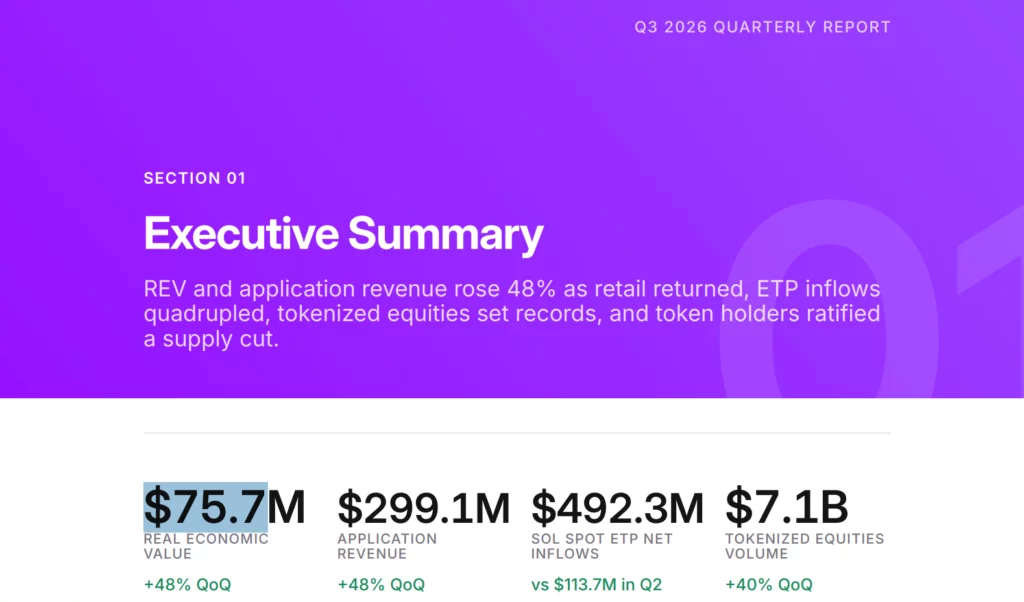
Bitwise reported that Solana ended Q3 with approximately 69% of its token supply staked and a gross staking yield of 5.99%, down from 6.38%. Its validator count declined from 696 to 659 during the quarter, with the report attributing the reduction to operating cost pressures.


Be the first to comment