




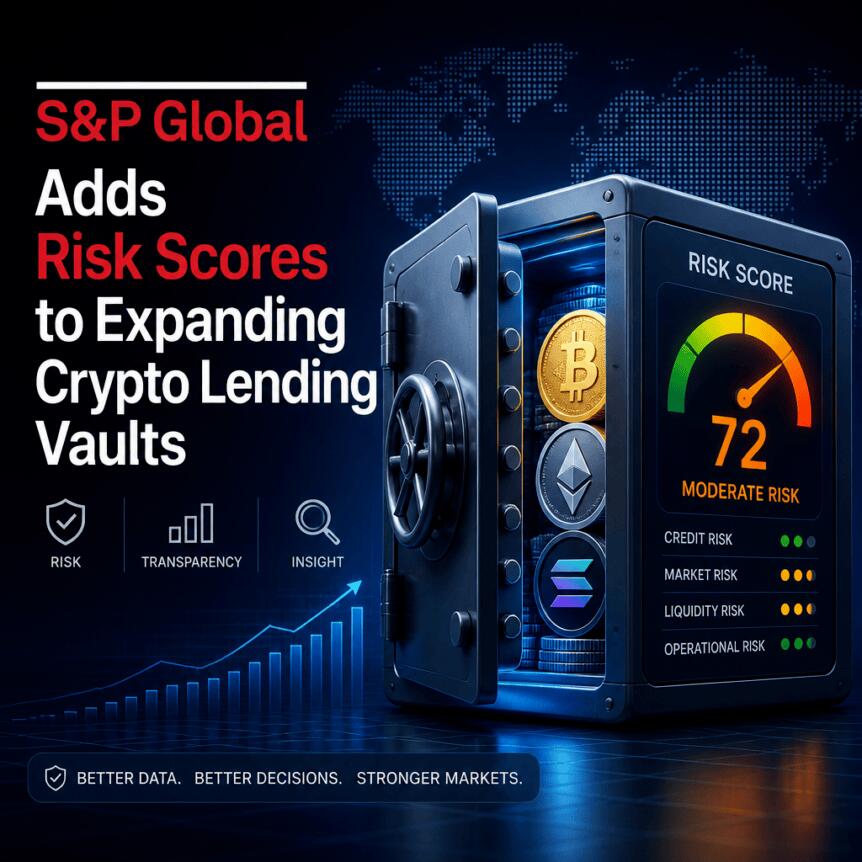
S&P Global Ratings has introduced a new risk assessment framework aimed at digital asset lending vaults, as onchain yield products continue to draw more capital from retail and institutional-style participants. The framework is designed to help investors understand how and where lending vault structures can fail, without offering traditional credit ratings or commenting on expected returns.
Announced in a press release Monday, the approach—described as a Vault Risk Assessment framework—breaks down risk into six categories: portfolio credit quality risk, liquidity mismatch risk, curator risk, blockchain risk, protocol risk, and vault security and governance risk. According to S&P Global Ratings, the evaluations focus on the potential for investor losses rather than the size or attractiveness of yields.

Key takeaways
- S&P Global Ratings’ new framework evaluates digital asset lending vaults across six distinct risk areas tied to potential investor losses.
- The assessments are not credit ratings and do not evaluate yields, keeping the tool focused on downside vulnerability rather than performance forecasts.
- S&P says no single category is presumed to be the “main” source of risk; a major weakness in any factor can materially constrain the overall assessment.
- Vault deposits have grown sharply, with S&P estimating deposits reached about $10 billion in September—up from roughly $1.5 billion two years earlier.
A downside-focused framework for vault investors
Digital asset lending vaults generally pool deposits and allocate capital through predefined strategies run by smart contracts or, in some designs, by human or third-party curators. Depositors typically receive vault tokens that represent their share of the underlying assets and a claim on returns produced by the vault’s strategy.
S&P Global Ratings’ stated goal is to make risk visibility more practical for capital allocators. In remarks to Cointelegraph, analyst Lisa Schroeer emphasized the framework’s emphasis on identifying vulnerabilities that could lead to loss.
Schroeer also described how the scoring logic is intended to work: a “material weakness” in any factor can limit the overall Vault Risk Assessment, and a strong score in one area cannot automatically offset a severe gap in another. Her comments point to a sector with multiple potential points of failure—spanning operational decisions, technical execution, and governance.
Importantly, S&P said the framework will not constitute a credit rating and will not assess yields. That distinction matters for investors because it separates risk diligence from return expectations: the framework is meant to inform decisions about whether a product’s structure exposes investors to particular downside pathways, rather than to predict how much profit the vault is likely to generate.
What S&P will look at: six risk categories
The announcement outlines six areas the framework will assess. While the press materials do not provide a full scoring rubric in the excerpt, the categories themselves map to common failure modes in crypto lending and vault operations:
- Portfolio credit quality risk — the likelihood that the assets or loans held by the vault underperform or fail.
- Liquidity mismatch risk — risks that arise when the vault’s ability to meet withdrawals doesn’t align with the liquidity profile of its deployed assets.
- Curator risk — risks tied to the role of discretionary or operational managers, when vault strategies are not purely automated.
- Blockchain risk — risks related to the underlying network environment and its operational or technical constraints.
- Protocol risk — risks stemming from the lending or strategy protocols the vault interacts with.
- Vault security and governance risk — risks related to smart contract security, key management, and governance processes.
S&P also said the framework was not designed to imply that one of the six categories is inherently more dangerous than the others. Instead, the company appears to be treating the overall risk profile as the combined effect of multiple interlocking vulnerabilities—consistent with the “no offset” philosophy Schroeer described.
Vault adoption grows fast, along with scrutiny
Vault products have expanded quickly as exchanges, wallet providers, and DeFi platforms have packaged lending and other yield strategies into interfaces designed for broader participation. S&P’s deposit estimates underscore how rapidly this segment has grown: deposits in digital asset lending vaults reached about $10 billion in September, compared with approximately $1.5 billion two years earlier.
The shift has also accelerated through distribution partnerships and mainstream-adjacent product rollouts. Earlier coverage from Cointelegraph noted that in February, Wallet in Telegram introduced self-custodial BTC ($85,634.00 · Live), ETH ($2,710.21 · Live), and USDT ($1.00 · Live) vaults using infrastructure from Morpho, TAC, and Re7. In May, Kraken launched a Bitcoin yield vault powered by Veda and curated by Sentora, reporting $30 million from 4,000 wallets within its first 10 hours, according to Cointelegraph coverage at the time.
Product expansion has not been limited to “pure” crypto assets. In September, Cointelegraph reported that Kraken launched yield vaults for tokenized versions of Nvidia, the SPDR S&P 500, and Invesco QQQ ETFs, with Sentora managing strategies that lend the assets through DeFi markets. The movement toward tokenized securities-style exposure increases the importance of consistent risk framing, especially when investors may assume the products behave more like traditional finance instruments than they do.
At the same time, high-profile security failures have kept attention on vault governance and protocol design. In August, Cointelegraph reported that the lending protocol Term Finance lost an estimated $8.5 million after an attacker exploited governance control of its Meta Vaults. Cases like this illustrate why “security and governance risk,” as well as protocol and curator responsibility, sit at the center of investor protection debates.
Regulatory uncertainty remains in the background
Beyond technical risks, crypto vaults still operate in a regulatory gray area in the United States. In July, SEC Commissioner Hester Peirce said some vaults and onchain lending products could fall under federal securities laws depending on how they are structured and operated, according to Cointelegraph coverage.
Peirce’s comments highlighted a key factor: vaults that involve discretionary decisions over asset allocation, yield strategies, lending terms, or liquidation thresholds may trigger securities, investment company, or investment adviser requirements. That distinction is relevant to S&P’s framework because curator and governance design—elements directly included in the assessment—can influence how discretionary control functions in practice.
Still, S&P’s announcement does not position the new framework as a regulatory tool. Instead, it is framed as a transparency and diligence aid for assessing the likelihood of investor losses within vault mechanics.
What to watch next
S&P Global Ratings said it plans to publish its first Vault Risk Assessments in future announcements, but it did not specify which vaults will be assessed first. Investors and operators should watch for those inaugural assessments, as the first published results may signal how S&P interprets the interaction between liquidation design, liquidity constraints, and governance—areas where real-world incidents have shown that “one weak link” can dominate outcomes.
This article was originally published as S&P Global Adds Risk Scores to Expanding Crypto Lending Vaults on Crypto Breaking News – your trusted source for crypto news, Bitcoin news, and blockchain updates.



Be the first to comment