



S&P Global Ratings has launched a risk assessment framework for digital asset lending vaults as the onchain investment products gain traction.
According to Monday’s announcement, the framework evaluates vaults across six areas: portfolio credit quality risk, liquidity mismatch risk, curator risk, blockchain risk, protocol risk, and vault security and governance risk.
S&P said the assessments will evaluate the risk of losses to investors in lending vaults, but will not constitute credit ratings or evaluate yields. As well, the framework was not designed to single out any one category of the six that poses a greater risk than the others, according to S&P Global Ratings analyst Lisa Schroeer.
“A material weakness in any factor can constrain the overall VRA,” Schroeer told Cointelegraph. “A strong score in one factor does not offset a material weakness in another.” She said that the approach reflects a sector where “there are many points of risk/failure that can break.”

Digital asset lending vaults pool investor deposits and deploy them through predefined strategies managed by smart contracts or human curators. Depositors receive tokens representing their share of the vault’s assets and returns.
According to S&P, deposits in digital asset lending vaults reached about $10 billion in September, up from $1.5 billion two years earlier. S&P said it plans to publish its first Vault Risk Assessments in future announcements, though it did not identify which vaults will be assessed first.
Explaining the framework’s potential role for investors, Schroeer said: “The assessment aims to provide more transparency on the risks so that any entity can make more informed decisions when deciding how to allocate capital to DeFi vaults.”
Related: Kraken adds S&P 500 to funded trading program, commodities to follow
Crypto vaults grow as risks draw scrutiny
Crypto vaults have expanded over the past year as exchanges, wallets and DeFi platforms have rolled out products that package lending and other yield-generating strategies for users.
In February, Wallet in Telegram introduced self-custodial BTC, ETH and USDT vaults using infrastructure from Morpho, TAC and Re7. Kraken followed in May with a Bitcoin yield vault powered by Veda and curated by Sentora, attracting $30 million from 4,000 wallets within its first 10 hours.
The model has since expanded into tokenized securities. In September, Kraken launched yield vaults for tokenized versions of Nvidia, the SPDR S&P 500 and Invesco QQQ ETFs, with Sentora managing strategies that lend the assets through DeFi markets.
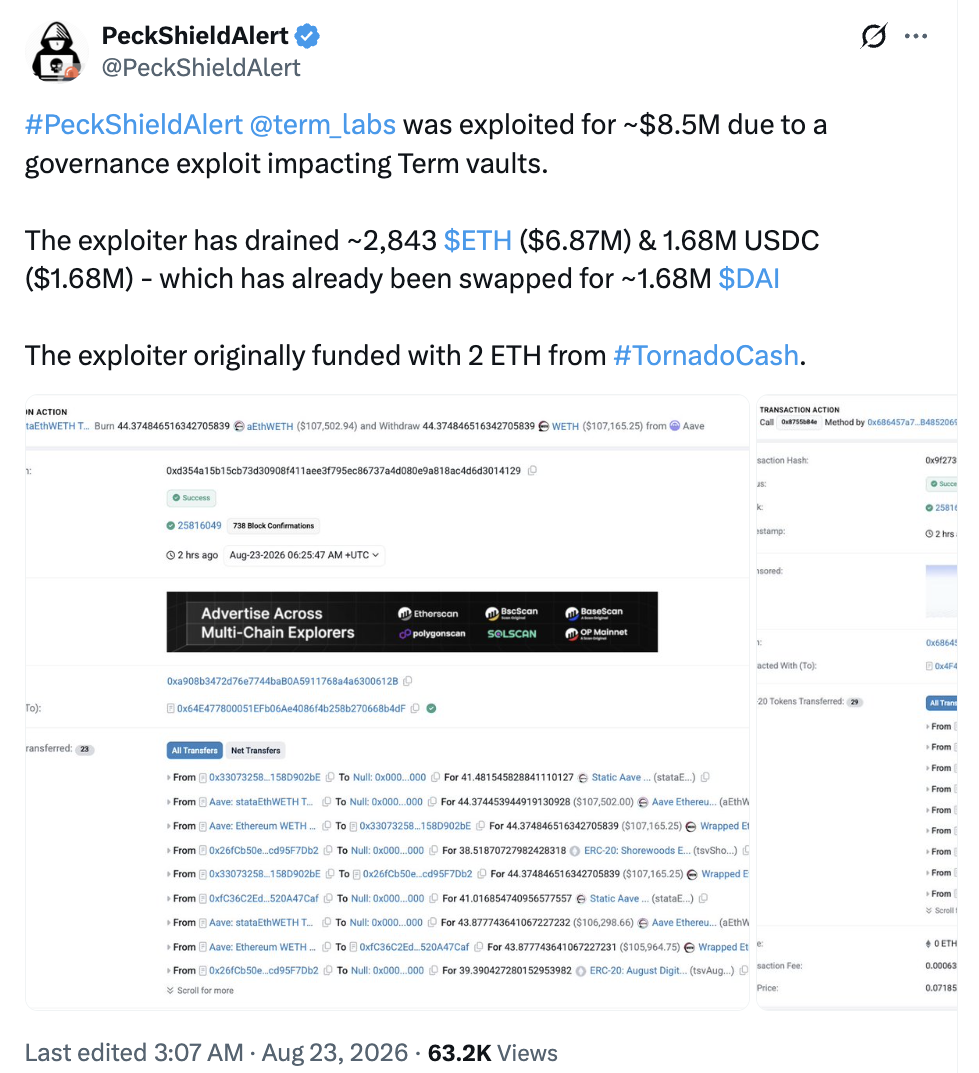
Source: PeckShieldAlert
The growing popularity of crypto vaults has not come without risks. In August, lending protocol Term Finance lost an estimated $8.5 million after an attacker exploited governance control of its Meta Vaults.
For the time being, crypto vaults remain in a regulatory gray area in the United States. In July, SEC Commissioner Hester Peirce said some vaults and onchain lending products could fall under federal securities laws depending on how they are structured and operated.
Peirce said vaults involving discretionary decisions over asset allocation, yield strategies, lending terms or liquidation thresholds could trigger securities, investment company or investment adviser requirements.
Magazine: Former SEC boss made AI Czar, Bitcoin may hit $600K this cycle: Hodler’s Digest



Be the first to comment