



Stablecoin Adoption is expanding beyond the cryptocurrency sphere, as residents in developing nations are opting to use dollar-denominated digital assets to safeguard their savings, pay for transactions abroad, and obtain value in other currencies.
The recent research conducted by the IMF on 188 countries with regard to the $21.4 trillion worth of stablecoin transactions from 2018 to 2025 illustrates the impact of economic distress in hastening this trend.
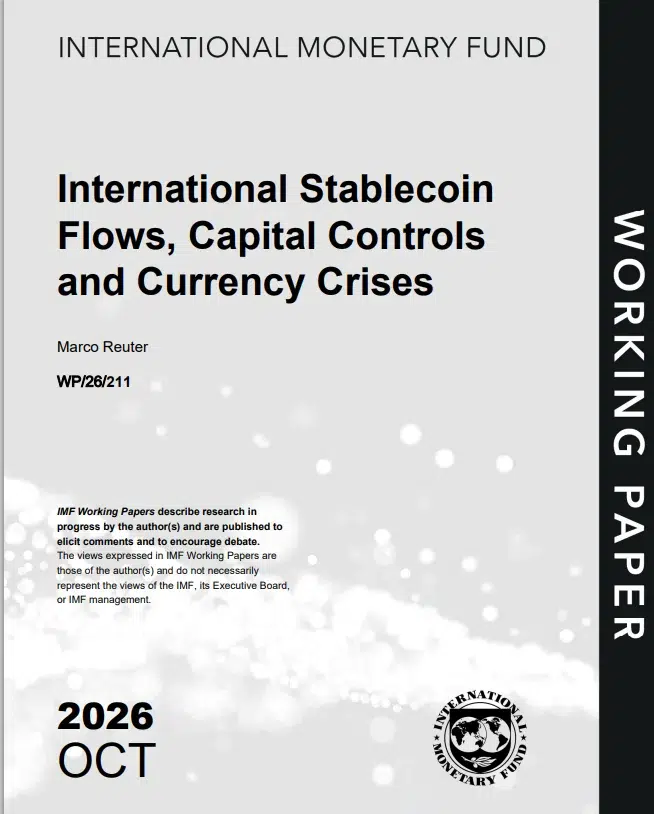
This implies that there is a move from the traditional ways of holding the US dollar currency to a more advanced method whereby one can hold a stablecoin pegged to the dollar through a wallet and move it anywhere across the world.
Also Read | Polygon Tokenization Growth Puts POL Price in Focus as Bearish Setup Develops

Stablecoin Adoption Rises When Currency Pressure Builds
There exists a strong link between Stablecoin Adoption and times of financial distress. Approximately 75 percent of stablecoin holdings come from emerging and developing countries, indicating that the adoption of such coins is high in regions other than developed countries.
Stablecoin use may increase when governments decide to impose capital controls on their nations. As shown by the IMF research, stablecoin activity increases by about 30 percent after six months of imposing capital controls.
A currency crisis may have an even more significant impact. The use of stablecoins increases by around 75% over the course of a year after the occurrence of a currency crisis, and some of this increased amount remains even when conditions become favorable again.
This demonstrates that stablecoins are being used not just as a means of transferring money but as a financial instrument as well.
Where a local currency depreciates, or where access to foreign currency is difficult, dollar-denominated stablecoins serve as an alternative solution. Users can essentially hold digital dollars without having a conventional US dollar bank account.
Nigeria Highlights the Digital Dollarization Trend
A good example where this process can be witnessed is provided by Nigeria. According to the IMF’s Nigeria Report 2026, it was established that stablecoins accounted for over 65% of Nigeria’s crypto inflows in 2024.
In addition, dollar-pegged stablecoins have gained popularity due to their role in transferring money across borders and storing foreign currency without using the domestic banking system.
Nigeria has been under constant pressure to devalue its national currency while still requiring foreign exchange. Stablecoins, therefore, represent an alternative solution in this situation.
Companies can use stablecoins for international payments, whereas individuals can use stablecoins for remittance purposes or as a means of securing their savings from devaluation of local currencies.
Nigeria becomes a good example of how stablecoin adoption can grow when there is no proper access to foreign currencies.
The emergence of the phenomenon accounts for the increasing interest in stablecoins in the field of monetary policy.
Central Banks Are Watching Stablecoin Adoption
The increasing uptake of Stablecoin Adoption has raised new challenges for central banks. Swiss National Bank board member Petra Tschudin stated on September 30 that extensive adoption of stablecoins could hamper the effectiveness of monetary policies. This is because it is feared that people will transfer their deposits held in commercial banks to stablecoins.
The challenge would arise from the fact that commercial banks depend heavily on deposits to make loans, whereas central banks depend on interest rates.
In case people choose to deposit more funds in stablecoins, some of these operations may be performed through non-traditional banking channels.
The problem becomes especially critical if the stablecoins are issued in foreign currencies. If there is a greater interest in dollar-denominated stablecoins, it will lead to less demand for domestic currency and weaken the impact of the central banks on national financial conditions.
Stablecoins Are Becoming More Than Crypto Assets
Stablecoin Adoption is a reflection of the need for faster payments and greater access to dollars.
Stablecoins allow for value transfers without being completely dependent on traditional financial systems. They can offer companies an additional alternative to settle transactions internationally, while individuals can have access to dollar-based assets via digital wallets.
However, increased usage carries risks in terms of financial sovereignty and stability. The domestic currency may experience increased competition if there is widespread usage of stablecoins as a medium of storing wealth in developing countries where the domestic currency is not that strong.
The study by the IMF therefore highlights a bigger shift. Stablecoins have not been limited to trading on crypto exchanges or facilitating blockchain transactions. They are being widely adopted in some countries to gain access to the US dollar.
With the rise of Stablecoin Adoption, digital dollars may impact banking, international payments, foreign exchange demands, and monetary policies. To many people, digital dollars provide easy access to dollar value.
Also Read | Greek Police Bust $8M Crypto Fraud Network Linked to 10,000 Investors



Be the first to comment