



One of the major hacks in the stablecoin space has occurred in StablR, compromised not by a coding issue but by a core governance design flaw.
The attack came from a private key belonging to one of the protocol’s multisig owners being compromised, through an unsecure security threshold achieving runaway approval levels very quickly.
The minting system for StablR was controlled by 1-of-3 multisig, meaning a critical operation could be executed with a single key holder. This arrangement proved disastrous. After harvesting only a single private key, the attacker was able to take control of the minting functions for the protocol.
The exploit did not target vulnerabilities in a smart contract, but rather manipulated governance permissions. The system functioned as designed, the core of the problem was that the governance design incorporated few safe-guards.

Security analysts observing the breach, like those cited in Blockaid’s alert, had little trouble identifying the ongoing exploit, reflecting that funds were being extracted rapidly and severely.
🚨Community Alert
Blockaid’s exploit detection system has identified an ongoing exploit on @StablREuro.~$2.8M extracted so far.
Both tokens are depegged: 0x50753cfaf86c094925bf976f218d043f8791e408 (StablR Euro)
and
0x7b43e3875440b44613dc3bc08e7763e6da63c8f8 (StablR USD) on…— Blockaid (@blockaid_) May 24, 2026
The Attacker Takes Full Control with Governance Manipulation
With control over a single compromised key, the attacker performed a sequence of steps in what appears to be an arm’s-length plan that constituted the following understanding of the protocol’s governance processes. They first added their own wallet as a permitted multisig owner. They then took out the other two real signers, successfully locking the original team out.
By this stage, only the attacker could mint any tokens.
They then minted 8.35 million USDR and 4.5 million EURR, stablecoins from StablR. These tokens had a combined face value of more than $10 million, and were issued with no collateral. Instead, they came out completely under the control of the attacker.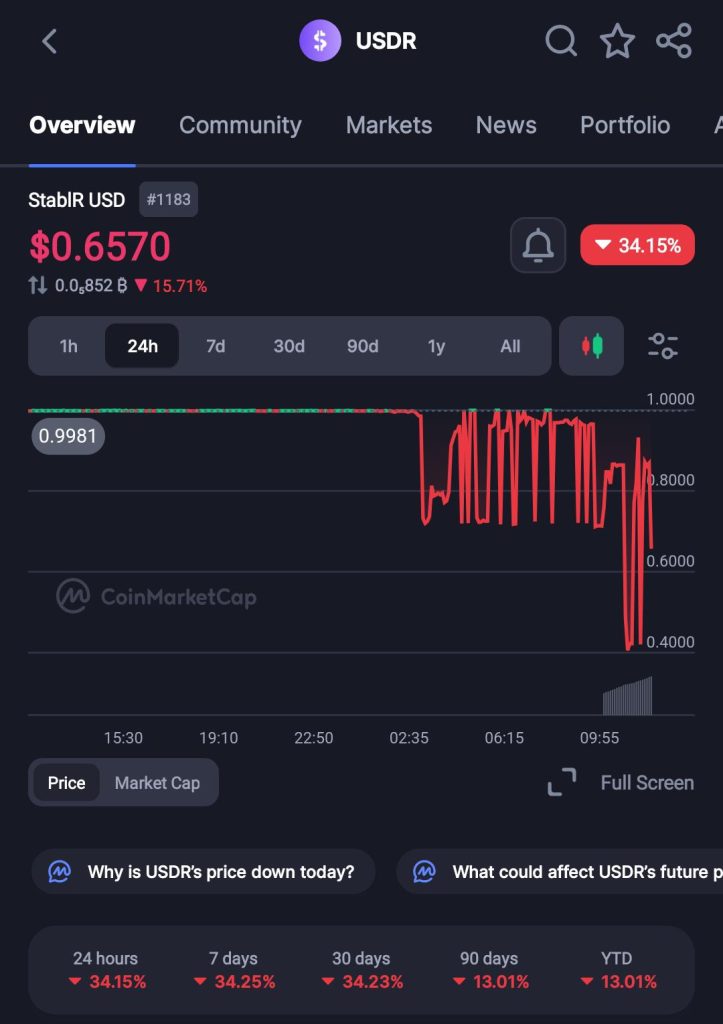
This part of the exploit illustrates a fundamental design flaw in poorly secured multisig: if governance is compromised, all mechanisms relying on it are open (minting, transfers and permissions).
$10 Million Turned Into a $2.8 Million Exit Due to Liquidity Constraints
Immediately after the mint, the attacker sold the tokens off quickly. To do this, they started trading the newly minted USDR and EURR on DEXs (decentralized exchanges) using pools with low liquidity.
This strategic decision directly affected the result. Although the tokens minted had a collective top value above $10 million, liquidity was weak and led to excessive price slippage during high volume sales. The attacker managed to swipe around 1,115 Ethereum, nearly $2.8 million in value.
It demonstrates a more subtle consideration in the world of DeFi: that while liquidity shortages can increase susceptibility due to price manipulation, they also limit the upside for an attacker. Liquidity constraints in this case limited the impact but failed to prevent the exploit entirely.
At that point, the funds have been taken out and the exploit was over, leaving both the protocol and users completely vulnerable.
The Peg is Lost As Confidence in the Market Crumbles
This led to holders of both stablecoins panic in a matter of hours after that. USDR fell from $1.00 to $0.71, and EURR from $1.10 to $0.89.
Stablecoins fundamentally depend on trust. However, depegging can happen quickly once confidence transforms their backing or governance. In such cases, the unauthorized minting of millions of tokens diluted perceived value, and thereby compromised the credibility of that system.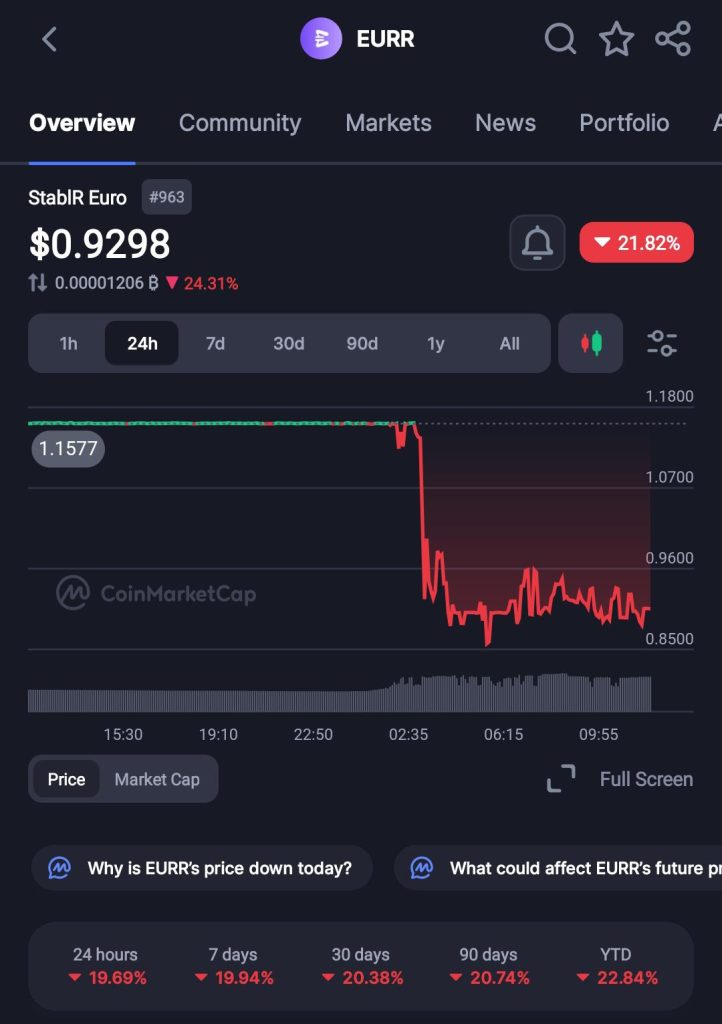
The reports suggest that more than $3 million worth of value was effectively lost as market players scrambled to liquidate positions, which expedited the price drop.
More in-depth analysis of the exploit here, via this breakdown, demonstrates that it was a failure of governance, not a code bug, that was to blame.
🚨 Think about how brutal this is…
You buy a “stablecoin” because:
• You want safety
• Lower volatility
• Protection from market crashesThen you wake up and see this:
> $USDR collapsed from $1.00 to $0.71
> $EURR dropped from $1.10 to $0.93
> Over $3M reportedly drained… pic.twitter.com/4TsWj5p8SQ— Wise Advice (@wiseadvicesumit) May 24, 2026
A Key Management Failure, Not a Smart Contract Bug
One of the most defining things about the StablR incident is that it was not a smart contract bug. And, bear in mind, there were no reentrancy attacks of integer overflow, or lack of code vulnerability.
In fact, the breach was entirely down to a fail in key management.
Private keys are still one of the most sensitive components of blockchain systems. In combination with weak governance structures, a multisig threshold of 1-of-3, for example, they become a single point of failure. In this case that sole weakness was enough to bring down the entire protocol.
This case begs a wider question about the fine line between operational efficiency and security. A lower multisig threshold improves agility but greatly undermines fault tolerance. This tradeoff introduces substantial risks in high-stakes settings like stablecoin issuance.
Projects that issue their tokens under an EU laws framework are also likely to be concerned about the risks of EU sanctions against them.
To complicate matters, StablR is a MiCA compliant stablecoin issuer licensed by the European regulator. It underscores that regulatory compliance does not equate to operational security.
The law is the Markets in Crypto-Assets (MiCA) regulation to develop more structure on the crypto business, and particularly stablecoins. This privacy lapse, however, shows that meeting regulatory compliance standards is only half the battle, sound internal business practice and robust secure processes must go hand in hand with such policy requirements.
This was not a legal failure, it was the implementation of proper governance and operational controls that slipped. This means that if regulators and institutions want to get wider adoption of blockchain financial products, this kind of incident outlines the continuing risks of infrastructure.
The Good and the Bad for the Rest of Crypto
The StablR exploit is not just an isolated event, but a cautionary tale for how governance design can destroy a protocol. A few strong lessons for the rest of the crypto community arise.
For starters, multisig setups require thoughtful execution. This 1-of-3 setup might be convenient, but when it comes to such sensitive functions (like token minting), risking compromise is not an option.
Second, focus on key management. Not even the most highly audited smart contracts can overcome compromised private keys!
Third, liquidity factors play a key role in both the dynamics of attacks and recovery efforts. Thin markets increase volatility, limit attackers gain and create systemic fragility.
Lastly, trust is still the cornerstone of stablecoin viability. And once lost, it is exceedingly difficult to regain.
With the industry maturing, well thought through innovation needs to go beyond mere technology and move into a more complete state, governance, operations, and user protection. The StablR incident underlines a key principle: when it comes to crypto, the weakest link is almost never the code itself, it is always the ecosystem around it.
Disclosure: This is not trading or investment advice. Always do your research before buying any cryptocurrency or investing in any services.
Follow us on Twitter @nulltxnews to stay updated with the latest Crypto, NFT, AI, Cybersecurity, Distributed Computing, and Metaverse news!





Be the first to comment