

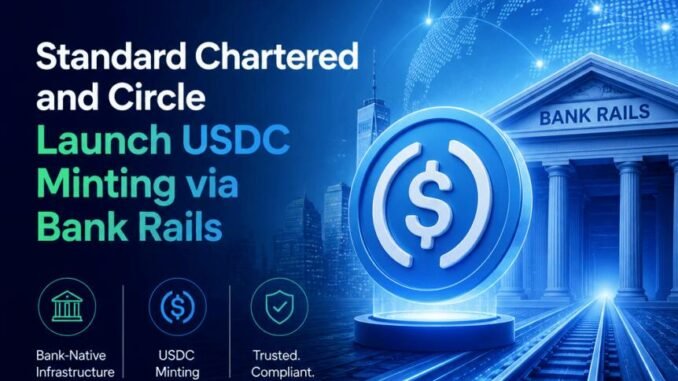

Standard Chartered and Circle have announced a new, bank-led workflow for institutional clients to mint and redeem USDC, positioning stablecoin access inside a traditional banking onboarding process. The system is designed to reduce the operational friction of dealing separately with a stablecoin issuer while aligning minting and redemption activities with the bank’s established risk, compliance, and governance controls.
In a press release, Standard Chartered said it will be the first Global Systemically Important Bank (G-SIB) to offer USDC minting and redemption through its own platform. Clients starting with the initial rollout will be able to mint and redeem the US dollar-backed stablecoin without opening additional accounts with Circle, with delivery beginning through the bank’s operations in the Dubai International Financial Centre (DIFC). The banks described the effort as an integrated offering that brings together banking, custody, and digital asset services under a single institutional relationship.
Key takeaways
- Standard Chartered and Circle are building a workflow that lets institutional clients mint and redeem USDC through a bank-led process.
- Standard Chartered says it is the first G-SIB to provide USDC minting and redemption services within its existing banking frameworks.
- The initial rollout is planned via Standard Chartered’s DIFC operations, with expansion to other jurisdictions depending on regulatory approval and client demand.
- The capability targets institutional needs such as on-chain settlement, treasury management, and liquidity management.
- The move reflects intensifying competition over stablecoin distribution, access, and governance as traditional banks deepen involvement in digital asset rails.
A bank channel for USDC minting and redemption
Standard Chartered said its collaboration with Circle embeds USDC access directly into the bank’s institutional offering. Instead of requiring clients to separately manage stablecoin issuance logistics with Circle, minting and redemption can be handled through the bank’s own platform. Standard Chartered framed this as a way to connect stablecoin operations to “banking, custody, and digital asset services” in one integrated setup.
For institutional users, the practical difference is that stablecoin issuance no longer has to be treated as an entirely separate operational track. Bank-led onboarding can also make it easier to map stablecoin activities to existing internal controls—particularly for firms that already depend on banks for custody, compliance, and settlement infrastructure.
Why DIFC first—and what comes next
According to the announcement, the service begins through the Dubai International Financial Centre, reflecting the role that regulated financial hubs often play in digital asset infrastructure rollouts. Standard Chartered also stated it intends to expand the capability to additional markets, but only “depending on regulatory approval and demand from clients.”
That conditional expansion matters for investors and institutional clients because the timeline for stablecoin access typically hinges less on technology than on licensing, regulatory interpretation, and operational approvals in each jurisdiction. Readers should expect further details as new markets are added and as banks refine which client segments and use cases can access the minting and redemption rails.
Institutional use cases now, payment rails later
Standard Chartered and Circle positioned the capability around current institutional workflows. The announcement says it supports on-chain settlement, treasury operations, and liquidity management. These are areas where firms often need predictable operational processes, clear governance boundaries, and connectivity to broader financial operations.
The collaboration also points beyond those immediate use cases. The banks described the system as providing infrastructure that could support payment-related use cases in the future—signaling a longer-term ambition to integrate stablecoin rails with payment and settlement workflows. While the announcement does not specify timelines or concrete payment deployments, the framing is consistent with how stablecoins are increasingly being assessed: not only as standalone tokens, but as components of regulated distribution and settlement stacks.
Stablecoin competition shifts toward distribution and governance
The Standard Chartered–Circle partnership arrives amid heightened attention on who controls stablecoin access and liquidity. Earlier coverage noted that Circle CEO Jeremy Allaire has publicly defended USDC’s network effects while responding to growing competition from new stablecoin entrants such as Open USD (OUSD). In that context, distribution channels and institutional partnerships can become decisive—even when multiple stablecoins are available—because liquidity and redemption pathways influence real-world usability.
Circle’s CEO previously said OUSD works closely with many of the founding members and expects those members to remain “large USDC partners and customers,” underscoring how relationships and access pathways are central to the stablecoin landscape. Standard Chartered’s announcement can be seen as an extension of that same logic: instead of focusing only on issuance, Circle and a major bank are working to embed USDC into an institutional distribution model that emphasizes governance and compliance.
More broadly, the integration trend suggests that traditional banks are not just observers of stablecoin growth. They are moving toward roles that resemble infrastructure providers—setting up onboarding, oversight, custody connections, and controlled minting/redemption access. For market participants, this can change how quickly stablecoin adoption spreads, because regulated, bank-mediated channels may lower barriers for large institutions that previously viewed direct stablecoin interaction as too operationally or compliance-heavy.
What to watch
As Standard Chartered rolls out USDC minting and redemption via DIFC, the key question will be how quickly the bank expands to other jurisdictions and which client segments gain access first. Observers should also watch whether similar integrations accelerate across other major banks, because the stablecoin race may increasingly be won—or slowed—by distribution, governance, and the ability to plug stablecoins into regulated settlement processes.



Be the first to comment