


Key Takeaways
- Standard Chartered set a $10 ARB target for the end of 2030.
- Arbitrum’s monthly revenue could reach $5 million in September.
- ARB still lacks a direct mechanism for accruing network value.
Standard Chartered Maps ARB’s Path to $10
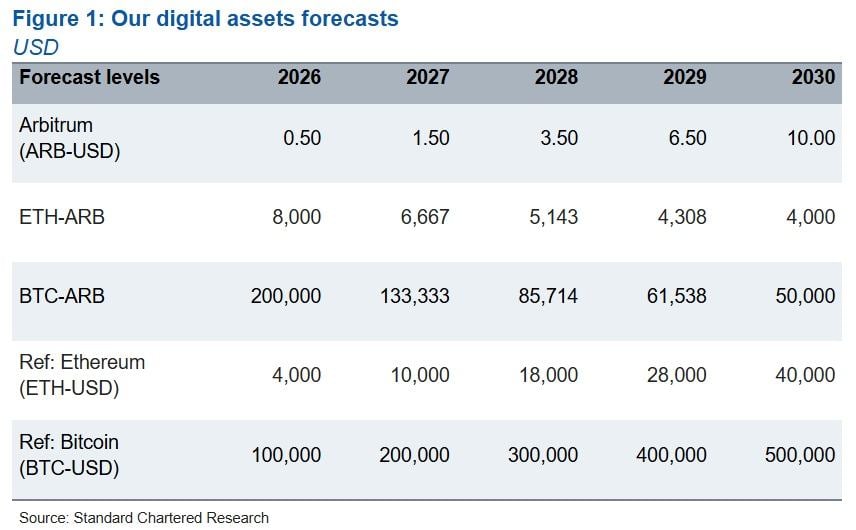
ARB could reach $10 by the end of 2030, according to a Sept. 15 analysis by Standard Chartered Global Head of Digital Assets Research Geoff Kendrick. The bank calculated a roughly 70-fold increase from its 14-cent reference price, but ARB has since risen to approximately 21 cents, making the target about 48 times its current price. Tokenized equity trading approached $3 billion in weekly volume during August, with Robinhood Chain among the leading venues.
The bank’s annual forecast places ARB at 50 cents in 2026, $1.50 in 2027, $3.50 in 2028, $6.50 in 2029, and $10 in 2030. Kendrick wrote:
“I think the ARB token, which is now hugely undervalued with this higher revenue base, is going to undergo a structural re-rating.”
ARB is an ERC-20 governance token that allows holders to vote on ArbitrumDAO proposals, including network upgrades and treasury decisions. Unlike real-world asset tokens, which can represent claims on traditional financial instruments, ARB does not provide ownership in assets brought onchain or a direct claim on Arbitrum’s revenue.
The ARB projections use the bank’s broader digital asset framework, which assumes bitcoin at $500,000 and ether at $40,000 by 2030. Standard Chartered cut its nearer-term BTC, ETH, XRP, and SOL forecasts in February while preserving those long-range bitcoin and ether targets. Its ARB table projects relative values of 50,000 ARB per bitcoin and 4,000 ARB per ether in 2030.
Robinhood Chain Expands Arbitrum’s Revenue Base
The Robinhood launch provides the clearest example of how Arbitrum could turn institutional adoption into recurring revenue. Robinhood Markets Inc. (Nasdaq: HOOD) launched Robinhood Chain’s public mainnet on July 1 using the Arbitrum Platform, creating a dedicated Ethereum layer-2 network for tokenized assets and decentralized finance. The rollout included Stock Tokens, lending, perpetual futures, and infrastructure integrations designed for financial applications.
Arbitrum’s business model allows financial companies to establish dedicated networks while paying for the underlying technology and support. Under the Arbitrum Expansion Program, Robinhood Chain returns 10% of protocol net revenue, with 8% flowing to the ArbitrumDAO treasury and 2% supporting the Arbitrum Developer Guild. Standard Chartered estimated Arbitrum’s September revenue at a $5 million monthly run rate, more than five times its level before Robinhood Chain launched. The bank based part of its growth outlook on its own forecast that tokenized assets will reach $4 trillion by the end of 2028.
Revenue Growth Does Not Flow Directly to ARB
The revenue-sharing arrangement lets Robinhood retain 90% of protocol net revenue while compensating the Arbitrum ecosystem. That structure became central to a debate involving executives from Solana, Arbitrum, and BNB Chain over whether blockchain competition should prioritize low transaction fees or sustainable commercial models. Standard Chartered expects similar arrangements to expand as more traditional financial companies establish dedicated blockchain infrastructure.
Standard Chartered’s recent altcoin research offers a useful comparison showing why direct value capture remains important. Its fivefold SKY forecast connects ecosystem growth to staking rewards and token buybacks that distribute value to holders. The ARB thesis lacks an equivalent mechanism today, leaving the target dependent on a future structural re-rating rather than an established transfer of network revenue to token holders.
Early network activity supports the revenue thesis, but it does not establish a direct mechanism connecting that income to ARB’s price. Robinhood Chain applications generated $2.66 million in revenue over 24 hours on Aug. 30, with memecoin trading tools GMGN and Pons and decentralized exchange Uniswap producing about 88% of the total. That figure measures money the applications earned from users, not revenue collected by Robinhood or Arbitrum. Standard Chartered identified slower tokenization, competing blockchains, and ARB’s lack of direct value accrual as principal risks to its forecast.




Be the first to comment