


Standard Chartered says layer-2 network Arbitrum could emerge as one of the digital asset industry’s top performers through 2030 as traditional financial firms move more assets onchain, giving the network a potentially lucrative revenue source beyond crypto-native activity.
In a note shared with Cointelegraph, Geoff Kendrick, Standard Chartered’s global head of digital assets research, said Arbitrum’s economics offer considerable upside because the network receives 10% of the net protocol revenue generated by companies building on it. Robinhood Chain, developed by the online brokerage, is the first major example.
According to Kendrick, Robinhood Chain has already materially changed Arbitrum’s economics. At its current run rate, Arbitrum is expected to generate $5 million in revenue in September, more than five times its level before Robinhood Chain launched in July.
Kendrick expects those economics to support a steady rise in Arbitrum’s native ARB token over the coming years, reaching as high as $10 by 2030. From current levels, that would represent a roughly 70-fold increase, far exceeding Standard Chartered’s projected returns for Bitcoin (BTC) and Ether (ETH) over the same period.

ARB was valued at around $0.14 on Tuesday, having gained 86% over the past month, according to Coingecko.
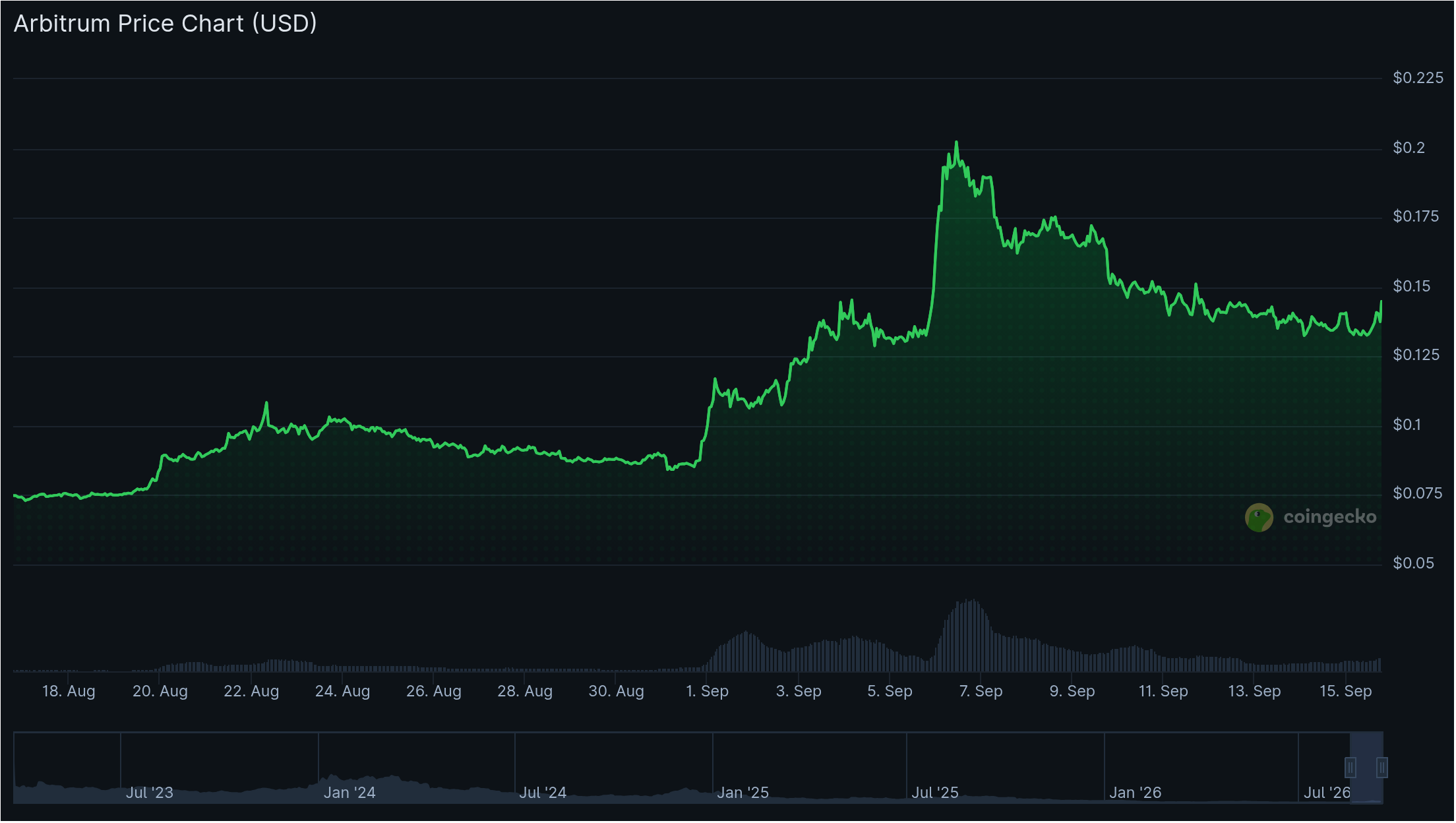
ARB 1-month performance. Source: Coingecko
Kendrick said the biggest risks to his ARB price projection include “a slower-than-expected pace of asset tokenization and more competition from alternate blockchains.”
Related: Arbitrum vote to release $71M in frozen Kelp exploit ETH set to pass
Arbitrum outlook hinges on tokenized assets
StanChart’s bullish thesis is heavily influenced by the growth of tokenized real-world assets, which have reached a cumulative value of nearly $39 billion, according to RWA.xyz data.
In the note, Kendrick reiterated Standard Chartered’s forecast that tokenized assets will reach $4 trillion by the end of 2028 as banks and asset managers bring more assets onchain. The bank sees Arbitrum as a potential beneficiary because it provides the infrastructure for companies to build their own layer-2 networks and receives a share of the revenue they generate.
Standard Chartered has also cited the growth of tokenization as part of its bullish outlook for Chainlink and the broader decentralized finance sector.
Related: Crypto Biz: AI took a back seat when Bitcoin started climbing


Be the first to comment