


What to know:
- Taiwan lawmaker Dr. Ko Ju-Chun urged discussions on Bitcoin reserves.
- Taiwan holds nearly $602 billion in foreign exchange reserves.
- The central bank must submit a digital asset report within one month.
- Bitcoin reserve discussions are gaining traction inside Taiwan’s government.

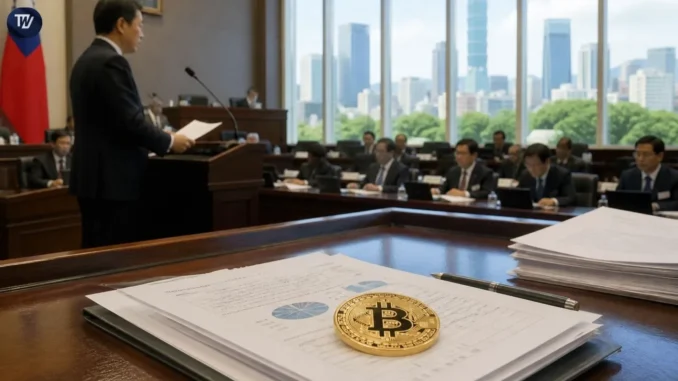
Taiwan’s Bitcoin reserve discussion moved into a higher level of government as of May 2, 2026, after Taiwanese legislator Dr. Ko Ju-Chun formally presented a Bitcoin Policy Institute report during a Legislative Yuan session on April 29.
The report was delivered directly to Premier Cho Jung-tai and Central Bank of China Governor Yang Chin-long during an official interpellation proceeding.
Ko urged Taiwan’s executive branch to examine whether part of the country’s $602 billion foreign exchange reserves should be allocated to BTC as a strategic reserve asset. He also asked the central bank to prepare a fresh report within one month focused on stablecoins and broader digital asset reserves.

Taiwan’s political structure gives strong authority to the premier over domestic policy matters. Because of this, the presentation marked an important development in Taiwan’s growing discussion surrounding Bitcoin reserves and digital asset strategy.
Ko currently serves as vice co-chair of the Legislative Yuan’s US-Taiwan Caucus and also founded the Emerging Technology Exchange Association. He previously raised similar concerns with Governor Yang during a March 30 legislative session. However, the April 29 meeting represented the first formal presentation of the report to the premier.
Also Read: COTI Price Analysis Signals Reversal Potential as Support Holds Strong
Bitcoin Policy Institute Highlights Reserve Risks
The report was written by Bitcoin Policy Institute Fellow Jacob Langenkamp and released in March 2026. It examined Taiwan’s economic, trade, and geopolitical position while arguing for Bitcoin’s role as a reserve asset.
According to the report, more than 80% of Taiwan’s reserves remain concentrated in U.S. dollar-denominated assets. The report warned that such concentration increases exposure to currency debasement risks and potential geopolitical disruption.
The research suggests that there may be several advantages for Taiwan in adopting BTC. It includes being independent from any other sovereign currency and its resistance to being confiscated during a possible blockade. BTC would not require any physical movement to remain accessible, unlike gold.
As Sam Lyman, director of research for Bitcoin Policy Institute, stated, these results, having reached the ears of Taiwan’s leadership, meant that there was increasing recognition among authorities regarding the use of Bitcoin as a reserve currency.
Central Bank Maintains Cautious Position
In late 2025, Taiwan’s central bank rejected Bitcoin’s use as a reserve currency because of its instability, lack of liquidity, and safekeeping.
However, the central bank did make some experimentation efforts with digital assets and is now preparing a digital asset sandbox with 210 bitcoin assets seized in previous transactions for future experimentation.
There is now a growing pressure from a fresh legislative move urging decision-makers to review previous decisions on the matter.
Also Read: Tezos Price Down 96% as Weak Demand Signals Accumulation Phase


Be the first to comment