



Zhibao Technology, a Nasdaq-listed Chinese insurtech company, signed a $154.7 million private investment in public equity (PIPE) agreement payable in 2,380 BTC. If it closes, investors would take control of the board and management. No closing had been disclosed as of Aug. 1.
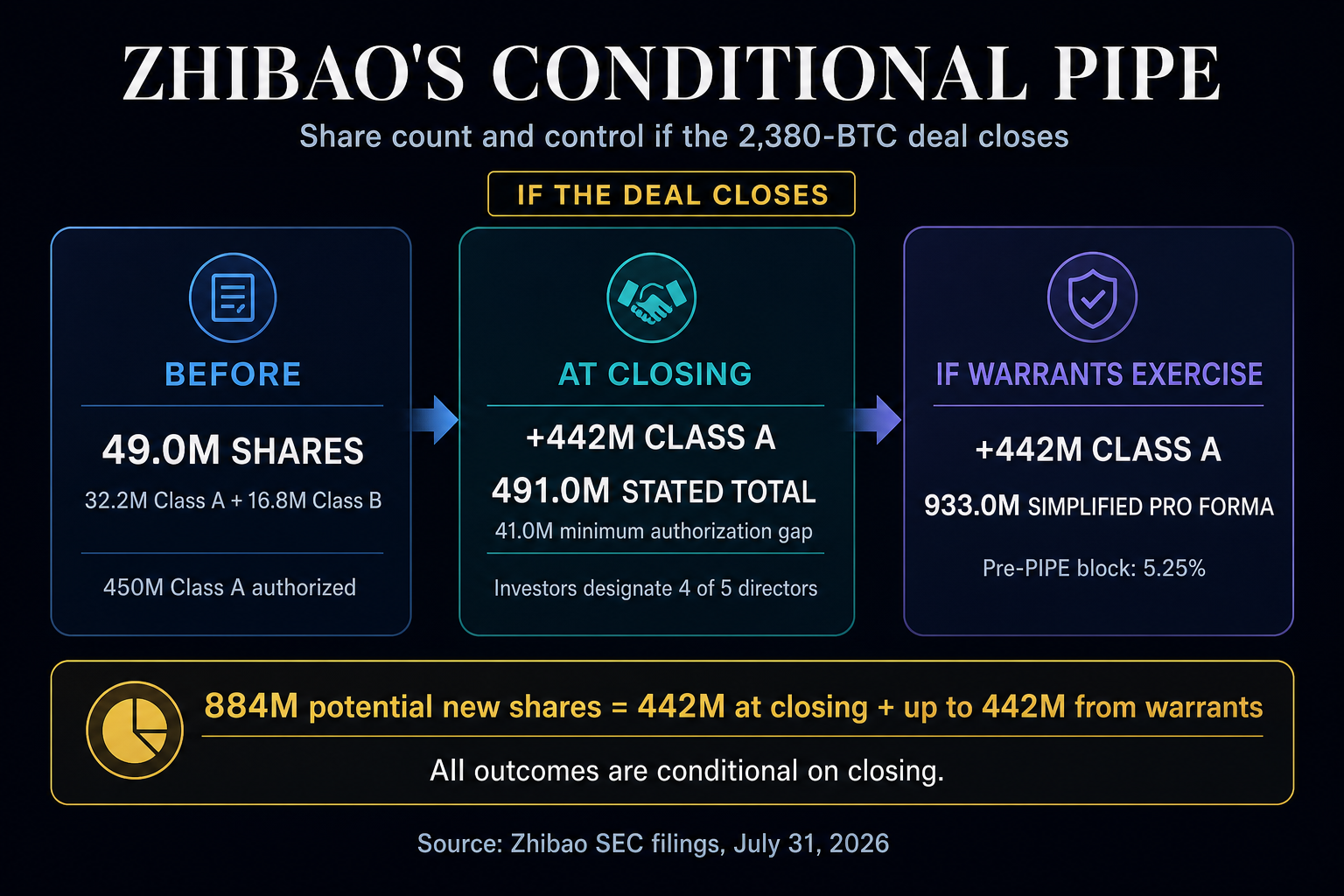
Under the July 31 securities purchase agreement, investors would buy 442 million units at $0.35 each. Every unit contains one Class A ordinary share plus a two-year warrant to buy another Class A share at $0.35. The potential issuance totals 884 million new shares: 442 million at closing and up to 442 million later through warrant exercise.
The governance shift would begin at closing. Investors would designate four of five directors and choose the new CEO and CFO. Four incumbent directors and the current CEO and CFO would resign, while Botao Ma would remain a director.
The agreement fixes BTC at $65,000 based on July 30 prices, producing the 2,380-BTC payment. Each of the 10 investor entities listed in the agreement is allocated 44.2 million units for $15.47 million, payable with 238 BTC.

Zhibao’s existing share structure cannot accommodate even the first issuance without a change. The company reported 32,184,970 Class A shares and 16,816,692 Class B shares outstanding, with 450 million Class A shares authorized. Its Class B shares convert one-for-one into Class A and carry 20 votes before conversion. Converting them and issuing the closing shares would produce 491,001,662 Class A shares, at least 41,001,662 more than the present authorization.
That issuance would sharply dilute the pre-PIPE share block. Its 49,001,662 shares would account for about 9.98% of the stated post-closing base, while Class B holders would lose their 20-to-one voting advantage. If every new warrant were later exercised, the stated base would rise to at least 933,001,662 shares and the pre-PIPE block would fall to about 5.25%. This simplified pro forma excludes older warrants, convertible notes, awards and future adjustments.

What the closing still requires
The agreement contemplates closing within 12 business days of July 31, or on another date agreed in writing. Conditions include sufficient authorized capital, Class B conversion, required shareholder and regulatory or exchange approvals, no exchange objection and Nasdaq compliance. The filings give no public timetable for a shareholder vote, capital increase or Nasdaq clearance. Those conditions could push closing beyond the 12-day target.

Zhibao also has a separate Nasdaq minimum-bid deficiency. The exchange notified the company on July 10 after its stock closed below $1 from May 27 through July 9. Zhibao’s initial deadline to regain compliance is Jan. 6, 2027, and requires at least 10 consecutive business days at or above $1. The PIPE documents leave the relationship between that deficiency and closing undefined.

Funding remains another unverified condition. Each investor represents that it legally and beneficially owns its allocated BTC and must send it to a company-designated custodian wallet on or before closing, unless the parties agree otherwise in writing.
The filings do not identify the entities’ natural-person controllers, the custodian or wallet, or independently establish that the BTC is available. Until a closing disclosure shows the approvals and transfer completed, the Bitcoin contribution, share issuance, and management overhaul remain conditional.




Be the first to comment