



Key Insights:
- Coverage of crypto scams widened after an $8.5 million Term Labs exploit.
- Attackers drained Ethereum and USDC from affected Term vaults.
- Term Labs confirmed the incident and opened an investigation.
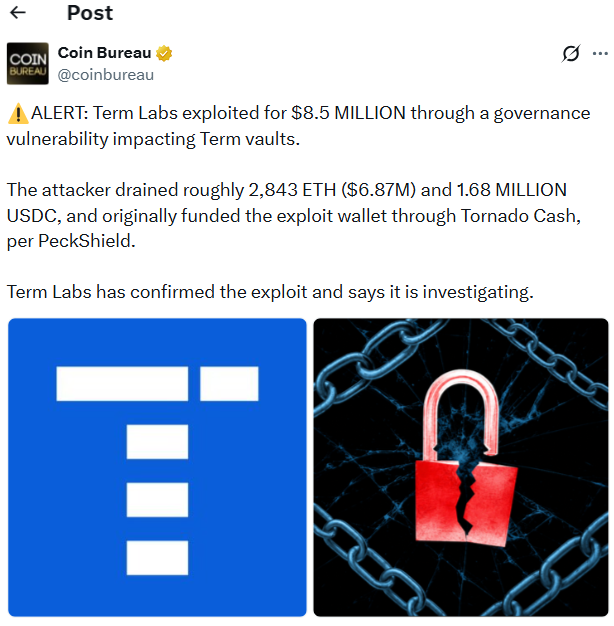
Term Labs, in its recent X post, confirmed a governance exploit affecting its vaults on Aug. 23, 2026. The incident drew broader coverage of crypto scams after security firms tracked roughly $8.5 million in outflows. The attack involved Ethereum assets, and USDC held through Term-linked vault infrastructure.
The incident mattered because governance permissions can expose pooled assets without compromising Ethereum itself.
Term Finance had already warned users that vault smart contracts could contain vulnerabilities that could cause fund losses. Its legal disclosures said Term Vaults rely on Yearn v3 contracts and external decentralized finance protocols.
Crypto Scams Focus Shifts to Term Labs Governance Exploit
PeckShield stated that the attacker drained about 2,843 ETH, valued at around $6.87 million, during its assessment. The blockchain security firm also tracked 1.68 million USDC leaving affected vaults. It said the USDC was later exchanged for roughly 1.6 million DAI.

PeckShield also traced the attacker’s initial funding to two ETH from Tornado Cash. That funding route did not establish the attacker’s identity or prove broader laundering activity. It only showed the reported source of funds used before the exploit.
Term Labs acknowledged the governance exploit through its official X account. The team said the incident affected the Term vaults and remained under investigation. It had not published a technical postmortem at the time this article was prepared.
CertiK separately tracked about $8.5 million in losses from the governance attack. Its monitoring identified the attacker’s address as 0xD5183d8BfC65a50863C62aF2538198A8288FFc13. CertiK said that the address later held 2,843 ETH and roughly 1.6 million DAI.
Crypto Scams Debate Centers on Vault Governance Risk
The Term Finance documentation described its protocol as a non-custodial fixed-rate lending infrastructure on Ethereum. Its Term Repos use smart contracts to lock collateral for borrowers and lenders. The documentation said separate lockers reduce exposure compared with one commingled collateral pool.
Term Finance’s protocol documentation also separated vault exposure from its core lending architecture. It said repo collateral stays inside dedicated smart-contract lockers, while vault strategies interact with external protocols.
That design reduced some shared-pool exposure, but it did not remove contract or governance risk. The company’s own terms explicitly warned that users could lose some or all deposited funds.
The exploited product involved Term Vaults rather than the protocol’s basic repo structure. Term’s legal terms described those vaults as contracts built on Yearn v3 infrastructure. The same disclosures warned that bugs, vulnerabilities, external protocol failures, or strategy problems could cause losses.
That distinction matters to readers tracking crypto scams and hacking activity. A governance exploit can abuse privileged controls or decision mechanisms without attacking the Ethereum consensus. Term Labs had not yet disclosed the exact governance function, contract path, or permission sequence used.
A Kraken crypto-asset disclosure described Term Finance as an Ethereum-based, non-custodial lending protocol. The document identified Terminal 0 Ltd., operating as Term Labs, as the developer. It also stated that TERM governance control was scheduled to migrate after the deployment of a Governor contract.
The disclosure did not describe the Aug. 23 exploit because it predated the incident. However, it provided context around the protocol’s planned governance structure. Term Labs had not confirmed whether the planned Governor architecture played any role in the attack.
Crypto Hack Leaves Ethereum and USDC Trail Under Review
The asset trail gave investigators several verifiable points despite limited technical disclosure. PeckShield tracked ETH and USDC outflows, while CertiK later reported ETH and DAI at the attacker address. That sequence aligned with PeckShield’s claim that the USDC was swapped after extraction.
The available evidence did not show a compromise of Ethereum or USDC infrastructure. Instead, Term Labs described the event as a governance exploit affecting its vaults. That wording kept responsibility centered on protocol-level controls rather than the underlying networks or tokens.
Term Finance had previously disclosed cybersecurity risks across its products. Its documentation warned that smart contract failures, governance disputes, hacking, and external protocol problems could affect users. Those disclosures did not identify the specific weakness used in this incident.
The next verifiable catalyst will be Term Labs’ promised investigation update. Traders and depositors will watch for affected vault identities, contract addresses, recovery steps, and any governance restrictions. A technical postmortem should also clarify whether funds remain recoverable.



Be the first to comment