


What to know:
- Tether splits mining into compute, power, cooling, and control layers for scalability.
- Modular design enables targeted upgrades, reduces downtime, and boosts efficiency.
- The MDK framework links systems, improves monitoring, and provides real-time performance control.

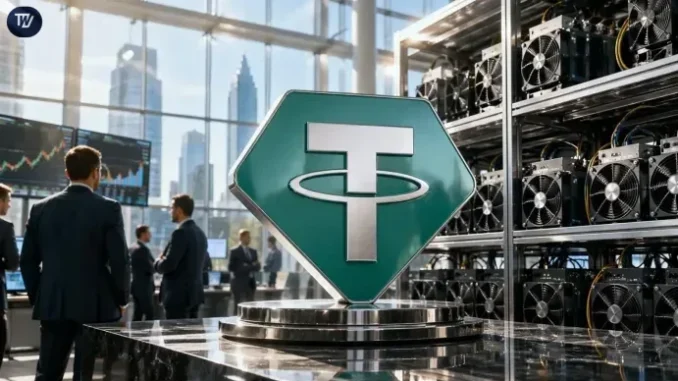
Tether is redesigning large-scale crypto mining hardware by moving from fixed rigs to modular systems. The change focuses on flexibility, efficiency, and performance control across operations, as the company restructures infrastructure into separate functional components for better scalability.
As per the announcement, the company said the new model divides mining infrastructure into compute, power, cooling, and control layers. Each layer can be adjusted independently. This structure allows operators to fine-tune performance and manage systems more precisely.
Also Read: Tether Launches Open-Source MDK to Streamline Bitcoin Mining

Tether Shifts to Component-Based Mining
According to Tether, the modular approach helps with focused upgrades. Individual parts can be substituted by operators, rather than by complete machines. This minimizes downtime and enhances system efficiency in large facilities in the long term.
Tether is collaborating with Canaan Inc. and ACME Swisstech to develop the system. It is designed with application-specific hashboard modules. These modules are linked to the control and thermal systems of Tether.
The building is an upgrade to the conventional plug-and-play model of mining rigs. Operators do not use fixed units but interchangeable components. This enables hardware to be upgraded without replacing the entire system.
The majority of mining systems are based on single-machine systems. This approach is simple to implement and restricts coordination. It further complicates optimization over large-scale operations.
Tether Separates Compute, Power, and Cooling Layers
Chief executive Paolo Ardoino said that the company was redefining the mining model. He stated that modular compute systems are tunable and upgradable. This facilitates direct cost, efficiency, and performance control.
In its design, Tether separates enclosure and power systems and compute. The layers are able to work and be controlled separately. The company claimed that this narrows down operation limitations in industrial setups.
One of the key components of the system design is cooling. The computer is immersion-cooled. This way is used to submerge parts in liquid to bring the heat under better control.
The design enhances thermal performance and minimizes energy waste. It also helps in extending the life of hardware when used continuously. The company coordinated hardware design with cooling infrastructure to do this.
Open-Source MDK Powers Real-Time Mining Operations
This system allows operators to make changes to output in real time. This eliminates the use of factory-set settings. It provides the possibility of performance modifications depending on the existing operating conditions.
Tether also added a Mining Development Kit (MDK) along with hardware updates. The framework is an open source and is aimed at managing systems. It seeks to relate various aspects of mining activities.
The kit consists of a JavaScript-based toolkit on the backend and a React interface library. Developers are able to create dashboards that can be interactive with mining systems. This eliminates reliance on vendor software.
The framework gives a cohesive perspective on infrastructure performance. In a single interface, operators are able to monitor systems and manage processes. This enhances visibility in mining conditions.
Also Read: ZetaChain Exploit: 1 Critical Flaw, Millions at Risk

Be the first to comment