

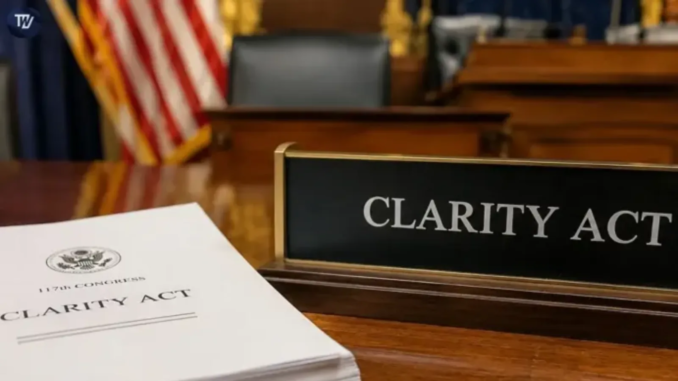

The simultaneous endorsements from BlackRock, Fidelity, Franklin Templeton, Goldman Sachs, and SoFi for the Digital Asset Market Clarity Act do not represent a victory for the crypto-asset sector. They constitute a warning signal.
The legislation, presented under the argument of providing clear rules of the road, actually functions as a regulatory capture mechanism that transfers control of the ecosystem to the very financial intermediaries that the Bitcoin protocol sought to make unnecessary.
Rejecting the CLARITY Act means defending decentralization, permissionless innovation, and individual financial sovereignty against a legal scaffolding designed to protect obsolete business models and consolidate state power over digital value flows.
The technical core of the bill—the delimitation of competences between the SEC and the CFTC—proves incompatible with the decentralized architecture of crypto-assets. The law introduces a decentralization threshold that grants bureaucrats the authority to determine which protocols qualify as sufficiently distributed to escape the security classification.

The wording subjects projects that operate through self-executing smart contracts to a subjective assessment of organizational control, token concentration, and dependence on development teams.
The imposition of a centralized test for decentralization forces protocols to restructure themselves to meet administrative criteria, eroding precisely the characteristic that makes them valuable: the ability to operate without a central authority that can censor transactions, freeze funds, or modify consensus rules.
The binary SEC-CFTC classification ignores that numerous tokens fit into neither of the two categories inherited from the twentieth century, and forces contrived definitions that only benefit law firms and compliance consultancies.
The dispute over stablecoin yields exposes the bill’s true function with blunt clarity. JPMorgan Chase pressures to restrict the ability of issuers to offer returns to holders, alleging a supposed unfair advantage over bank deposits.
The argument reveals that the CLARITY Act serves as a battlefield where traditional banking seeks to eliminate, by law, competitors that offer more efficient products. Stablecoins that transfer yields generated from reserves in Treasury bonds or low-risk instruments allow users to obtain a return that retail banks fail to match because their business model depends on capturing the interest rate spread.
The legislation, far from leveling the playing field, enshrines banking protectionism that bans innovation in savings and payment services. If the final text restricts yields, the message to developers and investors will be unequivocal: the U.S. financial system prefers to subsidize the profitability of established intermediaries rather than allow open competition in programmable financial products.
The backing from Wall Street giants must not be interpreted as a validation of the crypto sector. BlackRock and Fidelity manage regulated investment vehicles that compete for capital flows against decentralized lending protocols, automated liquidity pools, and staking platforms.

Their support for the CLARITY Act pursues a specific strategic objective: the creation of regulatory barriers to entry that exclude from the market projects that cannot afford legal teams to navigate registration forms, compliance audits, and continuous disclosure requirements.
The compliance burden imposed by a comprehensive federal framework acts as an economic filter that reserves the regulated market for entities with sufficiently large balance sheets. The crypto industry was born precisely to eliminate centralized gatekeepers; handing the keys to the ecosystem to the same actors that for years ignored or attacked Bitcoin constitutes a complete inversion of the founding principles of decentralized finance (DeFi).
Franklin Templeton and Goldman Sachs applaud the law because a predictable regulatory framework allows them to launch products without legal risk, but that predictability carries a cost: the exclusion of any model that does not fit the molds defined by the regulator.
Innovation in crypto-assets has thrived precisely at the margins of the system, where small teams can deploy smart contracts without asking permission, experiment with community governance mechanisms, and distribute tokens to global users without registering with a federal agency.
The CLARITY Act threatens to turn that permissionless innovation into a crime, unless the operator obtains licenses, meets capital requirements, and accepts continuous supervision from the SEC or the CFTC. The market stability that David Solomon invokes is nothing other than the elimination of disruptive competition.
The ethical restrictions for government officials included in the updated text add an additional layer of state control. The clause, presented as a transparency measure regarding the crypto interests of high-ranking officials, lays the groundwork for a government registry of digital asset holdings. What begins as an obligation for officials can extend, through subsequent amendments or administrative interpretations, to broader categories of citizens.
Regulatory history demonstrates that financial oversight measures tend to expand once the surveillance infrastructure is established. The requirement to report addresses, balances, and transactions directly contradicts the principle of financial privacy that decentralized networks guarantee.
The current legislative paralysis—the Senate postponed the vote to prioritize judicial nominations and sanctions against Russia—does not represent a victory for the sector. The risk persists in the autumn session, after the midterm elections, when political pressure to pass some type of crypto framework may intensify and produce an even more restrictive text, enriched with amendments negotiated in committees where commercial banks exercise disproportionate influence.

The regulatory uncertainty that institutional lobbies lament so much actually functions as a space of operational freedom for projects that do not wish to be trapped in a legal straitjacket designed by and for intermediaries. The absence of a federal framework does not prevent the operation of decentralized exchanges (DEXs), lending protocols, or Layer-2 networks. Those infrastructures operate through open-source code and do not require legislative permission to exist.
The appropriate response of the crypto ecosystem to the CLARITY Act does not consist of negotiating more favorable wording, but of rejecting from the root any regulatory framework that attempts to fit decentralized systems into categories designed for centralized intermediaries.
Technical self-regulation—through smart contract audits, on-chain transparency, community governance, and open-source standards—offers user protection mechanisms that are more effective and less prone to capture than statutes drafted in Congress.
The investor protection that BlackRock and Fidelity invoke already exists in the form of cryptographic verification, not bureaucratic oversight. A user can verify a protocol’s reserves in real time, audit its liquidation logic, and confirm the immutability of governance rules without needing an official to issue a seal of approval.
The CLARITY Act aspires to transform permissionless innovation into a privilege granted by the State. The crypto industry, which has built a parallel financial system precisely to escape that model, must read the situation clearly: Wall Street’s endorsement does not legitimize regulation; it turns it into an existential threat.
True market stability does not arise from laws that protect banks from stablecoin competition, but from the technical capacity of protocols to resist censorship, manipulation, and regulatory capture. Rejecting the CLARITY Act constitutes an act of defense of financial decentralization, transactional privacy, and the freedom to build monetary tools that operate outside state and corporate control.
Crypto freedom does not submit to a vote in the Senate; it is exercised by running nodes, signing transactions, and refusing to ask permission to innovate.



Be the first to comment