


Subscribe to Bankless or sign in
For years, trading a perp meant going offshore. In other words, you’d spin up a VPN and find an exchange with no U.S. presence, accepting that if things went sideways, you had no real recourse. That era’s ending, though.
Two weeks ago, the CFTC greenlit the first onshore U.S.  Bitcoin L1Bitcoin is the first and most well-known cryptocurrency introducing a new payment network and a kind of money. View Profile” class=”stubHighlight”> Bitcoin perpetual futures contract on Kalshi, alongside a no-action letter (i.e. signaling it won’t bring an enforcement action) clearing
  Coinbase ExchangeCoinbase is one of the worlds oldest and largest crypto exchanges.View Profile” class=”stubHighlight”> Coinbase to route customers to Deribit. Given that perps already eat something like 90% of all crypto trading volume, onshoring them like this is no small thing.

The CFTC Greenlights Crypto Perps in America on Bankless
The CFTC just took its most significant crypto action in years.
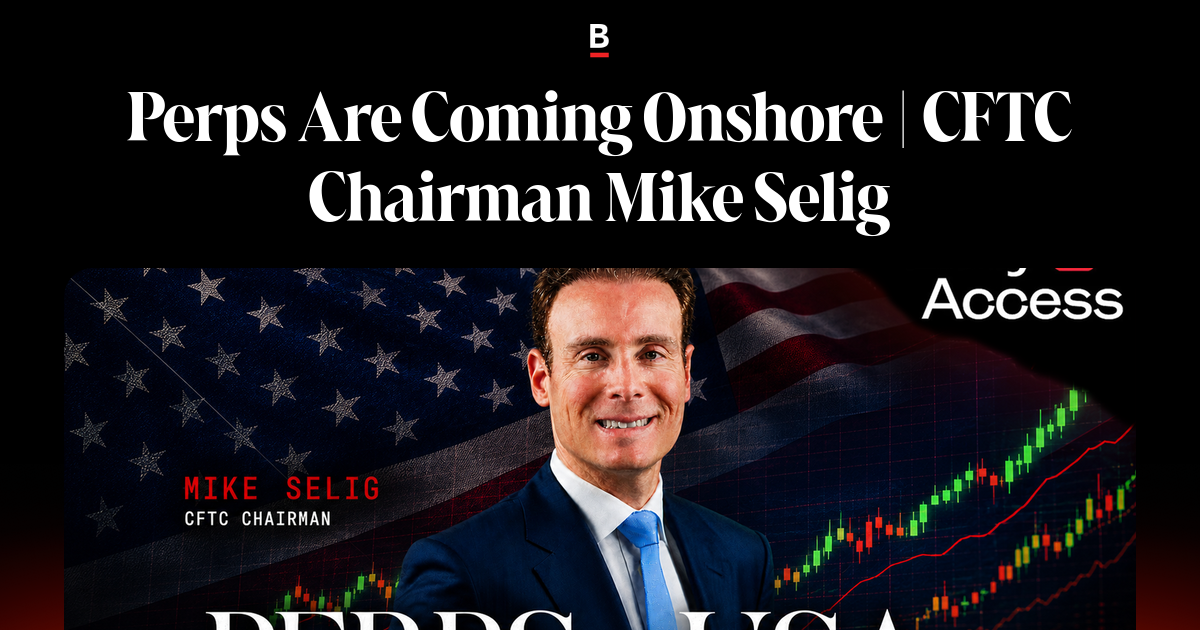
Amid this environment, CFTC Chairman Mike Selig just came back on Bankless to explain his views on this new chapter for crypto in America and the end of the “regulation by enforcement” years.
Why now, though? The CFTC hasn’t approved a new type of derivative instrument in over a decade. Suddenly perps are in the lineup here, and the gold rush is already on: Coinbase, Kalshi, Kraken, Robinhood, and onchain players like  Hyperliquid DerivativesHyperliquid is a Decentralized Exchange and L1 for perpetual futures trading.View Profile” class=”stubHighlight”> Hyperliquid are all angling for the U.S. market at once.
So how fast will things move now, and what’s the catch for degens raised on offshore leverage? Can an instrument as wild as the perp really get domesticated for American soil? That’s the terrain of this latest convo with Chairman Selig.
EARLY ACCESS: Perps Are Coming Onshore | CFTC Chairman Mike Selig
For years, crypto perps grew offshore. Now the CFTC says… we’re bringing perps home
“We want the industry to survive, to thrive and to build here in the US.”
Unlock access to the episode with @ChairmanSelig of… pic.twitter.com/h55BgmCnpd
— Bankless (@Bankless) June 9, 2026
How the floodgates open
The mechanism to watch is self-certification. Selig and his SEC counterpart, Chair Paul Atkins, have sorted crypto assets into clear categories: digital commodities, collectibles, securities, stablecoins, and so forth.
Anything in the digital commodities bucket (i.e. assets that derive value from a network or protocol, e.g. BTC, ETH, SOL, or UNI) can now be self-certified by a CFTC-registered exchange, meaning the venue can list a perp without asking permission first, subject only to the CFTC’s power to reject after the fact.
The effect has been near-instant. Selig said roughly 17 assets beyond Bitcoin were self-certified or in the process of doing so within a single week. Memecoins and more exotic assets still face a full staff review, but the L1 majors are essentially cleared for takeoff now.
The American catch
U.S. perps will arrive wrapped in guardrails, however. Think things like registered exchanges, clearinghouses that ringfence customer funds, contracts vetted as not “readily susceptible to manipulation,” and etc.
Plus, the leverage possibilities will face a considerable onshore haircut. Where offshore venues dangle 250x leverage, Selig said the U.S. was currently eyeing the comparatively tame 5–7x range, and maybe 10x at the absolute ceiling.
Watered down, sure, though his throughline was protection. “I do not want another FTX,” he said, noting pointedly that the CFTC-regulated FTX entity was the one that actually kept customer funds safe during FTX’s collapse.
The frontiers nobody’s solved yet
The juiciest questions live at the edges, of course:
- RWA perps, like oil, gold, and even pre-IPO names like
 OpenAI GuestOpenAI is an artificial intelligence research organization and company best known for ChatGPT.View Profile” class=”stubHighlight”> OpenAI and Anthropic, already make up the majority of perps volume, and they’re almost entirely offshore today. Will these also be coming to the U.S. soon?
 - Equity perps are a hybrid beast, too: a perp (the CFTC’s domain) wrapped around a stock (the SEC’s domain), which forces two agencies long stuck in turf wars to suddenly cooperate. Can this happen efficiently?
- And then there’s Hyperliquid, the onchain perps juggernaut that almost certainly won’t ever bolt on KYC (i.e. know-your-customer identity checks). How Selig thinks about pulling that onshore is one of the episode’s most telling Q&A threads.
Selig wants it all here, the volume, the liquidity, the builders, on U.S. soil and under U.S. rules. Whether the perp can stay wild and get domesticated at the same time is the open question. Either way, the instrument that conquered crypto offshore is finally coming to The States.
Become a Bankless Citizen to hear the full episode.
Perps Are Coming Onshore | CFTC Chairman Mike Selig on Bankless
Crypto innovation is back



Be the first to comment