




Author
Ahmed Barakat
Author


Share

Uniswap founder Hayden Adams pushed back publicly against criticism of the protocol’s newly activated v4 fees on Tuesday, arguing that claims the change reduces liquidity provider earnings rest on flawed assumptions. The rebuttal follows Uniswap governance’s approval of protocol fee activation across selected v4 pools on multiple blockchains.
Adams used a 30-basis-point pool as his reference case: a 5-basis-point protocol fee, he said, represents roughly 14% of total swap fees, not a reduction in what LPs earn. His central argument is that protocol fees are additive to the existing fee structure rather than deducted from LP allocations.
Discover: The Best Crypto to Diversify Your Portfolio
The Technical Dispute at the Center of the Controversy
That framing is where the controversy sharpens. Critics and portions of the DeFi governance community have pointed to Uniswap’s own v4 documentation, which describes protocol and LP fees as applied sequentially, protocol fee first, then LP fee on the remaining input.
Under that sequential structure, any positive protocol fee mathematically narrows the base on which LP fees are calculated, even if swap volume holds constant.
Adams’ “additive” characterization and the sequential-application mechanics described in protocol documentation represent genuinely different claims about how the fee stack operates.
The primary source does not elaborate on Adams’ technical reasoning for reconciling the two, and no further detail from his X post is available in the sourced reporting. That gap is the live dispute, not whether protocol fees exist, but whether their structural effect on LP returns is material or negligible in practice.
It is also worth noting that Adams’ arithmetic deserves a brief examination: 5 basis points out of 30 basis points is 16.7% of total swap fees by simple division, not 14%. Whether Adams is applying a different calculation method, perhaps referencing effective LP take after some adjustment, is not explained in the sourced report. The 14% figure is his, and it has not been independently verified in the available sourcing.
Uniswap Scale and the Stakes for LPs
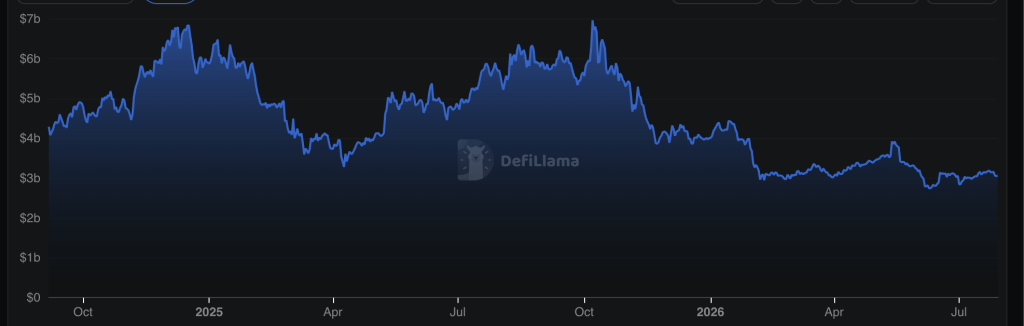
The stakes here are meaningful. Uniswap holds approximately $3.06 billion in total value locked, making it the largest decentralized exchange by TVL according to DefiLlama. Fee structure changes at that scale carry direct consequences for concentrated liquidity providers managing positions across the protocol’s major pools.
The broader tension sits between UNI tokenholders who benefit from protocol revenue capture and LPs who supply the liquidity that generates those fees.
As Ethereum’s dominant DEX, and as ETH price dynamics continue to influence DeFi activity broadly, Uniswap’s ability to retain competitive liquidity depth while extracting protocol revenue is the central economic question that governance has effectively reopened with this activation.
For active LPs, the practical question is whether the actual net yield on deployed capital shifts once protocol fees are live across a broader pool.
Adams’ position is that it will not. The math embedded in the protocol’s own documentation suggests the answer is more nuanced than a flat denial. Governance votes to extend v4 protocol fees to additional deployments are expected to continue, meaning this dispute is unlikely to resolve on founder messaging alone; it will resolve on LP performance data as it accumulates.
Trade Ripple XRP on Bybit and Get a Chance to Win Our $1,000 USDT Airdrop


Be the first to comment