



- Theo has invested $20 million in Fidelity International’s USD Digital Liquidity Fund through Sygnum Bank, adding FILQ to its onchain Treasury product thBILL.
- The move makes Theo the first crypto-native platform to access Fidelity International’s tokenized fund offering.
Theo has invested US$20 million in Fidelity International’s USD Digital Liquidity Fund. With this investment, the onchain capital markets platform becomes the first crypto-native investor in the asset manager’s tokenized fund offering.
The investment was executed through Sygnum Bank and supported by Chainlink’s data and orchestration standards.
The move adds Fidelity International’s FILQ fund to Theo’s institutional tokenized Treasury product, thBILL.
This also expands the product beyond its existing exposure to ULTRA, a tokenized Treasury strategy managed by Wellington Management and FundBridge Capital and tokenized by Libeara.

FILQ is Fidelity International’s first tokenized product and is built on Sygnum’s Desygnate platform. The fund gives professional and institutional investors exposure to yield from regulated, highly rated government securities while keeping the instrument usable across onchain workflows.
The fund received an Aaa-mf rating from Moody’s.
Sygnum said Moody’s described the product as having “a very strong ability” to meet its objectives of capital preservation and high liquidity. The product is intended for professional and institutional investors through Sygnum and is subject to regulatory requirements in selected jurisdictions.
The integration matters because tokenized Treasury products are moving from proof-of-concept experiments into a more competitive institutional market.
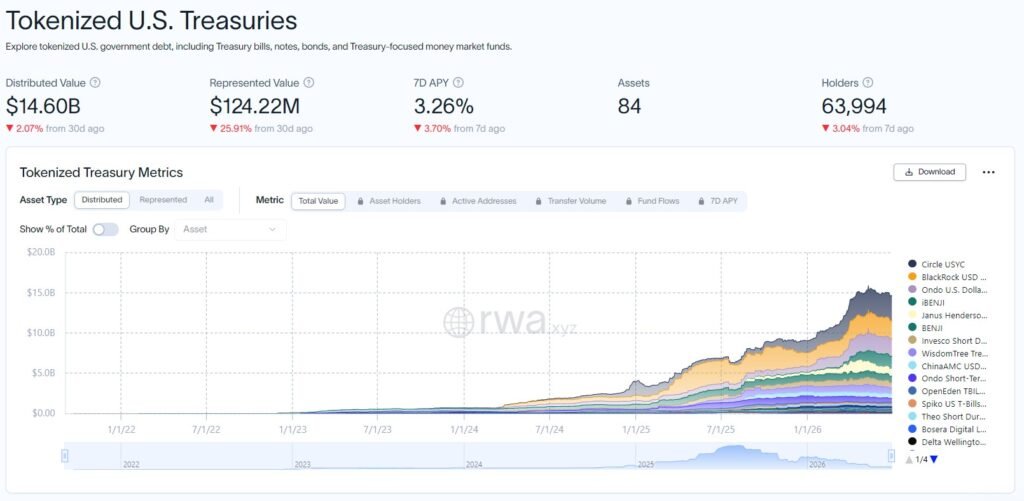
Tokenized U.S. Treasury products now represent a multi-billion-dollar category, covering Treasury bills, bonds and Treasury-focused money market funds. RWA.xyz data shows $14.6 billion in distributed value across 84 tokenized Treasury assets, with 63,994 holders till July 1 2026.
For crypto-native firms, the appeal is straightforward.
Stablecoins offer instant settlement and broad onchain utility, but they generally do not pass yield to holders. FILQ is positioned differently: it combines money-market-fund-like yield exposure with the programmability and 24/7 usability expected in digital asset markets.
That is the gap Theo is trying to fill with thBILL.
By holding FILQ inside thBILL, Theo makes a traditional liquidity fund usable in onchain treasury, collateral, reporting and liquidity workflows. The aim is not just to tokenize fund units, but to make them functional inside crypto-native market structure.
Arijit Pingle, Co-CEO of Theo, said FILQ is “the strongest institutional foundation we’ve put under thBILL, and the first time a crypto-native platform has accessed Fidelity International’s tokenized fund offering.”
“The breadth of Fidelity International’s expertise across global fixed income makes this exactly the kind of institutional foundation our product was built for — accessible 24/7 onchain,” Pingle said.
The Fidelity allocation also gives Theo a second major asset-management relationship inside thBILL.
In December, Theo and Stable committed more than $100 million to ULTRA, a tokenized U.S. Treasury strategy managed by Wellington Management and FundBridge Capital. ULTRA uses Libeara’s tokenization infrastructure, while Standard Chartered provides custody for the underlying portfolio.
That makes thBILL a crypto-native Treasury product backed by exposure to funds linked to two large traditional asset managers.
The combination reflects a broader shift in tokenization: crypto firms are no longer only building synthetic yield products or lending pools. They are increasingly trying to plug regulated money-market and Treasury funds into digital asset rails.
Chainlink’s role is central to that design.
The company brings FILQ’s NAV and distribution data onchain through the Chainlink Runtime Environment. Sygnum’s earlier work with Fidelity International and Chainlink focused on bringing NAV data onchain for tokenized assets, a function the firms described as important for transparency, accessibility and historical data availability.
In the FILQ structure, J.P. Morgan provides daily NAV data that is received and approved before being made available onchain.
That data layer is important because tokenized funds need reliable pricing if they are to be used in collateral, treasury management and settlement workflows. Without trusted NAV data, the token may exist onchain but remain difficult to use in institutional risk systems.
Emma Pecenicic, Head of Digital Assets Distribution at Fidelity International, said tokenisation is “a foundational shift in how global financial markets will function.”
“By combining long-standing investment expertise with digital-native infrastructure, we are helping to enable regulated, institutional-grade liquidity on-chain for markets that operate around the clock, bringing new utility to onchain investors like Theo,” Pecenicic said.
The development comes as major financial institutions push deeper into blockchain-based settlement and tokenized funds.
J.P. Morgan, BlackRock, BNY and Franklin Templeton are among the large financial firms expanding work around tokenized funds, deposits and blockchain-based settlement. The U.S. Treasury market remains one of the largest and most systemically important markets globally, which is why tokenized Treasury products have become an early focus for institutional blockchain adoption.
Still, tokenization is not the same as liquidity.
A tokenized fund can offer faster settlement, better programmability and broader distribution, but its usefulness depends on investor access, regulatory permissions, pricing transparency and redemption mechanics.
Sygnum says FILQ supports 24/7 subscriptions and redemptions after onboarding, with near-instant settlement during market hours and liquidity facilities outside those hours, though transactions may be queued or subject to fees depending on conditions.
That distinction is important for institutions.
The market is moving toward always-on capital markets, but the underlying assets still sit inside regulated fund, custody and administration structures. The winners will likely be products that can combine blockchain settlement with institutional safeguards, rather than simply putting traditional assets onchain.
Fatmire Bekiri, Head of Tokenization at Sygnum, said the bank’s infrastructure was designed “to bridge institutional-grade assets and onchain markets.”
“Seeing FILQ back thBILL is a strong validation of the institutional-grade infrastructure emerging onchain,” Bekiri said.
The transaction gives thBILL a stronger claim to institutional-grade backing.
Moreover, it shows how tokenized Treasuries are becoming a bridge between crypto liquidity and traditional asset management — a space where Fidelity International, Wellington, Standard Chartered, Sygnum and Chainlink are now part of the same operating stack.
Johann Eid, Chief Business Officer at Chainlink Labs, said bringing secure NAV and distribution data onchain allows FILQ to be integrated into Theo’s thBILL workflows.
“We’re excited to accelerate the future where all the world’s value is tokenized onchain and powering 24/7 markets,” Eid said.
The above article “Theo Adds Fidelity’s FILQ to thBILL in Tokenized Treasury Push” was first published on AlexaBlockchain. Read the complete article here: https://alexablockchain.com/theo-adds-fidelitys-filq-to-thbill/
Disclaimer: The information provided on AlexaBlockchain is for informational purposes only and does not constitute financial advice. Read complete disclaimer here.





Be the first to comment