



The number of blockchain addresses holding tokenized equities has reached a record 759,000 as investors move stock exposure into markets that remain open after U.S. exchanges close.
The holder count increased 92% over the past 30 days and 522% since the start of 2026, extending a surge driven by new tokenized-stock platforms, wider asset coverage and around-the-clock trading.
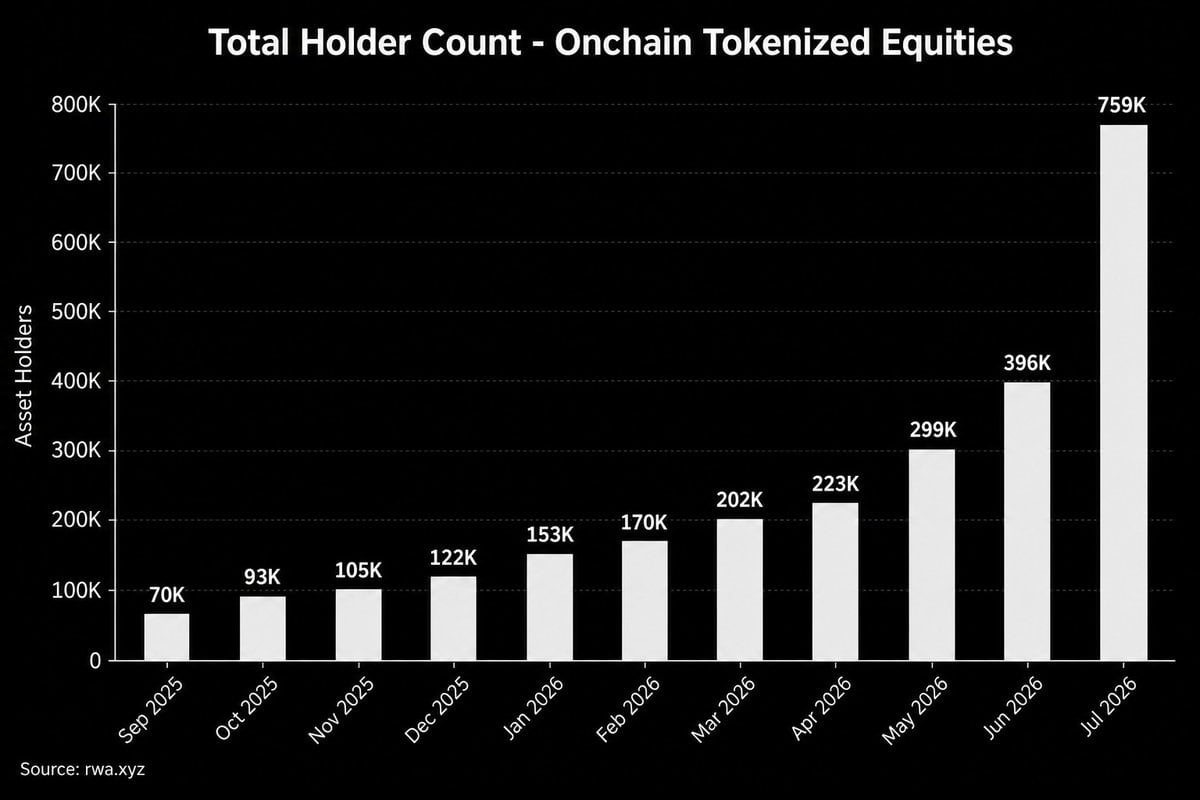
The metric tracks onchain addresses rather than verified individual investors, meaning one trader can control multiple wallets. It nevertheless captures the rapid expansion of equity-linked tokens beyond the smaller group of crypto-native funds and institutional users that dominated the market’s earlier phase.
Chip and memory stocks have emerged among the most actively traded assets as sharp moves in Nvidia, Samsung Electronics, SK Hynix and other semiconductor names pull equity volatility into blockchain markets. Tokenized products allow eligible users to maintain exposure during evenings, weekends and market holidays, although their ownership rights, backing and redemption terms vary by issuer.
Jupiter Records 360% Growth In Off-Hours Volume
Jupiter reported a 360% year-to-date increase in monthly tokenized-equity volume executed outside regular market hours. More than 65% of the platform’s stock-token activity now occurs when Nasdaq and the New York Stock Exchange are closed.
The growth follows the launch of a regulated Solana trading stack from Securitize, Jump Trading and Jupiter. Securitize provides securities issuance, transfer-agent and compliance infrastructure, while Jump supplies liquidity and Jupiter routes trades through its onchain interface.
Continuous access does not make tokenized shares identical to common stock held through a conventional brokerage. Some products provide legally recognised ownership, while others offer only economic exposure through debt instruments, derivatives or special-purpose vehicles. Dividend treatment, voting rights, transfer restrictions and redemption access depend on the product’s legal structure.
Tokenized equities are also moving beyond spot trading. Kraken now accepts selected xStocks as collateral for leveraged positions, while derivatives venues have introduced perpetual contracts tied to public and private companies.
BNY Moves Fund Ownership Records Onchain
Traditional financial institutions are building parallel infrastructure for blockchain-native securities. BNY launched global Digital Transfer Agency capabilities on Wednesday, placing legally recognised fund ownership and transaction records directly on public blockchains.
Baillie Gifford is using the system for BAGEY, the first publicly available, fully native U.K.-regulated tokenized fund. BNY Investments Dreyfus plans to issue BLIQUID money-market fund tokens, while BlackRock is expected to launch BSTBL as a tokenized share class designed for stablecoin reserve managers.
The rollout follows a DTCC trial involving JPMorgan, BlackRock, Goldman Sachs and almost 40 other institutions covering tokenized stocks, ETFs and U.S. Treasurys.
BNY’s service will initially operate with selected U.S. and U.K. clients, supporting fiat and stablecoin subscriptions, redemptions and peer-to-peer transfers. The bank services approximately $8.6 trillion across 7.6 million investor accounts.


Be the first to comment