

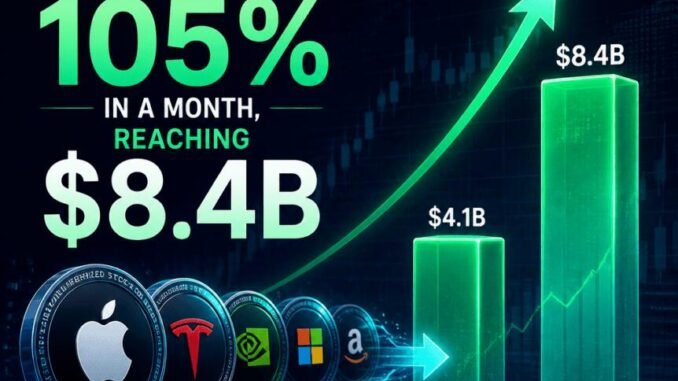

Activity in tokenized equities has accelerated sharply, with tokenized stock transfers more than doubling over the past month to $8.41 billion, according to RWA.xyz data. At the same time, the distributed value of tokenized equities rose 43% to $2.16 billion and the number of holders increased 17% to more than 409,000, highlighting a steady expansion in participation rather than a one-off spike.
Growth was led by several major tokenization platforms. Figure’s distributed value jumped 935% over 30 days, Securitize rose 332%, and xStocks increased by around 62%. Ondo remained the largest tokenized stock issuer by distributed value at roughly $846 million, followed by xStocks (~$708 million), Securitize (~$306 million), and Figure (~$239 million), per the same dataset.
Key takeaways
- Tokenized stock transfers climbed to $8.41 billion over the last month, more than doubling versus the prior period.
- Distributed value for tokenized equities reached $2.16 billion, up 43%, with holders rising 17% to 409,000+.
- Figure, Securitize, and xStocks posted the fastest recent momentum, with Figure up 935% in 30 days.
- Tokenized US Treasurys were largely flat over the same window, while the overall tokenized RWA market grew to about $33.5 billion.
Tokenized equities leave tokenized treasuries behind
RWA.xyz’s figures suggest tokenized stocks are currently outperforming other parts of the broader real-world asset (RWA) market. While the distributed value for tokenized US Treasurys—the sector’s largest asset class—was essentially flat over the past month, distributed value across tokenized RWAs grew by about 4% to $33.5 billion.
That relative performance matters for market participants because it points to where incremental demand is forming. Tokenized treasuries have often been viewed as the most straightforward onchain analogue to liquid, regulated fixed-income instruments. Yet, in this latest snapshot, equities are drawing more rapid growth—both in transfers and in the number of holders—indicating that tokenized access to corporate ownership is attracting attention and usage.

Fast-growing platforms and shifting share of attention
The month’s gains were not evenly distributed across issuers. RWA.xyz data shows that several platforms experienced outsized percentage increases: Figure’s distributed value surged 935% in 30 days, Securitize’s climbed 332%, and xStocks’ grew about 62%. Even with such dramatic percentage moves, the rankings by absolute distributed value also show continuity: Ondo still leads with about $846 million.
This combination—rapid percentage growth among multiple players while the largest issuers maintain top positions—suggests the category is broadening rather than concentrating only around one dominant platform. For users, that can translate into more variety in access routes and custody/settlement workflows. For investors and traders, it may also imply that liquidity and market depth in specific tokenized equity offerings could improve as the holder base expands.
It also highlights the competitive dynamic among infrastructure providers and regulated issuers. When distributed value rises across the board, platforms that can onboard issuers, manage compliance, and support distribution into investor wallets typically gain share—not only in marketing, but in the operational capacity to keep assets moving.
From crypto exchanges to public-market listing models
The new growth appears tied to a wider push—spanning crypto-native venues and traditional capital markets—to bring tokenized equities closer to mainstream issuance. According to RWA.xyz, the tokenized stock market has expanded from roughly $378 million to $2.16 billion over the past year, a gain of about 471%.
One driver has been the wave of tokenized equity-style offerings using exchange distribution. During the SpaceX IPO, Kraken, Bybit, and Bitget Wallet reportedly used xStocks infrastructure to offer tokenized pre-IPO access. Even though customer demand exceeded the available allocation, the episode underscored how quickly investors were willing to engage with blockchain-mediated access to an IPO.
Momentum is now spreading into public-market signaling models. Earlier this month, Securitize reportedly became the first newly public company to issue tokenized versions of its shares on the Solana and Avalanche blockchains as it debuted on the New York Stock Exchange, according to related coverage from Cointelegraph: Securitize gains on NYSE debut with tokenized stock live on Solana/Avalanche.
These developments reflect a gradual shift from tokenization as a niche experiment to tokenized equities as a repeatable distribution channel—one that can run in parallel with established exchange and issuance mechanics.
Traditional finance firms step up tokenization plans
Competition is no longer limited to crypto exchanges. Traditional market utilities and exchanges are also moving toward tokenized securities infrastructure. In May, the DTCC announced plans to launch a tokenized securities service in October after receiving regulatory approval to offer tokenization services on pre-approved blockchains under a three-year pilot. Cointelegraph previously covered the announcement: DTCC eyes October tokenized securities launch.
Earlier this year, the New York Stock Exchange and its parent company, Intercontinental Exchange, unveiled plans for a platform intended to trade tokenized stocks and ETFs. Separately, Nasdaq partnered with Kraken and infrastructure firm Backed to develop technology linking traditional equities with blockchain networks, as discussed in Cointelegraph coverage: Nasdaq partnered with Kraken.
At the same time, ICE CEO Jeffrey Sprecher has argued that regulators should allow traditional exchanges to offer 24/7 onchain perpetual futures, framing it as a level-playing-field issue for regulated venues competing with crypto-native platforms. Cointelegraph reported on this stance in NYE/ICE urged for a level playing field on 24/7 onchain perps.
While these future initiatives extend beyond tokenized stocks alone, they reinforce a common theme: established institutions are increasingly treating tokenization and onchain settlement as strategic priorities rather than optional pilots.
For investors and builders, the next question is whether the current burst in tokenized equity activity holds over the coming months—especially as tokenized US Treasurys appear flat in distributed value. Watching holder growth, transfer volumes, and whether additional issuers join the model will likely determine if this momentum is a temporary acceleration or the start of a broader, sustained onchain equity distribution trend.


Be the first to comment