


Published: Jun 13, 2026 at 12:28

Tom Lee, the co-founder of Fundstrat Global Advisors and Chairman of BitMine Immersion Technologies, recently provided a compelling explanation for the lackluster performance of the cryptocurrency market.

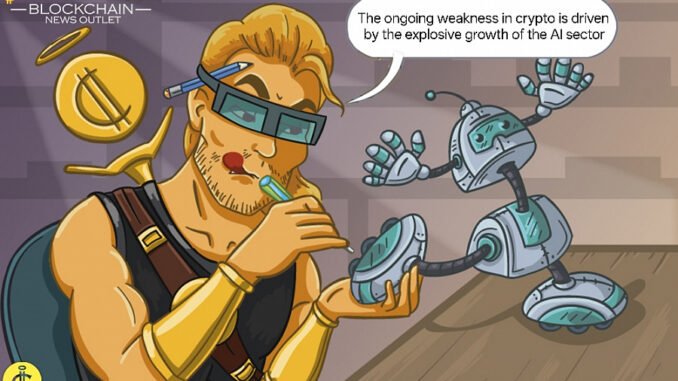
According to Lee, the ongoing weakness in digital assets is primarily driven by the explosive growth of the artificial intelligence (AI) sector, which is effectively “siphoning off” massive amounts of capital from risk-tolerant investors.
The Great Capital Rotation
Lee points out that retail and institutional investors alike are increasingly prioritizing positions in high-growth AI companies. Giants such as Google, Meta, and heavyweights like SpaceX, OpenAI, and Anthropic are dominating the narrative and the wallet share of global capital. This shift has created a “competing asset” environment where AI-driven equity stories offer a tangible, high-velocity growth narrative that currently outshines the consolidation phase seen in the crypto market.
Furthermore, Lee acknowledged that investor frustration is understandable. Many market participants expected digital assets to rally alongside broader tech sectors; however, the reality has been one of stagnation.
He notes that geopolitical anxieties, specifically surrounding the situation in Iran, have added an extra layer of caution, leading traders to retreat from more speculative crypto positions in favor of safer or more established tech equity bets.
A Convergence of Technologies
Despite the current headwinds, Lee remains unequivocally bullish on the long-term convergence of blockchain and AI. He posits that rather than being separate entities, cryptocurrency and blockchain technology represent the next logical phase of the AI evolution.
As AI models become more sophisticated, the demand for blockchain infrastructure will grow, Lee stated. He highlights three critical areas where blockchain will become indispensable to the AI ecosystem:
-
Verification and Integrity: As AI-generated content (deepfakes, misinformation) proliferates, blockchain will be necessary to cryptographically verify data authenticity and provenance. -
Transaction Security: The rise of autonomous AI agents executing financial tasks will require the immutable, borderless settlement layer that only blockchain can provide. -
Tokenization of Real-World Assets (RWAs): Lee emphasizes that we are moving toward a future where traditional assets—stocks, real estate, and fiat currency—will be tokenized into programmable, blockchain-native instruments.
The Broader Context
While Lee’s perspective is grounded in market dynamics, other industry observers add necessary nuance to this “AI vs. Crypto” narrative.
Analysts from institutions like BlackRock and Franklin Templeton have recently noted that AI and crypto share a fundamental backbone: energy and compute. The “AI boom” has driven massive investment into data centers and energy infrastructure, which, ironically, creates new opportunities for decentralized infrastructure networks (DePIN) to sell excess capacity or optimize energy distribution for AI mining.
Tom Lee’s diagnosis suggests that the crypto market is not “dying”; rather, it is undergoing a structural transition. As the initial speculative phase fades, the industry is aligning itself to provide the security, transparency, and programmable infrastructure that an AI-driven global economy will ultimately demand.
Disclaimer. The data provided is collected by the author and is not sponsored by any company or token developer. This is not a recommendation to buy or sell cryptocurrency and should not be viewed as an endorsement by Coinidol.com. Readers should do their research before investing in funds. Brought from CoinIdol.com.
Cointelegraph.



Be the first to comment