




Bank reserves fell $77.579 billion on a weekly-average basis last week ending July 29. Days later, the US ($0.05 · Live) Treasury borrowing estimate for July through September rose by $68 billion. The overlap puts Bitcoin’s liquidity setup under scrutiny. Several forces moved across the Fed’s balance sheet, blurring any direct line from Treasury cash to the reserve decline.
The US Treasury borrowing estimate released on Aug. 3 puts the end-September cash balance at $950 billion. Against its May 4 baseline, the headline increase is $68 billion. Strip out the $19 billion higher starting balance, and the revision grows to $87 billion, driven mainly by lower projected net cash flows.
The measure excludes SOMA auction add-on rollovers and includes financing needed for SOMA redemptions. It tracks net borrowing, while gross issuance follows a different yardstick. The Treasury release covers government financing. Bitcoin enters the picture downstream through the effects on cash and funding markets.


The Federal Reserve’s H.4.1 release shows weekly-average reserve balances at $2.984570 trillion for the week ended July 29, down from $3.062149 trillion for the week ended July 22. Over the same-dated comparison, the Treasury General Account, its cash account at the Fed, climbed from $829.623 billion to $910.776 billion.
The Wednesday, July 29, snapshot was $2.944541 trillion in reserves and $970.442 billion in the TGA. The $81.153 billion TGA rise was the largest named component of the $89.880 billion weekly-average increase in deposits other than reserve balances. Other Fed balance-sheet items moved too, so Treasury cash was only part of the week’s reserve story. Buyer funding sources shape how much pressure reaches bank reserves, and Fed operations can redirect the flow.

US Treasury borrowing: the Aug. 5 financing mix is the test
Treasury scheduled the Q3 financing details for 8:30 a.m. on Aug. 5. At 1:53 a.m. UTC on Aug. 4, the official quarterly refunding index continued to show the policy statement, auction schedule, and buyback schedule as pending.
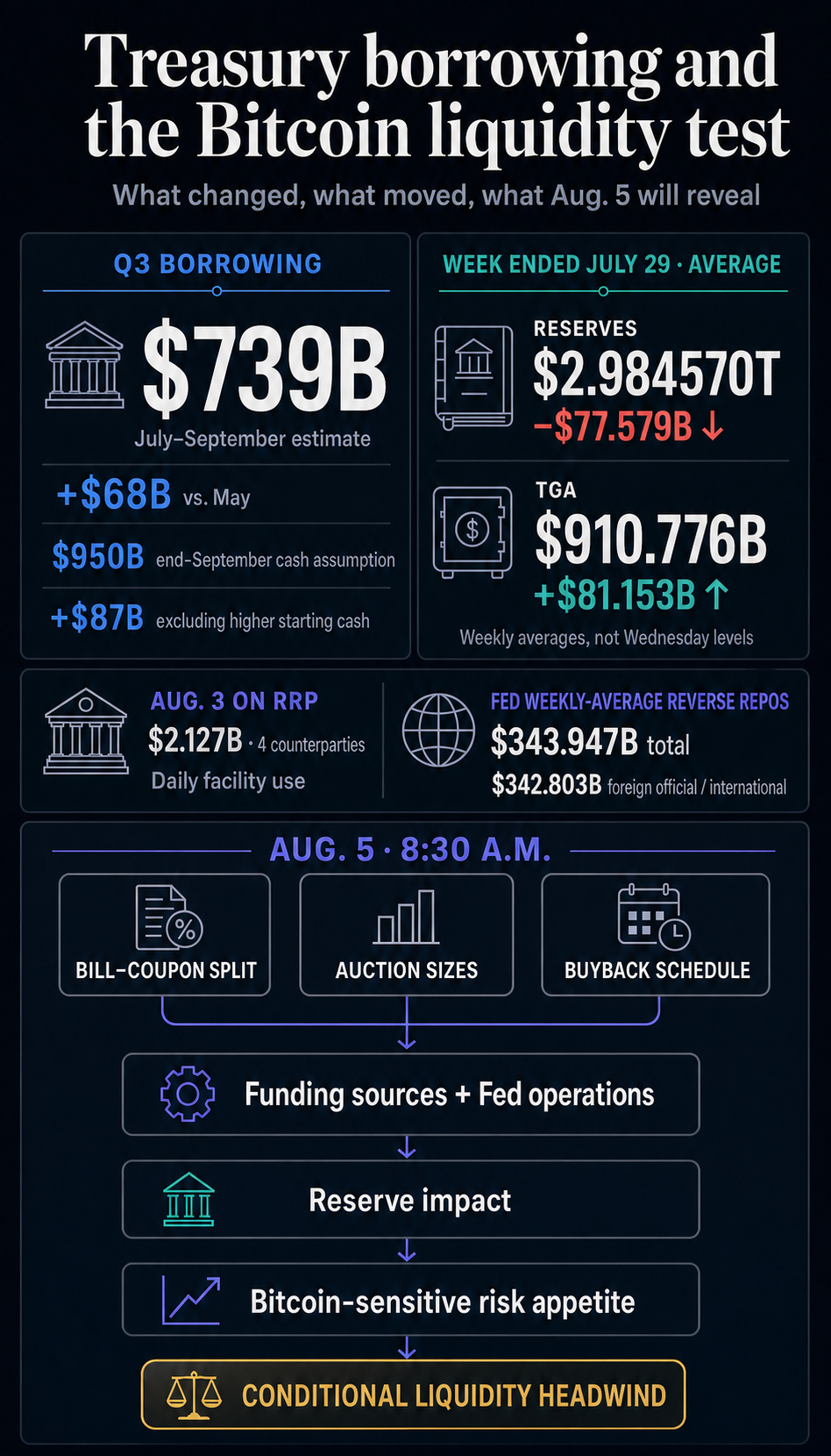
The Aug. 5 package will turn a single borrowing total into an actual financing map. Its bill-coupon split and auction sizes show where the weight lands, with the buyback schedule completing the picture. A bill-heavy plan’s reserve effect follows buyers’ funding sources. More coupon supply leans on demand for longer-dated debt.
In remarks on July 9, SOMA Manager Roberto Perli called reserves ample and warned that heavy net bill issuance in July and August 2026 could tighten money markets. Speaking in his personal capacity, he also left room to adjust reserve-management purchases as conditions change.

On Aug. 3, the New York Fed’s overnight reverse-repo operation accepted $2.127 billion from four counterparties. That figure is a one-day gauge of facility use. For the week ended July 29, the Fed’s broader reverse-repo average was $343.947 billion, with $342.803 billion held by foreign official and international accounts. That balance sits in a separate account category from the domestic overnight facility.
Bitcoin’s next macro signal comes from the plumbing. The Aug. 5 financing map will show where Treasury puts the weight. Reserve balances after settlement will show whether the pressure reaches broader risk appetite.
The post Tomorrow sees a massive liquidity trap for Bitcoin as the US Treasury is quietly draining $77 billion from bank reserves appeared first on CryptoSlate.



Be the first to comment